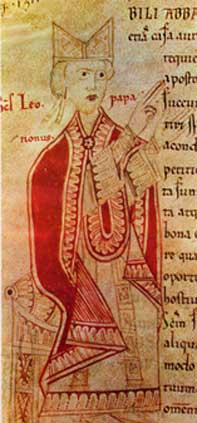
File:Leon_IX.jpg · Wikimedia Commons · See Wikimedia Commons
Leo IX
Sign in to saveAlso known as Bruno of Egisheim-Dagsburg, Pope Leo IX, Pope Saint Leo IX, St. Leo IX
Head of the Catholic Church from 1049 to 1054
Leo IX was the pope, or head of the Catholic Church, from 1049 to 1054. He is historically significant because his papacy occurred during a pivotal period in Christian history, though the specific details of his impact would require additional context to fully explain.
AI-generated from the Wikipedia summary — may contain errors.
Person · Open Library
- Born
- 1002
- Died
- 1054
- Works
- 2
Top works
- Regule constitutiones [et] reseruationes
- Battle of the Virtues and Vices
via Open Library + Wikidata
Recent publications · Crossref
5 total works indexed
- Random Forests
· 2001 · cited 111,790x
- The ERA5 global reanalysis
· 2020 · cited 22,816x
- Global burden of 369 diseases and injuries in 204 countries and territories, 1990–2019: a systematic analysis for the Global Burden of Disease Study 2019
· 2020 · cited 15,393x
- Astropy: A community Python package for astronomy
· 2013 · cited 13,135x
- Bagging predictors
· 1996 · cited 13,104x
via Crossref · CC0
Wikidata facts
- Image
- Pope Leo IX.jpg
Show 7 more facts
- Commons category
- Leo IX
- date of birth
- 1002-06-21
- date of death
- 1054-04-19
- name in native language
- Leo PP. IX
- birth name
- Bruno d'Egisheim-Dadsburg
- P8168
- Sainte-Eulalie
- Commons Creator page
- Leo IX
Sources (10)
via Wikidata · CC0
Works in European collections
6 objects attributed to Leo IX, held across European museums, libraries & archives · via Europeana
![D. Leonis Eivs Nominis I. Romani Pontificis, Ob Excellentem Ervditionem Et Insignem Vitae Sanctimoniam, Iam Olim Magni Cognomen Obtinentis Opera, quae quidem haberi potuerunt, omnia : magno labore ad manuscriptorum codicum fidem à permultis, ijsq[ue] foedis mendis nunc denuò repurgata](https://api.europeana.eu/thumbnail/v2/url.json?uri=https%3A%2F%2Fapi.digitale-sammlungen.de%2Fiiif%2Fimage%2Fv2%2Fbsb10148977_00003%2Ffull%2Ffull%2F0%2Fdefault.jpg&type=IMAGE)
D. Leonis Eivs Nominis I. Romani Pontificis, Ob Excellentem Ervditionem Et Insignem Vitae Sanctimoniam, Iam Olim Magni Cognomen Obtinentis Opera, quae quidem haberi potuerunt, omnia : magno labore ad manuscriptorum codicum fidem à permultis, ijsq[ue] foedis mendis nunc denuò repurgata
Hermanni Contracti monachi Augiæ Divitis, Humberti S. R. E. Cardinalis Silvæ Candidæ Episcopi opera omnia

Hermanni Contracti monachi Augiae Divitis, Humberti S.R.E. cardinalis Silvae Candidae episcopi opera omnia
![D. Leonis Eivs Nominis I. Romani Pontificis, ... Opera, quae quidem haberi potuerunt, omnia : magno studio ad manuscriptorum codicum fidem à permultis, iisq[ue] foedis mendis nunc demum repurgata](https://api.europeana.eu/thumbnail/v2/url.json?uri=https%3A%2F%2Fapi.digitale-sammlungen.de%2Fiiif%2Fimage%2Fv2%2Fbsb10148978_00005%2Ffull%2Ffull%2F0%2Fdefault.jpg&type=IMAGE)
D. Leonis Eivs Nominis I. Romani Pontificis, ... Opera, quae quidem haberi potuerunt, omnia : magno studio ad manuscriptorum codicum fidem à permultis, iisq[ue] foedis mendis nunc demum repurgata
![D. Leonis Eivs Nominis I. Romani Pontificis, ... Opera, quae quidem haberi potuerunt, omnia : magno studio ad manuscriptorum codicum fidem à permultis, iisq[ue] foedis mendis nunc demum repurgata](https://api.europeana.eu/thumbnail/v2/url.json?uri=https%3A%2F%2Fapi.digitale-sammlungen.de%2Fiiif%2Fimage%2Fv2%2Fbsb10148976_00007%2Ffull%2Ffull%2F0%2Fdefault.jpg&type=IMAGE)
D. Leonis Eivs Nominis I. Romani Pontificis, ... Opera, quae quidem haberi potuerunt, omnia : magno studio ad manuscriptorum codicum fidem à permultis, iisq[ue] foedis mendis nunc demum repurgata

Ivonis Carnotensis variarum epistolarum liber - BSB Clm 111
~11 min read
Article
Pope Leo IX (Italian: Leone IX, German: Leo IX.; born Bruno von Egisheim-Dagsburg; 21 June 1002 – 19 April 1054) was the Bishop of Rome and ruler of the Papal States from 12 February 1049 to his death in 1054. Leo IX is considered to be one of the most historically significant popes of the Middle Ages; he was instrumental in the precipitation of the Great Schism of 1054, considered the turning point in which the Catholic and Eastern Orthodox Churches formally separated.
Leo IX favoured traditional morality in his reformation of the Catholic Church. One of his first public acts was to hold the Easter synod of 1049; he joined Emperor Henry III in Saxony and accompanied him to Cologne and Aachen. He also summoned a meeting of the higher clergy in Reims, in which several important reforming decrees were passed. At Mainz, he held a council at which the Italian and French as well as the German clergy were represented, and ambassadors of the Byzantine emperor were present. Here too, simony and clerical marriage were the principal matters dealt with. He is regarded as a saint by the Catholic Church; his feast day is celebrated on 19 April.
Gallery (2)
Available in 70 languages
- Español
- Français
- Deutsch
- 中文
- 日本語
- Русский
- Português
- Italiano
- العربية
- Afrikaans
- Albanian
- Armenian
- Bahasa Indonesia
- Basque
- Belarusian
- Bikol
- Breton
- Bulgarian
Show 51 more
- Catalan
- cdo
- Croatian
- Czech
- Egyptian Arabic
- Esperanto
- Estonian
- Filipino
- Finnish
- Galician
- Georgian
- Greek
- Hakka Chinese
- Hebrew
- Hungarian
- Ido
- Iloko
- Irish
- Javanese
- Latin
- Latvian
- Lithuanian
- Macedonian
- Malagasy
- Malay
- Marathi
- Mazanderani
- Nederlands
- Norwegian
- Polski
- Quechua
- Romanian
- Serbian
- Serbian (Latin)
- Sicilian
- Slovak
- Slovenian
- Svenska
- Swahili
- Tiếng Việt
- Türkçe
- Ukrainian
- Urdu
- Waray
- Wu Chinese
- Yoruba
- Zaza
- zh_min_nan
- zh_yue
- فارسی
- 한국어
via Wikidata sitelinks · CC0