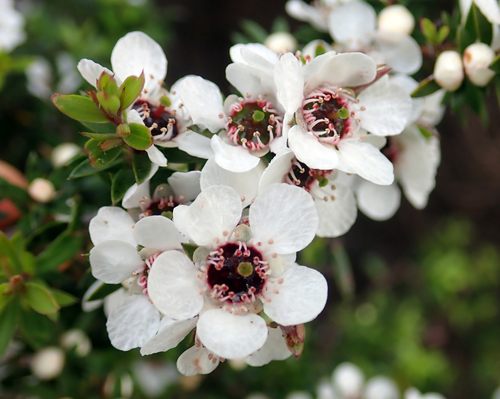
no rights reserved, uploaded by Peter de Lange · cc0
Leptospermum
Sign in to saveLeptospermum is a genus of shrubs and small trees in the myrtle family Myrtaceae commonly known as tea trees, although this name is sometimes also used for some species of Melaleuca. Most species are endemic to Australia, with the greatest diversity in the south of the continent, but some are native to other parts of the world, including New Zealand and Southeast Asia. Leptospermums all have five conspicuous petals and five groups of stamens which alternate with the petals. There is a single style in the centre of the flower and the fruit is a woody capsule.
Species
Mānuka
GENUS
- KingdomPlantae
- PhylumTracheophyta
- ClassMagnoliopsida
- OrderMyrtales
- FamilyMyrtaceae
薄子木属又名松梅屬(Leptospermum)为桃金娘科下的一属,约有80至86个物种。大部分为澳大利亚特有种,个别分布至新西兰、马来西亚,“Leptospermum scoparium”產的麥盧卡蜂蜜含有獨特的麥盧卡獨特因子,“Leptospermum recurvum”为马来西亚特有种。 薄子木属植物为灌木,偶尔为小型乔木,高1至8米,极少数可达20米,分支密集。叶片常绿,互生,单一,锐尖,小型,大部分物种叶片的长度很少超过1厘米。花直径可达3厘米,花瓣五片,可为白色、粉色或红色。 取自“https://zh.wikipedia.org/w/index.php?title=薄子木属&oldid=46656990” 分类:桃金娘科隐藏分类:本地相关图片与维基数据不同
via GBIF · Kew POWO
Museum specimens
- Specimen records
- 600
- With media
- 408
- Family
- Myrtaceae
- Collections
- CINC, MO, GH, USF, A, SD
- Recorded in
- New Zealand, Vietnam, Philippines, Indonesia, United States, Portugal, Malaysia, New Caledonia
Research
367 papers- A Comprehensive Review of the Botany, Bioactive Compounds and Health Benefits of Leptospermum.Chemistry & biodiversity · 2025
- Five New Phenylpropanoyl Phloroglucinol Derivatives from Leptospermum scoparium.Chemistry & biodiversity · 2023
- Leptospermum Medical Grade Manuka Honey Ointment in the Treatment of Persistent Corneal Epithelial Defect.Ocular immunology and inflammation · 2023
- Leptospermum petersonii as a Potential Natural Food Preservative.Molecules (Basel, Switzerland) · 2020
- The Leptospermum scoparium (Mānuka)-Specific Nectar and Honey Compound 3,6,7-Trimethyllumazine (Lepteridine(TM)) That Inhibits Matrix Metalloproteinase 9 (MMP-9) Activity.Foods (Basel, Switzerland) · 2023
via PubMed
Wikidata facts
- Instance of
- taxon
- Parent taxon
- Leptospermeae
- Image
- Leptospermum scoparium3.jpg
Show 7 more facts
- taxon rank
- genus
- taxon name
- Leptospermum
- Commons category
- Leptospermum
- topic's main category
- Category:Leptospermum
- taxon common name
- 鱼柳梅属
- has fruit type
- capsule
Sources (1)
via Wikidata · CC0
~9 min read
Encyclopedic overview
10 sectionsContents
- Description
- Taxonomy and naming
- Distribution and habitat
- Ecology
- Uses
- Use in horticulture
- Use in floristry
- Honey production
- Species
- References
Leptospermum is a genus of shrubs and small trees in the myrtle family Myrtaceae commonly known as tea trees, although this name is sometimes also used for some species of Melaleuca. Most species are endemic to Australia, with the greatest diversity in the south of the continent, but some are native to other parts of the world, including New Zealand and Southeast Asia. Leptospermums all have five conspicuous petals and five groups of stamens which alternate with the petals. There is a single style in the centre of the flower and the fruit is a woody capsule.
The first formal description of a leptospermum was published in 1776 by the German botanists Johann Reinhold Forster and his son Johann Georg Adam Forster, but an unambiguous definition of individual species in the genus was not achieved until 1979. Leptospermums grow in a wide range of habitats but are most commonly found in moist, low-nutrient soils. They have important uses in horticulture, in the production of honey and in floristry.
Excerpted from Wikipedia’s “Leptospermum” article, available under the CC BY-SA 4.0 licence.