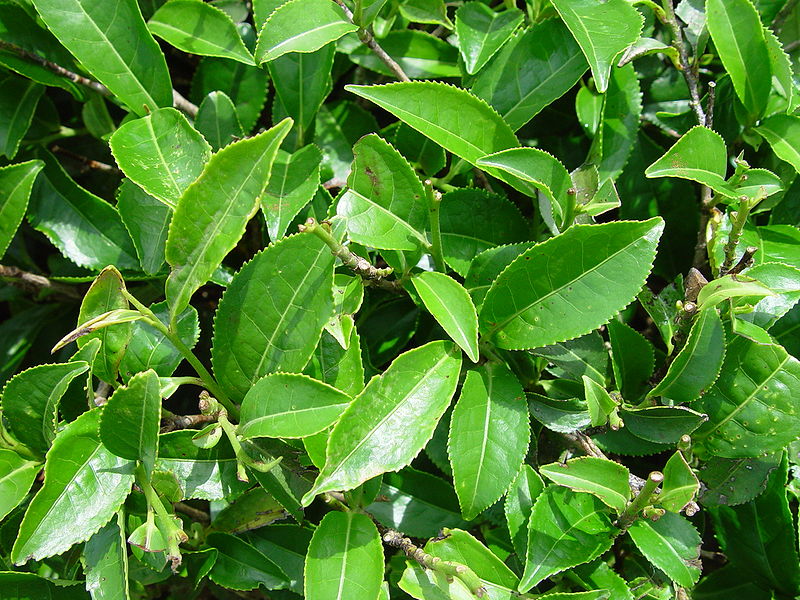
File:Csinensis.jpg · Wikimedia Commons · See Wikimedia Commons
OverviewAI-generated
Camellia sinensis, commonly known as tea, is a species in the family Theaceae. It belongs to the genus Camellia and is classified within the order Ericales, class Magnoliopsida, and phylum Tracheophyta. The plant is a useful species that serves as a source for green tea, matcha, and other teas. It is utilized as a food, drink, medicinal plant, and for afforestation. The species produces a capsule fruit type and is categorized as a Calcifuge.
The taxon range includes China, the Tibet Autonomous Region, and Guangdong. Native areas also encompass Assam, South-Central China, Southeast China, the East Himalaya, Hainan, Laos, Myanmar, Thailand, and Vietnam. According to the IUCN Red List, the conservation status of Camellia sinensis was assessed as Data Deficient in 2018. The species is not extinct.
Synthesized by Vinony from 54 facts across 11 sources: Wikidata, GBIF, Firecrawl, PubMed, iNaturalist, Gbif Occ, IUCN Red List, Encyclopedia of Life, Plants of the World, iDigBio, Vinony graph. Generated from structured data (not the Wikipedia text) and checked against those facts — may still contain errors.
Species
Data Deficienttea
Camellia sinensis
SPECIES
- KingdomPlantae
- PhylumTracheophyta
- ClassMagnoliopsida
- OrderEricales
- FamilyTheaceae
Chile Central
via GBIF · IUCN · Kew POWO
Museum specimens
- Specimen records
- 1,566
- With media
- 1,272
- Family
- Theaceae
- Collections
- UACH, INECOL, ENCB-IPN, CAS, MEL, NY
- Recorded in
- Mexico, China, India, Myanmar, United States, Japan, Indonesia, Malaysia
Research
6,983 papers- Safety Assessment of Camellia sinensis-Derived Ingredients As Used in Cosmetics.ReviewInternational journal of toxicology · 2019Becker LC, Bergfeld WF, Belsito DV et al.DOI: 10.1177/1091581819889914
- Camellia sinensis: historical perspectives and future prospects.ReviewJournal of agromedicine · 2005Patel SHDOI: 10.1300/J096v10n02_08
- Exploring tea (Camellia sinensis) microbiome: Insights into the functional characteristics and their impact on tea growth promotion.ReviewMicrobiological research · 2022Bag S, Mondal A, Banik ADOI: 10.1016/j.micres.2021.126890
- Toxicological effects of Camellia sinensis (green tea): A review.ReviewPhytotherapy research : PTR · 2018Bedrood Z, Rameshrad M, Hosseinzadeh HDOI: 10.1002/ptr.6063
- Therapeutic potentialities of green tea (Camellia sinensis) in ischemic stroke: biochemical and molecular evidence.ReviewMetabolic brain disease · 2024Azami S, Forouzanfar FDOI: 10.1007/s11011-023-01294-4
- Applications of Tea (Camellia sinensis) and its Active Constituents in Cosmetics.ReviewMolecules (Basel, Switzerland) · 2019Koch W, Zagórska J, Marzec Z et al.DOI: 10.3390/molecules24234277
- How does tea (Camellia sinensis) produce specialized metabolites which determine its unique quality and function: a review.ReviewCritical reviews in food science and nutrition · 2022Liao Y, Zhou X, Zeng LDOI: 10.1080/10408398.2020.1868970
- Implications of endophytic microbiota in Camellia sinensis: a review on current understanding and future insights.ReviewBioengineered · 2020Xie H, Feng X, Wang M et al.DOI: 10.1080/21655979.2020.1816788
via PubMed
Described at
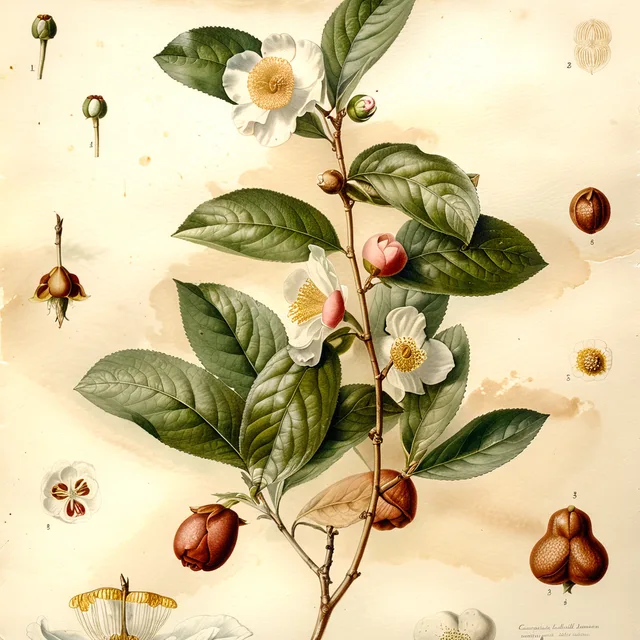
Té (Camellia sinensis): 12 Usos Tradicionales + Evidencia
¿Para qué sirve té? Estimulante de los Andes con 10 estudios. (Camellia sinensis) Ficha completa con usos, evidencia y seguridad.
yerbateca.org →Link to a page describing this subject · 17,921 chars · not written by Vinony
Wikidata facts
Show 13 more facts
- taxon rank
- species
- taxon name
- Camellia sinensis
- Commons category
- Camellia sinensis
- Commons gallery
- Camellia sinensis
- taxon common name
- té chino
- has fruit type
- capsule
- OpenStreetMap tag
- crop=tea
- IUCN conservation status
- Data Deficient
- taxon range
- Guangdong
- short name
- C. sinensis
- taxon author citation
- O. Kuntze
- described at URL
- yerbateca.org/plantas/camellia-sinensis
Sources (8)
via Wikidata · CC0
~21 min read
Encyclopedic overview
Camellia sinensis is a species of evergreen shrub or small tree in the flowering plant family Theaceae. Its leaves, leaf buds, and stems are used to produce tea. Common names include tea plant, tea shrub, and tea tree (unrelated to Melaleuca alternifolia, the source of tea tree oil, or the genus Leptospermum commonly called tea tree).
White tea, yellow tea, green tea, oolong, dark tea (which includes pu-erh tea) and black tea are all made from two of the five varieties which form the main crops now grown, C. sinensis var. sinensis and C. s. var. assamica, but are processed differently to attain varying levels of oxidation with black tea being the most oxidized and white being the least. Kukicha (twig tea) is also made from C. sinensis, but uses twigs and stems rather than leaves.
Excerpted from Wikipedia’s “Camellia sinensis” article, available under the CC BY-SA 4.0 licence.
Gallery (18)
Available in 91 languages
- Español
- Français
- Deutsch
- 中文
- 日本語
- Русский
- Português
- Italiano
- العربية
- हिन्दी
- Afrikaans
- Amharic
- Aragonese
- Asturian
- azb
- Azerbaijani
- Bahasa Indonesia
- Bangla
Show 72 more
- Basque
- Bosnian
- Bulgarian
- Catalan
- Cebuano
- Croatian
- Czech
- Danish
- Divehi
- Egyptian Arabic
- Esperanto
- Estonian
- Filipino
- Finnish
- Galician
- Ganda
- Georgian
- Hebrew
- Hungarian
- Kazakh
- Kinyarwanda
- Latin
- Latvian
- Lithuanian
- Low German
- Macedonian
- Malagasy
- Malay
- Malayalam
- Manipuri
- Moroccan Arabic
- Nederlands
- Nepali
- Northern Frisian
- Norwegian
- Norwegian Nynorsk
- Occitan
- Ossetic
- Pampanga
- Polski
- Quechua
- Romanian
- Sanskrit
- Scots
- Serbian
- Shona
- simple
- Sinhala
- Slovak
- Slovenian
- Sundanese
- Swahili
- Tamil
- Telugu
- Tiếng Việt
- Türkçe
- Ukrainian
- Upper Sorbian
- Uzbek
- Walloon
- Waray
- Western Frisian
- Western Mari
- Western Panjabi
- Wu Chinese
- Zaza
- zh_min_nan
- zh_yue
- Zhuang
- فارسی
- ไทย
- 한국어
via Wikidata sitelinks · CC0