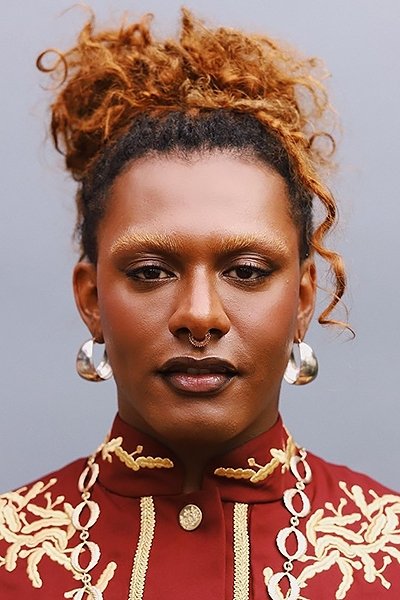
Profile via TMDB · Courtesy of TMDB
Liniker
Sign in to saveAlso known as Liniker de Barros Ferreira Campos
Liniker de Barros Ferreira Campos (Araraquara, 3 July 1995), widely known as Liniker, is a Brazilian singer-songwriter and former bandleader for Brazilian soul and Black music band Liniker e os Caramelows. Her voice has been described as 'powerful and low-pitched' with a 'slightly raspy, soul-singer' character as well as 'versatile' with a 'recurrent falsetto' and 'easily recognisable timbre'—with occasional comparisons arising towards Tim Maia. Liniker is an openly trans woman, and her music is an influence on young Brazilians facing gender discrimination, an audience which 'rarely finds itse
Film & TV
Araraquara, São Paulo, Brazil
Liniker de Barros Ferreira Campos OMC (Araraquara, July 3, 1995) is a Brazilian singer, songwriter, actress, and visual artist.
Known for
- As Dores do Mundo: Hyldon2026
- Som Brasil apresenta: Anitta2026
- Som Brasil apresenta: Anitta EQUILIBRIVM — Self2026
- Novela em Sinfonia — Self2025
- Nesse Canto Eu Conto — Self2025
- Tiny Desk Brazil — Self2025
- Transe — Liniker2024
- CAJU: Visual Experience — self2024
- CAJU Tour — Self2024
- Ivete Sangalo: Rock In Rio 40 Anos — Participação Especial2024
via TMDB
Music · MusicBrainz
- Type
- Person
- Gender
- Female
- Country
- Brazil
- Active from
- 1995
Discography
- Liniker no Cultura Livre2016
- O Barzinho2017
- Presente2019
- Barato Total2020
- Não Adianta - ACORDA AMOR2020
- Como Vai Você2021
- Indigo Borboleta Anil2021
- Atômico Platônico2022
- Vida2022
- CAJU2024
Member of
- Liniker e os Caramelows2015–2020
via MusicBrainz · CC0
Listeners · Last.fm
- Listeners
- 318,985
- Total plays
- 32,452,208
Tags
Liniker de Barros Ferreira Campos is a Brazilian singer, songwriter and actress. Former leader of soul and Black music band Liniker e os Caramelows, her music is an influence on young Brazilians facing gender discrimination, an audience which 'rarely finds itself represented in Brazilian music'. In 2022, Liniker became the first transgender woman to win a Latin Grammy, winning Best Portuguese Language Popular Music Album for Indigo Borboleta Anil and Best Portuguese Language Song for "Baby 95".
Wikidata facts
- Instance of
- human
- Family name
- Campos
- Gender
- trans woman
- Citizenship
- Brazil
- Place of birth
- Araraquara
- Occupation
- actor
- Languages spoken
- Brazilian Portuguese
- Native language
- Brazilian Portuguese
- Genre
- soul
- Instrument
- voice
- Image
- Liniker no TVZ Multishow em 2023.jpg
- Work location
- Brazil
Show 8 more facts
- date of birth
- 1995-07-03
- Commons category
- Liniker
- social media followers
- 67484
- birth name
- Liniker de Barros Ferreira Campos
- start of work period
- 2015-00-00
- pseudonym
- Liniker
- influenced by
- Tim Maia
- ethnic group
- Black people
Sources (13)
via Wikidata · CC0
~6 min read
Encyclopedic overview
8 sectionsContents
- Biography
- Early life and adolescence
- Musical career and activism
- Partnership with Johnny Hooker and ''Flutua''
- Views on queer rights
- Musical influences
- References
- External links
Liniker de Barros Ferreira Campos (Araraquara, 3 July 1995), widely known as Liniker, is a Brazilian singer-songwriter and former bandleader for Brazilian soul and Black music band Liniker e os Caramelows. Her voice has been described as 'powerful and low-pitched' with a 'slightly raspy, soul-singer' character as well as 'versatile' with a 'recurrent falsetto' and 'easily recognisable timbre'—with occasional comparisons arising towards Tim Maia. Liniker is an openly trans woman, and her music is an influence on young Brazilians facing gender discrimination, an audience which 'rarely finds itself represented in Brazilian music.'
==Biography== ===Early life and adolescence=== Liniker was born in the city of Araraquara in rural São Paulo state. Her mother Ângela raised her as a single mother. Liniker reports how she always wanted to wear her mother's clothes: 'I was OK with myself, the city was the problem...when I came back to Araraquara, I thought I'd show them who I really was [by wearing a dress with lipstick and earrings on]. This is when my uncle confronted me, he wanted to know what was going on and gave me one of his clothes to wear so I would learn "how to dress like a man", to which I thanked but said I wasn't taking it. And then my mother said, "Let Liniker be, he's an artist."'
Excerpted from Wikipedia’s “Liniker” article, available under the CC BY-SA 4.0 licence.