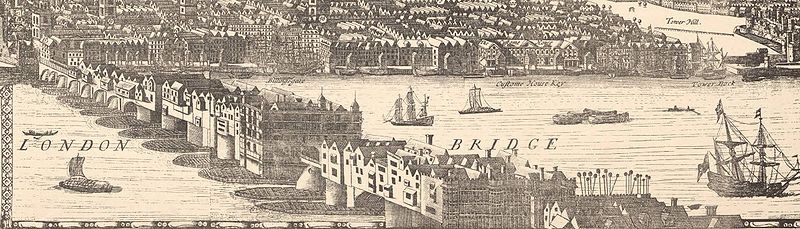
File:London-bridge-1682.jpg · Wikimedia Commons · See Wikimedia Commons
London Bridge
Sign in to saveroad bridge across River Thames in London, opened in 1973
London Bridge is a road bridge that spans the River Thames in London, carrying traffic across one of the city's most important waterways. Opened in 1973, it replaced an earlier Victorian bridge and remains a significant piece of infrastructure for the city's transportation network.
AI-generated from the Wikipedia summary — may contain errors.
Wikidata facts
- Instance of
- box girder bridge
- Named after
- London
- Country
- United Kingdom
- Located in
- London
- Material used
- reinforced concrete
- Location
- London
- Image
- London Bridge Illuminated.jpg
- Height
- 16
- Width
- 32
- Length
- 283
- Significant event
- 2019 London Bridge stabbing
Show 14 more facts
- Commons category
- London Bridge
- crosses
- River Thames
- P12749
- Roland Ratzenberger
- Commons gallery
- London Bridge
- date of official opening
- 1973-00-00
- longest span
- 104
- next crossing upstream
- Cannon Street Railway Bridge
- next crossing downstream
- Tower Bridge
- maintained by
- Greater London Authority
- inception
- 1973-03-16
- carries thoroughfare
- A3 road
- different from
- London Bridge
- on focus list of Wikimedia project
- Wikipedia:Vital articles/Level/4
- native label
- London Bridge
Sources (6)
via Wikidata · CC0
~27 min read
Encyclopedic overview
The name "London Bridge" refers to several historic crossings that have spanned the River Thames between the City of London and Southwark in central London since Roman times. The current crossing, which opened to traffic in 1973, is a box girder bridge built from concrete and steel. It replaced a 19th-century stone-arched bridge, which in turn superseded a 600-year-old stone-built medieval structure. In addition to the roadway, for much of its history, the broad medieval bridge supported an extensive built up area of homes and businesses, part of the City's Bridge ward, and its southern end in Southwark was guarded by a large stone City gateway. The medieval bridge was preceded by a succession of timber bridges, the first of which was built by the Roman founders of London (Londinium) around AD 50.
The current bridge stands at the western end of the Pool of London and is positioned 30 metres (98 ft) upstream from previous alignments. The approaches to the medieval bridge were marked by the church of St Magnus-the-Martyr on the northern bank and by Southwark Cathedral on the southern shore. Until Putney Bridge opened in 1729, London Bridge was the only road crossing of the Thames downstream of Kingston upon Thames. London Bridge has been depicted in its several forms, in art, literature, and songs, including the nursery rhyme "London Bridge Is Falling Down", and the epic poem The Waste Land by T. S. Eliot.
Excerpted from Wikipedia’s “London Bridge” article, available under the CC BY-SA 4.0 licence.
Gallery (12)
On the map
Available in 77 languages
- Español
- Français
- Deutsch
- 中文
- 日本語
- Русский
- Português
- Italiano
- العربية
- हिन्दी
- Albanian
- Armenian
- Asturian
- Azerbaijani
- Bahasa Indonesia
- Bangla
- Basque
- Belarusian
Show 58 more
- Bosnian
- Breton
- Bulgarian
- Burmese
- Catalan
- Central Kurdish
- Cornish
- Croatian
- Czech
- Danish
- Egyptian Arabic
- Esperanto
- Estonian
- Finnish
- Galician
- Georgian
- Greek
- Hebrew
- Hungarian
- Ido
- Irish
- Kannada
- Latin
- Latvian
- Lithuanian
- Macedonian
- Malay
- Malayalam
- Marathi
- Mongolian
- Nederlands
- Norwegian
- Norwegian Nynorsk
- Old English
- Pashto
- Polski
- Punjabi
- Romanian
- Serbian
- Serbian (Latin)
- simple
- Slovak
- Slovenian
- Svenska
- Tamil
- Tatar
- Tiếng Việt
- Türkçe
- Ukrainian
- Urdu
- Welsh
- Western Frisian
- Western Panjabi
- Wu Chinese
- zh_yue
- فارسی
- ไทย
- 한국어
via Wikidata sitelinks · CC0