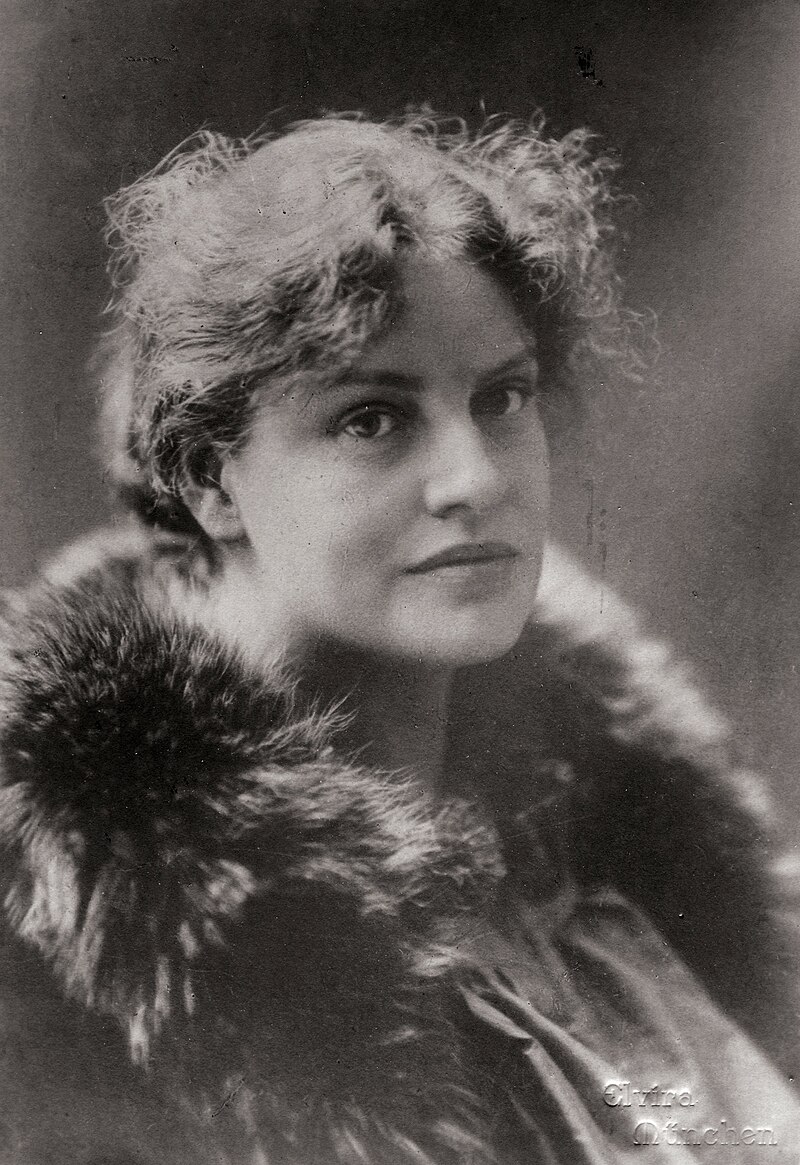
File:Lou_Andreas-Salomé_-_Foto_Atelier_Elvira.jpg · Wikimedia Commons · See Wikimedia Commons
Lou Andreas-Salomé
Sign in to saveAlso known as Louise von Salomé, Luíza Gustavovna Salomé, Lou Andreas-Salome, Louise von Salome, Luiza Gustavovna Salome
German-Russian Psychoanalyst and author
OverviewAI-generated
Lou Andreas-Salomé was a German writer, psychoanalyst, essayist, and autobiographer born in Saint Petersburg in 1861. She wrote in German and was educated at Saint Peter's School. Her professional work included essay writing, and she was influenced by Friedrich Nietzsche, Sigmund Freud, and Benedictus de Spinoza. She studied under Sigmund Freud and spoke Russian, French, German, and Dutch.
She was married to Friedrich Carl Andreas and had an unmarried partnership with Rainer Maria Rilke. Andreas-Salomé died in Göttingen in 1937 from kidney failure due to natural causes. She is buried in Göttingen City Cemetery. Her notable works include *Aus fremder Seele*, *Als Käm Ich Heim Zu Vater und Schwester*, *Ma, Mon expérience de l'amitié avec Nietzsche et Rée*, and *La materia erotica*.
Synthesized by Vinony from 30 facts across 4 sources: Wikidata, Open Library, Firecrawl, Europeana Sparql. Generated from structured data (not the Wikipedia text) and checked against those facts — may still contain errors.
Person · Open Library
- Born
- 1861
- Died
- 1937
- Works
- 117
Top works
- Aus fremder Seele
- ... Als Käm Ich Heim Zu Vater und Schwester
- Ma
- Mon expérience de l'amitié avec Nietzsche et Rée
- La materia erotica
via Open Library + Wikidata
Described at
Psychoanalytikerinnen in Deutschland
psychoanalytikerinnen.de →Hilda (Hildegard, Hilde) Clara Abraham wurde in Zürich geboren und wuchs in Berlin auf. Sie war die Tochter Karl Abrahams, des Pioniers der deutschen Psychoanalyse, und seiner Frau Hedwig geb. Bürgner. Weil Hilda als Kind eine ausgeprägte Neigung zu Tagträumen zeigte, unternahm ihr Vater mit seiner siebenjährigen Tochter eine Analyse nach dem Vorbild von Sigmund Freuds Analyse des "kleinen Hans". Als sich ihre Konzentrationsprobleme nicht legten, schickte er sie 1922 zu dem niederländischen Psychoanalytiker Johan van Ophuijsen in die Analyse, der zu der Zeit in Berlin war. Nach dem Tod ihres Vater 1925 setzte sie ihre Analyse bei van Ophuijsen in Den Haag fort. Hilda Abraham studierte Medizin in Berlin, Heidelberg und Wien und legte 1932 ihr Staatsexamen in Berlin ab, wo sie 1934 auch promoviert wurde. 1933 begann sie am Berliner Psychoanalytischen Institut noch eine Lehranalyse bei Werner Kemper, bevor sie nach Hitlers Machtergreifung mit ihrer Mutter und ihrem Bruder Gerd (Grant Allan) nach England emigrierte. Sie machte eine weitere Analyse bei Hilde Maas , absolvierte eine psychoanalytische Ausbildung am Londoner Institute of Psychoanalysis und wurde Mitglied und Lehranalytikerin der British Psycho-Analytical Society. Sie praktizierte als Psychoanalytikerin in London und war viele Jahre lang als Psychiaterin am British Hospital for Functional Nervous Disorders (Camden Clinic) und nach deren Schließung 1962 an der Paddington Clinic and Day Hospital tätig. Wie ihre Freundin Dinora Pines zählte Hilda C. Abraham zu den Anhänger:innen Anna Freuds . Obwohl Karl Abraham der Mentor Melanie Kleins in Berlin gewesen war, blieb seine Tochter immer eine entschiedene Gegnerin der Klein'schen Ideen. Ihr Interesse galt besonders der Psychologie der Frau. 1955 referierte Hilda Abraham auf dem Internationalen Psychoanalytischen Kongress in Genf über die psychotherapeutische Behandlung von Frauen am South London Hospital for Women, deren sexuelle Probleme sich in einer "nicht vollzogenen Ehe" manifestierten. Ihre Ergebnisse publizierte sie 1956 in den Aufsätzen Therapeutic and psychological approach to cases of unconsummated marriage und A contribution to the problems of female sexuality . Darüber hinaus widmete sich Hilda Abraham der Herausgabe und Übersetzung des Werks ihres Vaters. Gemeinsam mit Ernst Freud gab sie 1965 den Briefwechsel zwischen Sigmund Freud und Karl Abraham heraus. Ihre Biografie Karl Abrahams blieb jedoch unvollendet, als sie 65-jährig nach längerer Krankheit in London starb. (Artikelanfang) SCHRIFTEN (Auswahl) Über die Phrenicusexhairese. Med. Diss. Berlin 1934 Twin relationship and womb fantasies in a case of anxiety hysteria. IJP 34, 1953, 219-227 A contribution to the problems of female sexuality. IJP 37, 1956, 351-353 Therapeutic and psychological approach to cases of unconsummated marriage. Br Med J, April 14, 1956, 837-839 Die Anfänge der psychoanalytischen Vereinigung in Berlin. In Psychoanalyse in Berlin. Meisenheim 1971, 11-25 Die Anfänge von Karl Abrahams wissenschaftlicher Arbeit in Berlin. In H. Abraham et al.: Psychoanalyse in Berlin. Beiträge zur Geschichte, Theorie und Praxis. 50-Jahr-Gedenkfeier des Berliner Psychoanalytischen Instituts (Karl Abraham-Institut). Meisenheim 1971, 97-105 Karl Abraham. An unfinished biography. Int Rev Psycho-Anal 1, 1974, 17-72 Karl Abraham. Sein Leben für die Psychoanalyse - Eine Biografie. München 1976 (et al.) A controlled clinical trial of imipramine (Tofranil) with out-patients. Brit J Psychiat 109 (59), 1963, 286-293 Lou Andreas-Salomé war bereits eine bekannte Schriftstellerin, als sie sich im Alter von fünfzig Jahren der Psychoanalyse zuwandte. Geboren und aufgewachsen war Louise von Salomé in St. Petersburg als jüngere Schwester von fünf Brüdern. Ihr Vater Gustav von Salomé war ein wohlhabender Baltendeutscher hugenottischen Ursprungs, ihre Mutter Luise Wilm die Tochter eines reichen Hamburger Zuckerfabrikanten. Louise von Salomés erster geistiger Mentor war He
Excerpt from a page describing this subject · 40,000 chars · not written by Vinony
Wikidata facts
- Instance of
- human
- Given name
- Lou
- Gender
- female
- Citizenship
- German Reich
- Place of birth
- Saint Petersburg
- Place of death
- Göttingen
- Spouse
- Friedrich Carl Andreas
- Occupation
- philosopher
- Educated at
- Saint Peter's School
- Languages spoken
- Dutch
- Student of
- Sigmund Freud
- Field of work
- essay
- Image
- Lou Andreas-Salomé - Foto Atelier Elvira.jpg
Show 12 more facts
- place of burial
- Göttingen City Cemetery
- Commons category
- Lou Andreas-Salomé
- date of birth
- 1861-00-00
- date of death
- 1937-00-00
- Commons Creator page
- Lou Andreas-Salomé
- influenced by
- Benedictus de Spinoza
- Commons gallery
- Lou Andreas-Salomé
- cause of death
- kidney failure
- unmarried partner
- Rainer Maria Rilke
- writing language
- German
- manner of death
- natural causes
via Wikidata · CC0
Works in European collections
22 objects attributed to Lou Andreas-Salomé, held across European museums, libraries & archives · via Europeana

Two stories

Erotic
Letter from Lou Andreas-Salomé to Gerhart Hauptmann
Letter from Lou Andreas-Salomé to Gerhart Hauptmann
Letter from Lou Andreas-Salomé to Gerhart Hauptmann
Letter from Lou Andreas-Salomé to Gerhart Hauptmann
Letter from Lou Andreas-Salomé to Gerhart Hauptmann
Letter from Lou Andreas-Salomé to Gerhart Hauptmann
Letter from Lou Andreas-Salomé to Gerhart Hauptmann
Letter from Lou Andreas-Salomé to Gerhart Hauptmann
Letter from Lou Andreas-Salomé to Gerhart Hauptmann
Letter from Lou Andreas-Salomé to Gerhart Hauptmann
Letter from Lou Andreas-Salomé to Gerhart Hauptmann
Letter from Lou Andreas-Salomé to Gerhart Hauptmann
Letter from Lou Andreas-Salomé to Gerhart Hauptmann
Letter from Lou Andreas-Salomé to Margarete Hauptmann
Letter from Lou Andreas-Salomé to Margarete Hauptmann
Letter from Lou Andreas-Salomé to Margarete Hauptmann
Letter from Lou Andreas-Salomé to Fritz Mauthner
![[Postkarte]](https://api.europeana.eu/thumbnail/v2/url.json?uri=http%3A%2F%2Fdl.ub.uni-freiburg.de%2FdiglitData%2Fimage%2Fautogr0968%2F3%2F001.jpg&type=IMAGE)
[Postkarte]
![[Postkarte]](https://api.europeana.eu/thumbnail/v2/url.json?uri=http%3A%2F%2Fdl.ub.uni-freiburg.de%2FdiglitData%2Fimage%2Fautogr0967%2F3%2F001.jpg&type=IMAGE)
[Postkarte]
![[Postkarte]](https://api.europeana.eu/thumbnail/v2/url.json?uri=http%3A%2F%2Fdl.ub.uni-freiburg.de%2FdiglitData%2Fimage%2Fautogr0966%2F3%2F001.jpg&type=IMAGE)
[Postkarte]
~19 min read
Encyclopedic overview
Lou Andreas-Salomé (born either Louise von Salomé or Luíza Gustavovna Salomé or Lioulia von Salomé, Russian: Луиза Густавовна Саломе; 12 February 1861 – 5 February 1937) was a Russian-born psychoanalyst and a well-traveled author, narrator, and essayist from a French Huguenot-German family. Her diverse intellectual interests led to friendships with a broad array of distinguished thinkers, including Friedrich Nietzsche, Sigmund Freud, Paul Rée, and Rainer Maria Rilke.
Early years
Excerpted from Wikipedia’s “Lou Andreas-Salomé” article, available under the CC BY-SA 4.0 licence.