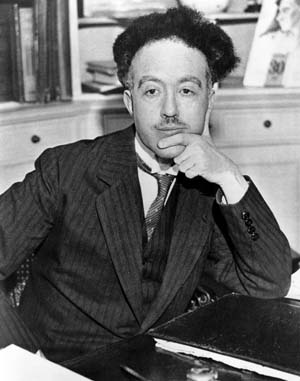
File:Broglie_Big.jpg · Wikimedia Commons · See Wikimedia Commons
Louis de Broglie
Sign in to saveAlso known as Prince Louis-Victor de Broglie, Louis-Victor-Pierre-Raymond, 7th duc de Broglie, Louis Victor Pierre Raymond duc de Broglie
Nobel laureate credited to pioneer the discovery of wave character of matter (1892–1987)
Louis de Broglie was a French physicist who proposed that matter, like light, has wave properties—a revolutionary idea that helped establish modern quantum mechanics. This discovery earned him the Nobel Prize and fundamentally changed how scientists understand the nature of particles and atoms.
AI-generated from the Wikipedia summary — may contain errors.
Nobel Prize
- The Nobel Prize in Physics1929
“for his discovery of the wave nature of electrons”
Wikidata facts
- Instance of
- human
- Given name
- Raymond
- Gender
- male
- Citizenship
- France
- Place of birth
- Dieppe
- Place of death
- Louveciennes
- Father
- Victor de Broglie
- Sibling
- Maurice de Broglie
- Occupation
- researcher
- Educated at
- Lycée Janson-de-Sailly
- Employer
- Institut Henri Poincaré
- Languages spoken
- French
- Notable work
- matter wave
- Family
- House of Broglie
- Noble title
- duke
- Doctoral advisor
- Paul Langevin
- Student of
- Maurice de Broglie
- Field of work
- theoretical physics
- Conflict
- World War I
- Image
- Prince Louis-Victor de Broglie.jpg
- Residence
- Neuilly-sur-Seine
Show 12 more facts
- Commons category
- Louis de Broglie
- date of birth
- 1892-08-15
- date of death
- 1987-03-19
- nominated for
- Nobel Prize in Physics
- Erdős number
- 5
- name in native language
- Louis Victor Pierre Raymond, duc de Broglie
- writing language
- French
- student
- Jean-Pierre Vigier
- birth name
- Louis Victor Pierre Raymond de Broglie
- maintained by WikiProject
- WikiProject Mathematics
- P8168
- Corinna
- interested in
- physics
via Wikidata · CC0
~21 min read
Encyclopedic overview
Louis Victor Pierre Raymond, 7th Duc de Broglie ( French: [də bʁɔj] ; 15 August 1892 – 19 March 1987) was a French theoretical physicist and aristocrat known for his contributions to quantum theory. In his 1924 Ph.D. thesis, he postulated the wave nature of electrons and suggested that all matter has wave properties. This concept is known as the de Broglie hypothesis, an example of wave–particle duality, and forms a central part of the theory of quantum mechanics. In 1929, de Broglie won the Nobel Prize in Physics, after the wave-like behaviour of matter was experimentally confirmed in 1927. This confirmation earned George Paget Thomson and Clinton Davisson the Nobel in 1937.
The wave-like behaviour of particles theorized by de Broglie was used by Erwin Schrödinger in his formulation of wave mechanics. De Broglie presented an alternative interpretation of these mechanics called the pilot-wave concept at the 1927 Solvay Conferences, but then abandoned it. In 1952, David Bohm developed a new form of the concept which became known as the de Broglie–Bohm theory. De Broglie revisited the idea in 1956, creating another version that incorporated ideas from Bohm and Jean-Pierre Vigier.
Excerpted from Wikipedia’s “Louis de Broglie” article, available under the CC BY-SA 4.0 licence.
Gallery (4)
Available in 93 languages
- Español
- Français
- Deutsch
- 中文
- 日本語
- Русский
- Português
- Italiano
- العربية
- हिन्दी
- Aragonese
- Armenian
- Asturian
- azb
- Azerbaijani
- Bahasa Indonesia
- Bangla
- Basque
Show 74 more
- be_x_old
- Belarusian
- Bosnian
- Bulgarian
- Catalan
- Central Kurdish
- Cornish
- Croatian
- Czech
- Danish
- Egyptian Arabic
- Esperanto
- Estonian
- Filipino
- Finnish
- Galician
- Georgian
- Greek
- Haitian Creole
- Hakka Chinese
- Hebrew
- Hungarian
- Ido
- Iloko
- Irish
- Javanese
- Kannada
- Kazakh
- Kurdish
- Kyrgyz
- Latin
- Latvian
- Lithuanian
- Macedonian
- Malay
- Malayalam
- Marathi
- Mazanderani
- Mingrelian
- Nederlands
- Nepali
- Newari
- Norwegian
- Norwegian Nynorsk
- Occitan
- Polski
- Punjabi
- Romanian
- Sanskrit
- Scots
- Serbian
- Serbian (Latin)
- simple
- Slovak
- Slovenian
- Svenska
- Swahili
- Tamil
- Tatar
- Tibetan
- Tiếng Việt
- Türkçe
- Ukrainian
- Urdu
- Uzbek
- Waray
- Western Panjabi
- Wu Chinese
- Yoruba
- zh_min_nan
- zh_yue
- فارسی
- ไทย
- 한국어
via Wikidata sitelinks · CC0