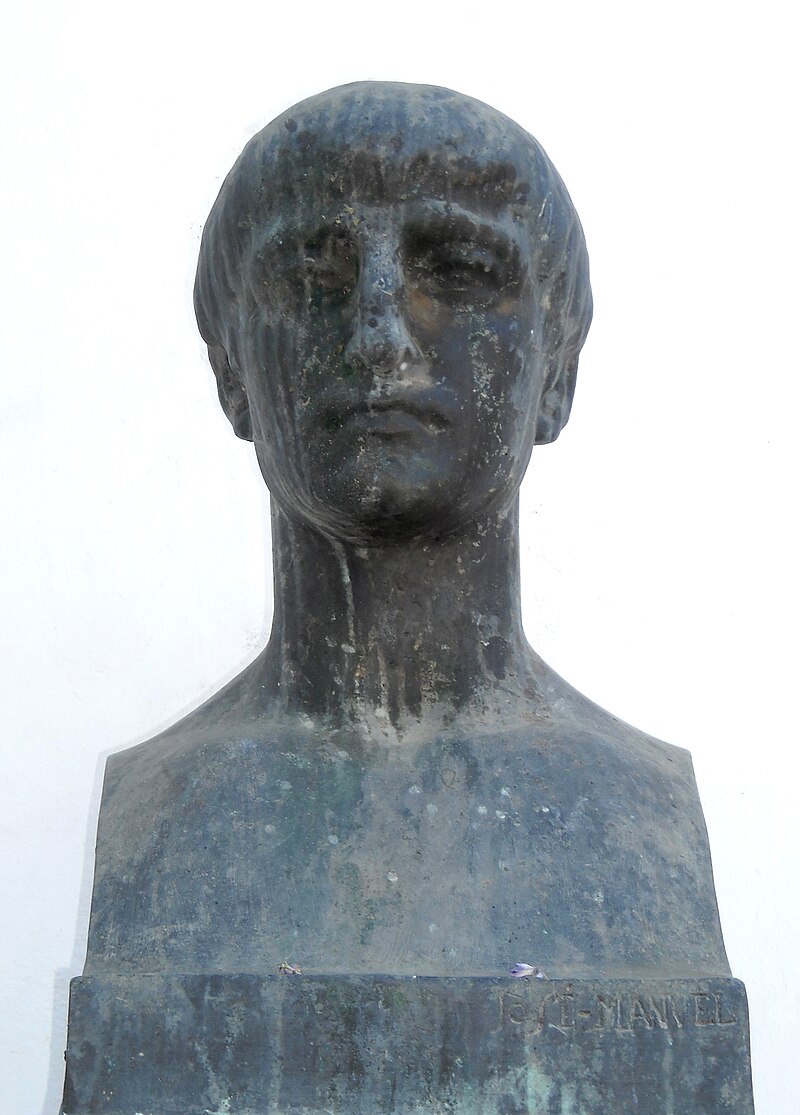
File:Busto_de_Lucano,_Cordoba.JPG · Wikimedia Commons · See Wikimedia Commons
Lucan
Sign in to saveAlso known as Marcus Annaeus Lucanus, Lucanus
Marcus Annaeus Lucanus (3 November AD 39 – 30 April AD 65), better known in English as Lucan (), was a Roman poet, born in Corduba, Hispania Baetica (present-day Córdoba, Spain). He is regarded as one of the outstanding figures of the Imperial Latin period, known in particular for his epic Pharsalia. His youth and speed of composition set him apart from other poets.
OverviewAI-generated
Lucan, also known as M. Annaeus Lucanus, was a male poet, historian, writer, and courtier from Ancient Rome. He was a member of the Annaea gens and wrote in Latin. His notable work is the epic poem *Pharsalia*, which is also titled *De bello civili*. Other works attributed to him include *Lvcanvs* and *M. Annei Lvcani cordvbensis De bello ciuili apud Pharsaliam libri x*.
Born on November 3, 0039, Lucan died in Rome on April 30, 0065. His death was a forced suicide resulting from exsanguination. He was related to Seneca and Lucius Junius Gallio Annaeanus. His works have been described in sources such as the *Nordisk familjebok*, the *Brockhaus and Efron Encyclopedic Dictionary*, the *Pauly–Wissowa*, and the *Encyclopædia Britannica* 11th edition.
Synthesized by Vinony from 24 facts across 3 sources: Wikidata, Open Library, Europeana Sparql. Generated from structured data (not the Wikipedia text) and checked against those facts — may still contain errors.
Person · Open Library
- Born
- 39
- Died
- 65
- Works
- 206
Top works
- De bello civili
- Lvcanvs
- M. Annei Lvcani, De bello civili, libri decem
- M. Annei Lvcani cordvbensis De bello ciuili apud Pharsaliam libri x. doctissimis argumẽtis & scholijs ornati
- La Pharsale de Lucain, ou, Les guerres ciuiles de Cesar et de Pompee. En vers françois
via Open Library + Wikidata
Key facts
- Person.name
- Lucan
- Person.image
- Busto de Lucano, Cordoba.JPG
- Person.caption
- Modern bust of Lucan in Córdoba. There are no ancient likenesses.
- Person.birth_date
- 3 November AD 39
- Person.birth_place
- Corduba, Hispania Baetica
- Person.death_date
- 30 April AD 65 (aged 25)
- Person.death_cause
- Forced suicide
- Person.occupation
- Poet
- Person.spouse
- Polla Argentaria
- Person.mother
- Acilia
- Person.family
- gens Annaea
via Wikipedia infobox
Wikidata facts
- Instance of
- human
- Gender
- male
- Citizenship
- Ancient Rome
- Place of birth
- Córdoba
- Place of death
- Rome
- Occupation
- courtier
- Languages spoken
- Latin
- Notable work
- Pharsalia
- Field of work
- epic poem
- Image
- Busto de Lucano, Cordoba.JPG
- Work location
- Ancient Rome
Show 12 more facts
- topic's main category
- Category:Lucan
- Commons category
- Lucan
- date of birth
- 0039-11-03
- date of death
- 0065-04-30
- Commons Creator page
- Lucan
- manner of death
- forced suicide
- relative
- Lucius Junius Gallio Annaeanus
- name in native language
- M. Annaeus Lucanus
- gens
- Annaea gens
- cause of death
- exsanguination
- writing language
- Latin
Sources (3)
via Wikidata · CC0
Works in European collections
33 objects attributed to Lucan, held across European museums, libraries & archives · via Europeana

M. Annæi Lvcani Pharsalia, Sive De Bello Civili Cæsaris et Pompeji Lib. X. : Pharsalia, Sive De Bello Civili

Pharsalia sive de bello civili inter Caesarem et Pompejum libri X.

La Pharsale ou les guerres civiles de Cesar et de Pompee en vers francois par de Brebeuf.

La guerra civile overo Farsaglia.

Lvcano Poeta, Y Historiador Antigvo: En que se tratan las guerras Pharsalicas, que tuuieron Iulio Cesar y Pompeyo. Traduzido de Latin en Romance Castellano, por Martin Lasso de Oropesa
[Pharsalia]

Pharsalia

Pharsalia

Lucanus

Lucanus

Lucanus

Lucanus

Lucanus italice versus, Chronicon impp. et Io. Cellensis epp

Lucanus

Lucanus

Lucanus

Lucanus

Lucanus

Lucanus

Lucanus

Lucanus

Lucanus

Lucanus

Lucanus

Lucanus

Lucanus

Lucanus

Lucanus

Lucanus

Lucanus

Lucanus

Lucanus
M. Annaei Lucani Cordubensis Pharsalia sive Belli civilis: ibri decem
~8 min read
Encyclopedic overview
6 sectionsContents
- Life
- Works
- References
- Sources
- Further reading
- External links
Marcus Annaeus Lucanus (3 November AD 39 – 30 April AD 65), better known in English as Lucan (), was a Roman poet, born in Corduba, Hispania Baetica (present-day Córdoba, Spain). He is regarded as one of the outstanding figures of the Imperial Latin period, known in particular for his epic Pharsalia. His youth and speed of composition set him apart from other poets.
==Life== Three brief ancient accounts allow for the reconstruction of a modest biography – the earliest attributed to Suetonius, another to an otherwise unknown Vacca, and the third anonymous and undated – along with references in Martial, Cassius Dio, Tacitus's Annals, and one of Statius's Silvae. Lucan was born in the Roman colony of Corduba into a wealthy family of central Italic origins; he was the son of and grandson of Seneca the Elder. He grew up under the tutelage of his uncle Seneca the Younger. He studied rhetoric at Athens and was probably provided with a philosophical and Stoic education by his uncle. thumb|left|Engraved title page of a French edition of Lucan's Pharsalia, 1657 The 5th-century author Sidonius Apollinaris implies that Polla Argentaria—Lucan's wife—may have assisted him in the creation of the Pharsalia, though the philologist Peter White suggests that this story could easily be a later invention and denigrates the account as "sentimental fancy".
Excerpted from Wikipedia’s “Lucan” article, available under the CC BY-SA 4.0 licence.
Gallery (7)
Available in 60 languages
- Español
- Français
- Deutsch
- 中文
- 日本語
- Русский
- Português
- Italiano
- العربية
- Afrikaans
- Albanian
- Aragonese
- Armenian
- Bahasa Indonesia
- Basque
- be_x_old
- Belarusian
- Breton
Show 41 more
- Bulgarian
- Catalan
- Cornish
- Czech
- Danish
- Egyptian Arabic
- Esperanto
- Estonian
- Extremaduran
- Finnish
- Friulian
- Georgian
- Greek
- Hebrew
- Hungarian
- Icelandic
- Ido
- Kyrgyz
- Latin
- Latvian
- Lithuanian
- Macedonian
- Marathi
- Mirandese
- Nederlands
- Norwegian
- Occitan
- Polski
- Punjabi
- Romanian
- Serbian (Latin)
- Sicilian
- Slovak
- Slovenian
- Svenska
- Türkçe
- Ukrainian
- zh_classical
- zh_yue
- فارسی
- 한국어
via Wikidata sitelinks · CC0