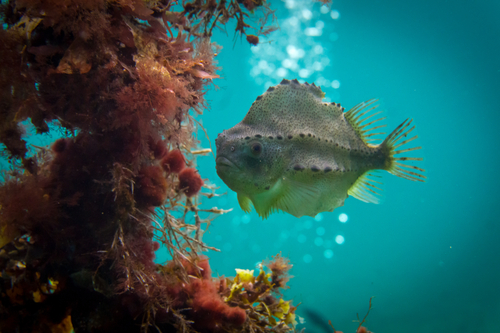
(c) Christopher Power, some rights reserved (CC BY-NC), uploaded by Christopher Power · cc-by-nc
lumpsucker
Sign in to saveAlso known as Cyclopteridae
The Cyclopteridae are a family of marine fishes, commonly known as lumpsuckers or lumpfish, in the order Scorpaeniformes. They are found in the cold waters of the Arctic, North Atlantic, and North Pacific oceans. The greatest number of species are found in the North Pacific. The family name Cyclopteridae derives from the Greek words κύκλος (kyklos), meaning "circle", and πτέρυξ (pteryx), meaning "wing" or "fin", in reference to the circle-shaped pectoral fins of most of the fish in this family.
Species
lumpfishes
Family
- PhylumChordata
- ClassTeleostei
- OrderPerciformes
- FamilyCyclopteridae
圓鰭魚科是輻鰭魚綱鮋形目的其中一科。
via
Wikidata facts
Show 5 more facts
- Commons category
- Cyclopteridae
- taxon rank
- family
- taxon name
- Cyclopteridae
- topic's main category
- Category:Cyclopteridae
- described by source
- Encyclopædia Britannica 11th edition
Sources (1)
via Wikidata · CC0
~7 min read
Encyclopedic overview
7 sectionsContents
- Genera
- Description
- Habitat and diet
- Behaviour and reproduction
- Fishers and the lumpsucker industry
- Species
- References
The Cyclopteridae are a family of marine fishes, commonly known as lumpsuckers or lumpfish, in the order Scorpaeniformes. They are found in the cold waters of the Arctic, North Atlantic, and North Pacific oceans. The greatest number of species are found in the North Pacific. The family name Cyclopteridae derives from the Greek words κύκλος (kyklos), meaning "circle", and πτέρυξ (pteryx), meaning "wing" or "fin", in reference to the circle-shaped pectoral fins of most of the fish in this family.
==Genera== Cyclopteridae includes the following valid genera: Subfamily Cyclopterinae Bonaparte, 1831 (lumpsuckers) Cyclopterus Linnaeus, 1758 Subfamily Liparopsinae Garman, 1892 (smooth lumpsuckers) Aptocyclus De la Pylaie, 1835 Subfamily Eumicrotreminae Oku, Imamura & Yabe, 2017 (spiny lumpsuckers) Cyclopsis Popov, 1930 Eumicrotremus Gill, 1862 (=Cyclopteropsis Soldatov & Popov, 1929) Lethotremus Gilbert, 1896 Proeumicrotremus Voskoboinikova & Orlov, 2020 == Description == thumb|left|200px|Smooth lumpfish|Aptocyclus ventricosus, inflated due to [[barotrauma]] Lumpsuckers are named appropriately enough; their portly bodies are nearly spherical with generally drab coloration and lithic patterns. The "sucker" part refers to the fish's modified pelvic fins, which have evolved into adhesive discs (located ventrally, behind the pectoral fins); the fish use these discs to adhere to the substrate. Many species have bony, wart-like tubercles adorning the head and body; these are important taxonomic features of the family.
Excerpted from Wikipedia’s “lumpsucker” article, available under the CC BY-SA 4.0 licence.