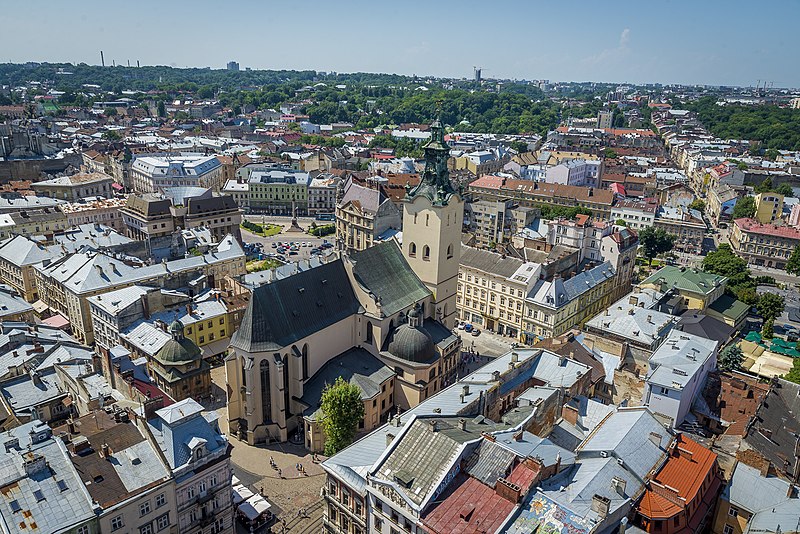
File:Латинський_кафедральний_собор_(Львів)_16.jpg · Wikimedia Commons · See Wikimedia Commons
Lviv
Sign in to saveAlso known as Lwów, Lemberg, Lvov, Lwow, L'viv, Lemberik, L'vov, Leopol
Lviv is the largest city in western Ukraine, as well as the fifth-largest city in Ukraine, officially with a population of 723,403 (2025 estimate). It serves as the administrative centre of Lviv Oblast and Lviv Raion, and is one of the main cultural centres of Ukraine. Lviv also hosts the administration of Lviv urban hromada. It was named after Leo I of Galicia, the eldest son of Daniel, King of Ruthenia. During its history the city has had several names.
Lviv is the largest city in western Ukraine and the country's fifth-largest city overall, serving as an important administrative and cultural hub for the region and the nation. With a population of approximately 723,403, it functions as the administrative center for Lviv Oblast and is recognized as one of Ukraine's main cultural centers.
AI-generated from the Wikipedia summary — may contain errors.
Key facts
- Settlement.name
- Lviv
- Settlement.settlement_type
- City
- Settlement.motto
- "Lviv is open to the world"
- Settlement.image_flag
- Lviv flag.svg
- Settlement.image_shield
- Coat of arms of Lviv.svg
- Settlement.shield_size
- 80px
- Settlement.image_blank_emblem
- Логотип Львова англійською.png
- Settlement.blank_emblem_type
- Logo
- Settlement.blank_emblem_size
- 80px
- Settlement.mapsize
- 230px
- Settlement.map_caption
- Lviv shown within Lviv Oblast##Lviv shown within Ukraine##Lviv shown within Europe
- Settlement.pushpin_map
- Ukraine Lviv Oblast#Ukraine#Europe
- Settlement.pushpin_relief
- 1
- Settlement.subdivision_type
- Country
- Settlement.subdivision_type1
- Oblast
- Settlement.subdivision_name1
- Lviv Oblast
- Settlement.subdivision_type2
- Raion
- Settlement.subdivision_name2
- Lviv Raion
via Wikipedia infobox
Wikidata facts
- Instance of
- Magdeburg rights
- Named after
- Lev I of Galicia
- Official name
- L' vov
- Award
- Order of Lenin
- Country
- Soviet Union
- Located in
- Lviv urban hromada
- Contains
- Shevchenko Raion
- Continent
- Europe
- Official language
- Russian
- Population
- 717273
- Area
- 182
- Elevation
- 296
- Time zone
- UTC+03:00
- Body of water
- Poltva River
- Head of government
- Andriy Sadovyi
- Legislature
- Lviv City Council
- Capital of
- Lviv urban hromada
- Shares border with
- Lviv Raion
- Founded by
- Daniel of Galicia
- Official website
- city-adm.lviv.ua
- Image
- Lwów - Widok z wieży ratuszowej 01.jpg
- Dialing code
- 322
- Licence plate code
- BC / 14
- Flag
- flag of Lviv
Show 24 more facts
- Coat of arms
- coat of arms of Lviv
- Patron saint
- Saint George
- category of associated people
- Category:People from Lviv
- twinned administrative body
- Graz
- category for people born here
- Category:Births in Lviv
- postal code
- 79000–79490
- Commons category
- Lviv
- category for people who died here
- Category:Deaths in Lviv
- topic's main category
- Category:Lviv
- Commons gallery
- Львів
- native label
- Львів
- P6482
- Lviv
- time of earliest written record
- 1256-00-00
- inception
- 1256-00-00
- category for people buried here
- Category:Burials in Lviv by place
- owner of
- Arena Lviv
- history of topic
- timeline of Lviv
- P8168
- Fameck
- category for honorary citizens of entity
- Category:Honorary citizens of Lviv
- different from
- Lvov
- on focus list of Wikimedia project
- Wikipedia:Vital articles/Level/4
- nickname
- Місто Лева
- P12749
- Birnie Island
Sources (15)
via Wikidata · CC0
~107 min read
Encyclopedic overview
61 sectionsContents
- Names and symbols
- History
- Galicia–Volhynia Wars
- Kingdom of Poland
- Habsburg Empire
- World War I
- Polish–Ukrainian War
- Interwar period
- World War II
- Soviet occupation and incorporation
- German occupation
- Soviet re-occupation
- Soviet era
- Independent Ukraine
- Russo-Ukrainian War
- 2022 Russian invasion of Ukraine
- Geography
- Climate
- Administrative divisions
- Demographics
- Historical populations
- Language
- Ethnic Polish population
- Jewish population
- Economy
- Information technology
- Culture
- Architecture
- Monuments
- Religion
- Christianity
- Judaism
- Arts
- Theatre and opera
- Museums and art galleries
- Music
- Universities and academia
- Mathematics
- Print and media
- In cinema and literature
- Parks
- Sport
- Association football
- Stadia
- Other sports
- Tourism
- Popular culture
- Public transport
- Railways
- Air transport
- Bicycle lanes
- Education
- Universities
- Notable people
- International relations
- Twin towns – sister cities
- Partner cities
- See also
- References
- Bibliography
- External links
Lviv is the largest city in western Ukraine, as well as the fifth-largest city in Ukraine, officially with a population of 723,403 (2025 estimate). It serves as the administrative centre of Lviv Oblast and Lviv Raion, and is one of the main cultural centres of Ukraine. Lviv also hosts the administration of Lviv urban hromada. It was named after Leo I of Galicia, the eldest son of Daniel, King of Ruthenia. During its history the city has had several names.
Lviv emerged as the centre of the historical regions of Red Ruthenia and Galicia in the 14th century, superseding Halych, Chełm, Belz, and Przemyśl. It was the capital of the Kingdom of Galicia–Volhynia from 1272 to 1340, when it went to King Casimir III the Great of Poland in a war of succession. In 1356, Casimir the Great granted it town rights. From 1434, it was the regional capital of the Ruthenian Voivodeship in the Kingdom of Poland. In 1772, after the First Partition of Poland, the city became the capital of the Habsburg semi-autonomous Polish-dominated Kingdom of Galicia and Lodomeria. Between 1918 and 1939, the city was the centre of the Lwów Voivodeship in the Second Polish Republic. During this period the city's culture and industry flourished, as did its academic institutions, such as the Lwów School of Mathematics, the , and the Lwów School of Economics. After the German-Soviet invasion of Poland in 1939, Lwów was annexed by the Soviet Union. It survived Soviet and German occupations during World War II largely unscathed. In February 1946, Lviv became a part of the Soviet Union, having lost an estimated 80-90% of its prewar population. In 1991 the city became part of the independent nation of Ukraine.
Excerpted from Wikipedia’s “Lviv” article, available under the CC BY-SA 4.0 licence.
Gallery (52)
On the map
3 mapped locations
Available in 148 languages
- Español
- Français
- Deutsch
- 中文
- 日本語
- Русский
- Português
- Italiano
- العربية
- हिन्दी
- Abkhazian
- Afrikaans
- Albanian
- Albanian
- Amharic
- Aragonese
- Armenian
- Arpitan
Show 129 more
- Asturian
- azb
- Azerbaijani
- Bahasa Indonesia
- Balinese
- Bangla
- Bashkir
- Basque
- Bavarian
- be_x_old
- Belarusian
- Betawi
- Bosnian
- Breton
- Bulgarian
- Catalan
- Cebuano
- Central Kurdish
- Chechen
- Chuvash
- Crimean Tatar
- Croatian
- Czech
- Danish
- Egyptian Arabic
- Erzya
- Esperanto
- Estonian
- Faroese
- Filipino
- Finnish
- fiu_vro
- Gagauz
- Galician
- Georgian
- Greek
- Hausa
- Hawaiian
- Hebrew
- Hungarian
- hyw
- Icelandic
- Ido
- Interlingue
- Javanese
- Kazakh
- Komi
- Kotava
- Kurdish
- Kyrgyz
- Ladino
- Lao
- Latin
- Latvian
- Lithuanian
- lld
- Lombard
- Macedonian
- Malagasy
- Malay
- Malayalam
- Maltese
- Manx
- Marathi
- Mari
- Mingrelian
- Moksha
- Mongolian
- nds_nl
- Nederlands
- Nepali
- Northern Frisian
- Norwegian
- Norwegian Nynorsk
- Occitan
- Old English
- Ossetic
- Palatine German
- Papiamento
- Pashto
- Picard
- Piedmontese
- Polski
- Pontic
- Quechua
- Romanian
- Rusyn
- Sardinian
- Scots
- Scottish Gaelic
- Serbian
- Serbian (Latin)
- Sicilian
- Silesian
- simple
- Sindhi
- Slovak
- Slovenian
- Svenska
- Swahili
- Tajik
- Talysh
- Tamil
- Tatar
- Tiếng Việt
- Türkçe
- Turkmen
- Tuvinian
- Udmurt
- Ukrainian
- Upper Sorbian
- Urdu
- Uzbek
- Venetian
- Veps
- Volapük
- Walloon
- Waray
- Welsh
- Western Frisian
- Western Mari
- Western Panjabi
- Wu Chinese
- Yakut
- Yiddish
- zh_yue
- فارسی
- ไทย
- 한국어
via Wikidata sitelinks · CC0