
MacPaint
Sign in to saveMacPaint is a raster graphics editor developed by Apple Computer and released alongside the original Macintosh personal computer on January 24, 1984. It was sold bundled with its word processing counterpart, MacWrite, for US$195. MacPaint was notable because it could generate graphics that could be used by other applications. It taught consumers what a graphics-based system could do by using the mouse, the clipboard, and QuickDraw picture language. Pictures could be cut from MacPaint and pasted into MacWrite documents.
Key facts
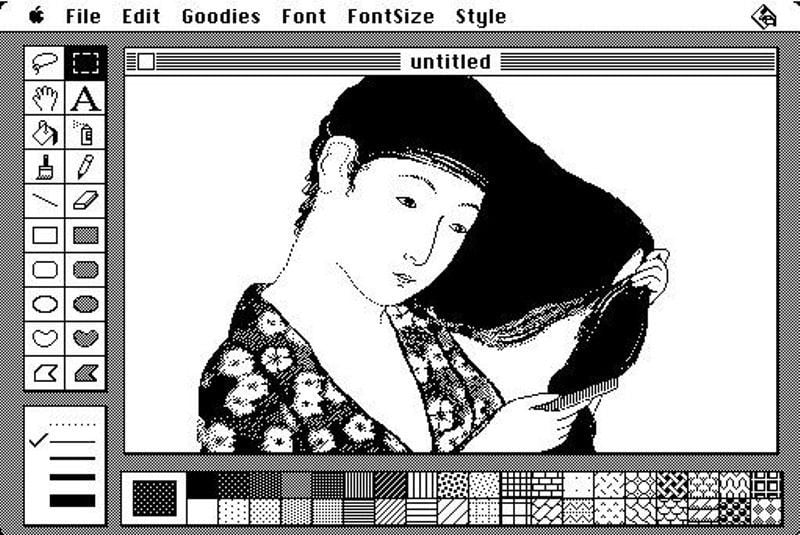
- Software.screenshot
- MacpaintWP.png
- Software.caption
- A picture in MacPaint 1.0
- Software.developer
- Apple Computer, Claris
- Software.latest_release_version
- 2.0
- Software.programming language
- Pascal
- Software.operating_system
- Classic Mac OS(System 1, 2, 3, 4, 5System 6System 7)
- Software.genre
- Raster graphics editor
- Software.license
- Proprietary
- Software.discontinued
- yes
- File format.name
- MacPaint image
- File format.type code
- PNTG
- File format.uniform type
- com.apple.macpaint-image
- File format.owner
- Apple Computer
- File format.genre
- Image file
via Wikipedia infobox
Described at
MacPaint and QuickDraw Source Code - CHM
computerhistory.org →For those who want to see how it worked “under the hood”, we are pleased, with the permission of Apple Inc., to make available the original program source code of MacPaint and the underlying QuickDraw graphics library. MacPaint is the drawing program application which interacts with the user, interprets mouse and keyboard requests, and decides what is to be drawn where. The high-level logic is written in Apple Pascal, packaged in a single file with 5,822 lines. There are an additional 3,583 lines of code in assembler language for the underlying Motorola 68000 microprocessor, which implement routines needing high performance and some interfaces to the operating system. QuickDraw is the Macintosh library for creating bit-mapped graphics, which was used by MacPaint and other applications. It consists of a total of 17,101 lines in 36 files, all written in assembler language for the 68000. MacPaint was written by Bill Atkinson, who was a member of the original Macintosh development team. He based it on his earlier LisaSketch (also called SketchPad) for the unsuccessful Apple Lisa computer, so he originally called it MacSketch. He started work on the Mac version in early 1983. Atkinson also created Quickdraw first for the Lisa, as LisaGraf. Andy Hertzfeld, another key member of the team, considers QuickDraw “the single most significant component of the original Macintosh technology” in its ability to “push pixels around in the frame buffer at blinding speeds to create the celebrated user interface.”² One of the problems with many early graphics programs was that as you dragged a shape or image across the screen, it had to be erased from its old position before being redrawn, which caused a distracting flicker. Bill eliminated the flicker by composing everything in a hidden memory buffer, which was then transferred to the screen quickly when it was completely ready. Around April 1983, Bill changed the name from MacSketch to MacPaint, and starting adding new features almost on a daily basis: The “Fat Bits” mode magnified screen areas so individual pixels could be edited. The “Paint Bucket” tool identified and filled closed areas with a pattern. The “Lasso” tool selected non-rectangular shapes. He even wrote an elaborate character-recognition routine to turn pixilated characters back into text, but in the end removed it because he wanted MacPaint to be used as a great drawing program, and not as an inadequate word processor. In writing MacPaint, Bill was as concerned with whether human readers would understand the code as he was with what the computer would do with it. He later said about software in general, “It’s an art form, like any other art form… I would spend time rewriting whole sections of code to make them more cleanly organized, more clear. I’m a firm believer that the best way to prevent bugs is to make it so that you can read through the code and understand exactly what it’s doing… And maybe that was a little bit counter to what I ran into when I first came to Apple… If you want to get it smooth, you’ve got to rewrite it from scratch at least five times.”¹ MacPaint was finished in October 1983. It coexisted in only 128K of memory with QuickDraw and portions of the operating system, and ran on an 8 Mhz processor that didn’t have floating-point operations. Even with those meager resources, MacPaint provided a level of performance and function that established a new standard for personal computers. There are many wonderful anecdotes about the original Macintosh team collected and preserved by Andy Herzfeld at www.folklore.org. Here, with Andy’s permission, are condensed versions of a couple of interesting ones about Bill Atkinson: A reporter asked Steve Jobs, “How many man-years did it take to write Quick Draw?” Steve asked Bill, who said, “Well, I worked on it on and off for four years.” Steve then told the reporter, “Twenty-four man-years”. Steve figured, with ample justification, that one Atkinson year was the eq
Excerpt from a page describing this subject · 11,501 chars · not written by Vinony
Wikidata facts
- Instance of
- proprietary software
- Developer
- Claris
Show 8 more facts
- streaming media URL
- www.computerhistory.org/collections/catalog/102702313
- archives at
- Computer History Museum
- programmed in
- assembly language
- inception
- 1984-00-00
- software version identifier
- 2.0
- described at URL
- www.computerhistory.org/atchm/macpaint-and-quickdraw-source-code
- discontinuation date
- 1998-00-00
- user manual URL
- archive.org/details/macpaint_201707
via Wikidata · CC0
~6 min read
Encyclopedic overview
6 sectionsContents
- Development
- FatBits
- Release and version history
- Version history
- References
- External links
MacPaint is a raster graphics editor developed by Apple Computer and released alongside the original Macintosh personal computer on January 24, 1984. It was sold bundled with its word processing counterpart, MacWrite, for US$195. MacPaint was notable because it could generate graphics that could be used by other applications. It taught consumers what a graphics-based system could do by using the mouse, the clipboard, and QuickDraw picture language. Pictures could be cut from MacPaint and pasted into MacWrite documents.
The original MacPaint was developed by Bill Atkinson, a member of Apple's original Macintosh development team. Early development versions of MacPaint were called MacSketch, still retaining part of the name of its roots, LisaSketch. It was later developed by Claris, the software subsidiary of Apple which was formed in 1987. The last version of MacPaint was version 2.0, released in 1988. It was discontinued by Claris in 1998 because of diminishing sales.
Excerpted from Wikipedia’s “MacPaint” article, available under the CC BY-SA 4.0 licence.