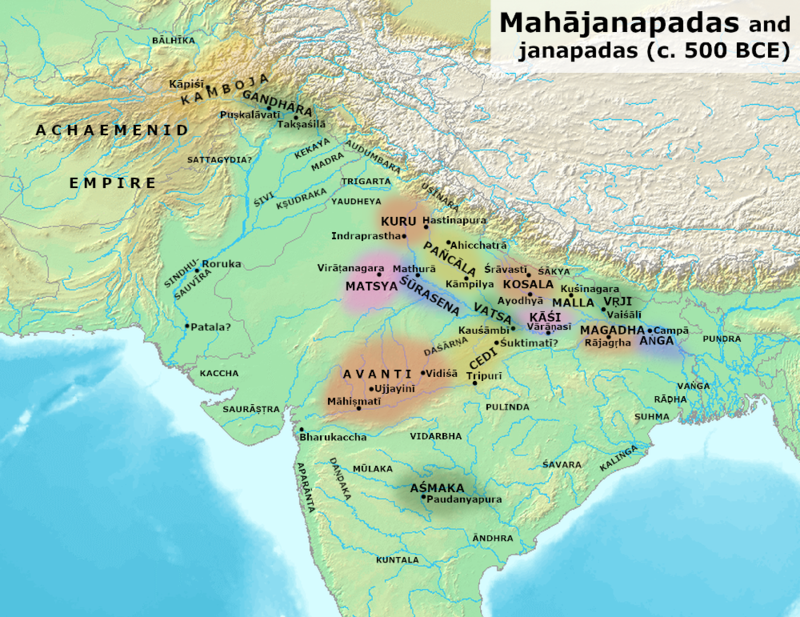
File:Mahajanapadas_(c._500_BCE).png · Wikimedia Commons · See Wikimedia Commons
Mahajanapada
Sign in to saveAlso known as mahājanapada, 16 mahajanapadas (great states), sixteen mahajanapadas (great states)
The Mahājanapadas were sixteen kingdoms and aristocratic republics that existed in ancient India from the sixth to fourth centuries BCE, during the second urbanisation period.
The Mahājanapadas were sixteen major kingdoms and republics that ruled different parts of ancient India between the sixth and fourth centuries BCE, during a time of significant urban growth and development. They matter because they represent an important period in Indian history when complex political systems and organized states were emerging across the subcontinent.
AI-generated from the Wikipedia summary — may contain errors.
Key facts
- Country.native_name
- Mahajanapadas
- Country.era
- Iron Age
- Country.life_span
- –
- Country.p1
- Painted Grey Ware culture
- Country.p2
- Vedic period
- Country.p3
- Janapadas
- Country.p4
- Kuru kingdom
- Country.s1
- Nanda Empire
- Country.s2
- Achaemenid Empire
- Country.image_map
- Mahajanapadas (c. 500 BCE).png
- Country.image_map_caption
- Map of the 16 Mahājanapadas.
- Country.common_languages
- Prakrits and Sanskrit
- Country.religion
- Historical Vedic religionBuddhismJainism
- Country.government_type
- aristocratic republic, monarchy
via Wikipedia infobox
Wikidata facts
- Instance of
- historical country
- Subclass of
- historical country
- Religion
- Historical Vedic religion
- Form of government
- republic
Show 7 more facts
- dissolved, abolished or demolished date
- 0345-00-00
- Commons category
- Mahajanapadas
- topic's main category
- Category:Mahajanapadas
- replaced by
- Maurya empire
- replaces
- Janapada
- inception
- 0600-00-00
- topic has template
- Template:Mahajanapada
Sources (1)
via Wikidata · CC0
~25 min read
Encyclopedic overview
24 sectionsContents
- History
- Overview
- List of Mahajanapadas
- Aṅga
- Aśmaka
- Avanti
- Chedi
- Gandhāra
- Kamboja
- Kāśī
- Kosala
- Kuru
- Magadha
- Malla
- Matsya
- Pañcāla
- Śūrasena
- Vajji
- Vatsa (or Vaṃsa)
- See also
- References
- Further reading
- Notes
- External links
The Mahājanapadas were sixteen kingdoms and aristocratic republics that existed in ancient India from the sixth to fourth centuries BCE, during the second urbanisation period.
== History == The 6th–5th centuries BCE are often regarded as a major turning point in early Indian history. During this period, India's first large cities since the demise of the Indus Valley civilization arose. It was also the time of the rise of sramana movements (including Buddhism and Jainism), which challenged the religious orthodoxy of the Vedic period.
Excerpted from Wikipedia’s “Mahajanapada” article, available under the CC BY-SA 4.0 licence.