File:Malachite,_Zaire.jpg · Wikimedia Commons · See Wikimedia Commons
malaquite
Sign in to savemineral do grupo dos carbonatos
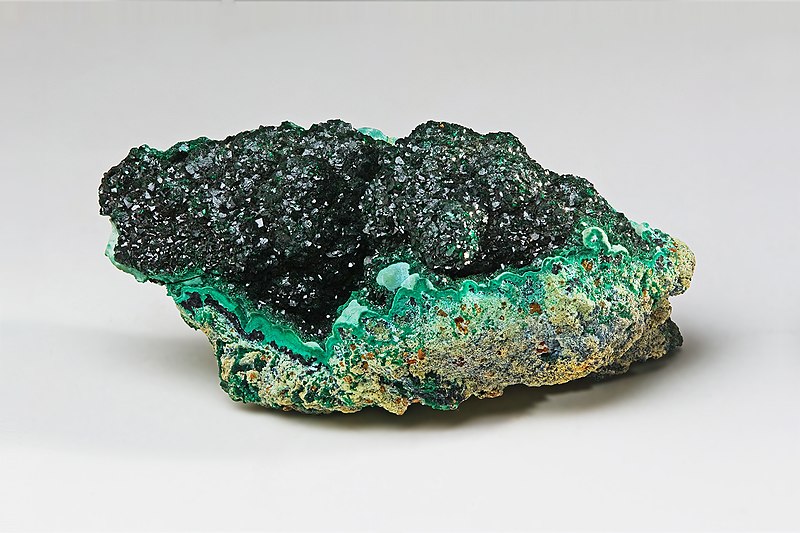
Malachite is a green mineral made of copper, carbon, and oxygen that typically forms banded patterns and grows in underground spaces where water and hot fluids cause it to crystallize. It has been valued throughout history for its distinctive appearance and has been used as a decorative stone, pigment, and source of copper.
AI-generated from the Wikipedia summary — may contain errors.
Key facts
- Mineral.name
- Malachite
- Mineral.category
- Carbonate mineral
- Mineral.boxbgcolor
- 3fce68
- Mineral.image
- Malachite, Zaire.jpg
- Mineral.caption
- Malachite from the Democratic Republic of the Congo
- Mineral.formula
- Cu2CO3(OH)2
- Mineral.IMAsymbol
- Mlc
- Mineral.molweight
- 221.1 g/mol
- Mineral.strunz
- 5.BA.10
- Mineral.system
- Monoclinic
- Mineral.class
- Prismatic (2/m) (same H-M symbol)
- Mineral.symmetry
- P21/a
- Mineral.color
- Bright green, dark green, blackish green, with crystals deeper shades of green, even very dark to nearly black commonly banded in masses; green to yellowish green in transmitted light
- Mineral.habit
- Massive, botryoidal, stalactitic, crystals are acicular to tabular prismatic
- Mineral.twinning
- Common as contact or penetration twins on and . Polysynthetic twinning also present.
- Mineral.cleavage
- Perfect on fair on
- Mineral.fracture
- Subconchoidal to uneven
- Mineral.tenacity
- Brittle
via Wikipedia infobox
Wikidata facts
- Named after
- peafowl
- Image
- Malachit, Kupferspat.jpg
Show 12 more facts
- Commons category
- Malachite
- streak color
- green
- Nickel-Strunz 9th edition (updated 2009)
- 5.BA.10
- Nickel-Strunz '10th ed', review of (9th ed/ 2009 update)
- 5.BA.10
- described by source
- Pauly–Wissowa
- crystal system
- monoclinic crystal system
- Mohs' hardness
- 3.75
- density
- 3.850
- different from
- Malachite
- IMA Mineral Symbol
- Mlc
- chemical formula
- Cu₂(CO₃)(OH)₂
- Strunz 8th edition (series ID, updated)
- Vb/B.01
Sources (6)
via Wikidata · CC0
Article · Português
Malaquita (no Brasil) ou malaquite (em Portugal) é um mineral do grupo dos carbonatos (carbonato de cobre (II)) com dureza entre 3 e 4 na Escala de Mohs. Seu sistema cristalino é monoclínico, e frequentemente forma massas botrioidais, fibrosas ou estalagmíticas. A malaquita geralmente resulta da alteração de minérios de cobre e ocorre frequentemente associada com azurita, goethita e cuprita. À exceção da cor verde, as propriedades da malaquita são muito similares àquelas da azurita, e agregados conjuntos dos dois minerais são encontrados com frequência, embora a malaquita seja mais comum do que a azurita. Foi usado como um pigmento mineral em pinturas verdes da antiguidade até aproximadamente 1800. O pigmento é moderadamente resistente à luz, muito sensível a ácidos e variável na cor. Quando a malaquita fica em contato com a água por muito tempo (em torno de 1 semana), sua cor muda para vermelho alaranjado. O tipo natural tem sido substituído por sua forma sintética, entre outros verdes sintéticos. Foi principalmente utilizado no Antigo Egipto tendo a particular importância nos séc.XV XVI, sendo mesmo referenciado no livro Cennino Cennini "Il libro dell'arte". Pode ser identificada pela sua cor verde e a reatividade com HCl. Grandes quantidades de malaquita têm sido extraídas nos montes Urais.
Abstract from DBpedia / Wikipedia · CC BY-SA
Gallery (20)
Available in 67 languages
- Español
- Français
- Deutsch
- 中文
- 日本語
- Русский
- Português
- Italiano
- العربية
- हिन्दी
- Afrikaans
- Armenian
- Asturian
- Azerbaijani
- Bahasa Indonesia
- Bashkir
- Basque
- be_x_old
Show 48 more
- Belarusian
- Bosnian
- Breton
- Bulgarian
- Catalan
- Croatian
- Czech
- Danish
- Esperanto
- Estonian
- Finnish
- Galician
- Georgian
- Greek
- Hebrew
- Hungarian
- Icelandic
- Ido
- Irish
- Kazakh
- Kyrgyz
- Latin
- Latvian
- Lithuanian
- Macedonian
- Malay
- Nederlands
- Norwegian Nynorsk
- Occitan
- Polski
- Romanian
- Serbian
- Serbian (Latin)
- simple
- Slovak
- Slovenian
- Svenska
- Tatar
- Tiếng Việt
- Türkçe
- Ukrainian
- Uyghur
- Uzbek
- Wu Chinese
- zh_yue
- فارسی
- ไทย
- 한국어
via Wikidata sitelinks · CC0