
OverviewAI-generated
Malta is a sovereign island country and unitary state located in Southern Europe. Its capital is Valletta, and its name is derived from the word for honey. The Republic of Malta is a member of the European Union, the United Nations, the Commonwealth of Nations, and the Council of Europe. It uses the euro and the Maltese lira as currency, with Maltese and English as official languages. The top-level Internet domain is .mt, and the telephone country code is 356.
The country has a population of approximately 574,250 and covers an area of 316 square kilometers. It is located at coordinates 35.9, 14.4, within the Central European Time zone. Malta contains administrative entities such as the Gozo Region, Malta Majjistral, Malta Xlokk, and the Central Region. The head of state is George William Vella, and the head of government is Robert Abela. The national anthem is L-Innu Malti, and the flag is represented by 🇲🇹.
Synthesized by Vinony from 67 facts across 9 sources: Wikidata, REST Countries, Open Meteo, Openweathermap, World Bank, OpenStreetMap, PubMed, Vinony graph, Geo. Generated from structured data (not the Wikipedia text) and checked against those facts — may still contain errors.
Weather now
7-day forecast
via Open-Meteo
Country

- Capital
- Valletta
- Population
- 574,250
- Region
- Europe · Southern Europe
- Demonym
- Maltese
- Currencies
- EUR (€)
- Languages
- English, Maltese
- Calling code
- +356
- Drives on
- Left
- Gini
- 28.7 (2018)
- FIFA code
- MLT
- TLD
- .mt
- Timezones
- UTC+01:00
via REST Countries
Indicators · World Bank
- GDP
- $25B(2024)
- Population
- 568,847(2024)
- Life expectancy
- 83 yrs(2024)
- Unemployment
- 2.9 %(2025)
- Urban population
- 95.7 %(2024)
- Internet users
- 93.9 %(2024)
- Forest area
- 1.4 %(2023)
- Renewable energy
- 8.6 %(2021)
via World Bank Open Data · CC BY 4.0
Wikipedia views (30d)
230,818 totalvia Wikimedia Pageviews API
Key facts
- Country.coa_size
- 90
- Country.national_motto
- "Strength and persistence"
- Country.sovereignty_note
- from the United Kingdom
- Country.established_event1
- State of Malta
- Country.established_date1
- 21 September 1964
- Country.established_event2
- Republic
- Country.established_date2
- 13 December 1974
- Country.area_km2
- 316
- Country.area_rank
- 187th
- Country.area_sq_mi
- 122
- Country.percent_water
- 0.001
- Country.population_estimate_rank
- 167th
- Country.conventional_long_name
- Republic of Malta
- Country.common_name
- Malta
- Country.image_flag
- Flag of Malta.svg
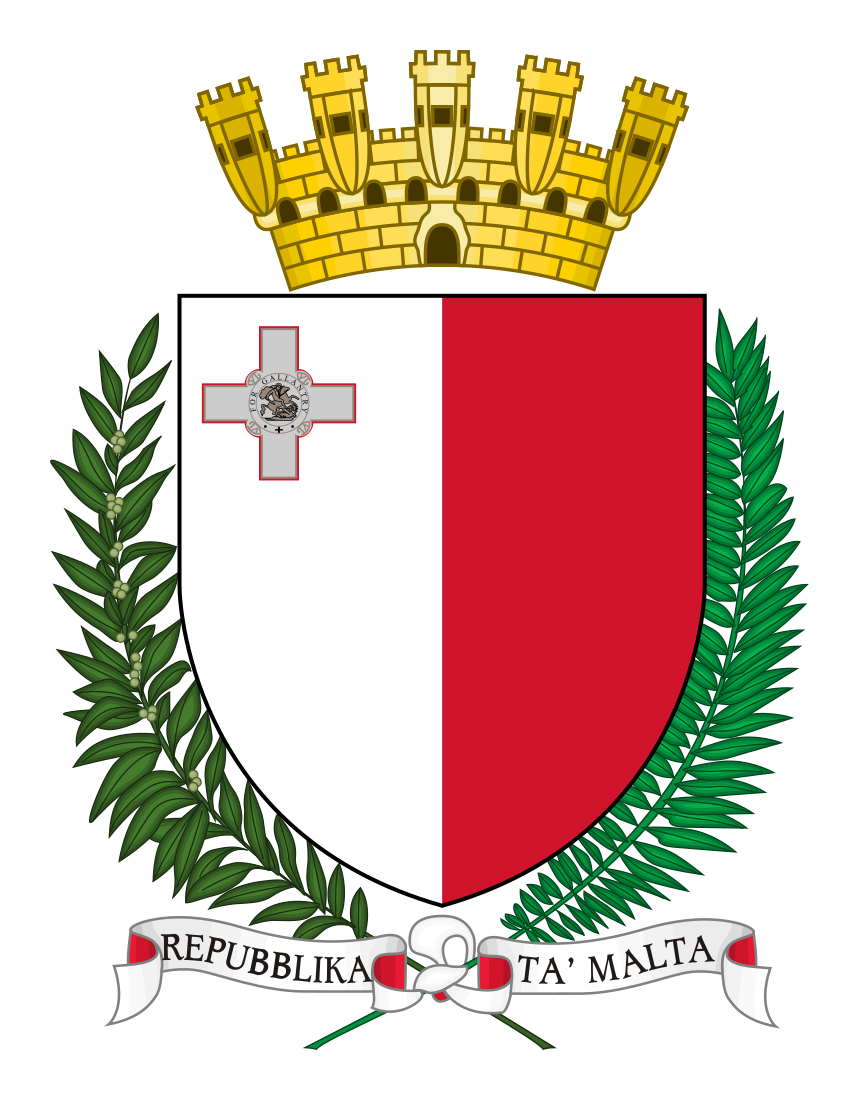
- Country.image_coat
- Coat of arms of Malta.svg
- Country.national_anthem
- "The Maltese Hymn"
- Country.image_map
- EU-Malta.svg
via Wikipedia infobox
Research
9,684 papers- The epidemiology of CHD in Malta.Cardiology in the young · 2024Grech V, Gatt M, Calleja NDOI: 10.1017/S1047951123003062
- Mass population vaccination for COVID-19 in Malta.ReviewJournal of visual communication in medicine · 2021Grech V, Souness J, Agius SDOI: 10.1080/17453054.2021.1920829
- Leishmaniasis in Malta and the Mediterranean basin.ReviewAnnals of tropical medicine and parasitology · 1997Fenech FFDOI: 10.1080/00034989760491
- Malta.Department of State publication. Background notes series · 1985United States. Department of State. Bureau of Public Affairs
- Malta fever.Bulletin of the New York Academy of Medicine · 1977Sternberg GM
- Nurse Leadership Development in Malta.Journal of transcultural nursing : official journal of the Transcultural Nursing Society · 2019Hughes V, Wright R, Cassar MDOI: 10.1177/1043659618811918
- Cannabis in Malta-big business or laxing restrictions?European journal of public health · 2019Mamo JJDOI: 10.1093/eurpub/ckz061
- Squamous cell carcinoma and MYH9-associated elastin aggregation (MALTA) syndrome.Clinical and experimental dermatology · 2023Fostier W, Husain A, Rajan NDOI: 10.1093/ced/llad263
via PubMed
Wikidata facts
- Instance of
- Maltese Islands
- Part of
- European Economic Area
- Named after
- honey
- Official name
- مالطه جمهوریتی
- Demonym
- Malteserinnen
- Religion
- Islam
- Award
- George Cross
- Country
- Kingdom of Great Britain
- Continent
- Europe
- Capital
- Valletta
- Official language
- English language
- Currency
- Maltese lira
- Population
- 531511
- Area
- 316
- Time zone
- Central European Time
- Body of water
- Mediterranean Sea
- Head of government
- Dom Mintoff
- Head of state
- Myriam Spiteri Debono
- Form of government
- parliamentary democracy
- Legislature
- Parliament of Malta
- Anthem
- L-Innu Malti
- Shares border with
- Italy
- Highest point
- Ta' Dmejrek
- Official website
- www.gov.mt
Show 73 more facts
- Image
- Malta, 2010 - panoramio - Bengt Nyman (23).jpg
- Life expectancy
- 83
- Nominal GDP
- 17765270015
- Unemployment rate
- 6
- Calling code
- +356
- Licence plate code
- M
- Electrical plug type
- BS 1363
- Mains voltage
- 230
- Motto
- Truly Mediterranean
- Flag
- flag of Malta
- Coat of arms
- Coat of arms of Malta
- Said to be same as
- Maltese Islands
- topic's main Wikimedia portal
- Portal:Malta
- category for people born here
- Category:Births in Malta
- Commons category
- Malta
- top-level Internet domain
- .mt
- topic's main category
- Category:Malta
- Commons gallery
- Malta
- category for people who died here
- Category:Deaths in Malta
- category for films shot at this location
- Category:Films shot in Malta
- category of associated people
- Category:Maltese people
- diplomatic relation
- Kosovo
- history of topic
- history of Malta
- IPA transcription
- ˈmalʲtə
- lowest point
- Mediterranean Sea
- mobile country code
- 278
- driving side
- left
- geography of topic
- Geography of Malta
- VAT rate
- 18
- executive body
- Government of Malta
- age of majority
- 18
- marriageable age
- 18
- office held by head of government
- Prime Minister of Malta
- language used
- Maltese Sign Language
- retirement age
- 62
- office held by head of state
- President of Malta
- number of out-of-school children
- 3403
- has characteristic
- free country
- located in/on physical feature
- Southern Europe
- inception
- 1964-09-21
- total fertility rate
- 1.38
- maritime identification digits
- 256
- Unicode character
- 🇲🇹
- replaces
- Crown Colony of Malta
- native label
- Malta
- GS1 country code
- 535
- culture
- culture of Malta
- economy of topic
- economy of Malta
- demographics of topic
- demographics of Malta
- different from
- Malta
- Democracy Index
- 7.68
- topic has template
- Template:Regions of Malta
- Human Development Index
- 0.918
- P11012
- Luxembourg
- central bank
- Central Bank of Malta
- hashtag
- Malta
- on focus list of Wikimedia project
- Wikipedia:Vital articles/Level/4
- Happy Planet Index score
- 43.5
- Gini coefficient
- 31
- Inequality-adjusted Human Development Index
- 0.849
- suicide rate
- 5.3
- owner of
- Fort St Angelo
- P12749
- Chelicerata
- birth rate
- 8.1
- male population
- 276869
- death rate
- 8
- rural population
- 27220
- female population
- 254244
- urban population
- 503893
- number of seats in assembly
- 5
- Commonwealth Sport country code
- MLT
Sources (15)
via Wikidata · CC0
Travel guide
Understand
Malta is the smallest member of the European Union by population, with only half a million people, but also by area, making it the fourth-most densely populated country in the world while being the tenth-smallest. Despite its diminutive size, Malta is an important freight trans-shipment point, financial centre and tourist destination.
Get in
Visitors from outside the EU, including Americans, must fill out a landing card, available on board some arriving flights (sometimes) or in the entrance hall of the airport from a small box between the customs agents. As of January 2020, American travellers report having their passports stamped into the Schengen Area and being waved straight on to baggage claim.
Get around
thumb|right|Malta Public Transport operates a fleet of modern buses coloured white and green The island of Malta is pretty densely populated and there is no rail transport of any kind, so expect crowded streets no matter how you try to get around. On the plus side, distances are relatively short and bus fares are low compared to Western Europe.
See
The ancient capital of Mdina, also known as the Silent City, rests at a high point in the heart of the island. Surrounded by the scenic town of Rabat, this fortress is one of Malta's finest jewels, boasting architecture, history and a quality cup of coffee with a splendid view. Mdina gets very peaceful and romantic in the evenings when the day trippers leave.
Valletta is similar in that it boasts a rich history, only being the modern capital, it is very much alive and much more modern, serving as both a shopping area during the day and offering an array of museums and cultural sites. Of particular note is St John's Co-Cathedral, built by one of the earlier Grandmasters of the Knights Hospitaller. It contains the various chapels of the Knights' langue's, with Caravaggio paintings, tapestries and various relics of immense value to the Maltese heritage. The floors of the cathedral are the tombs of the most famous knights of the Order of St. John, and a crypt, though off-limits to tourists, hosts the bodies of some of the most illustrious of Grandmasters, including the city's founder, Jean de Valette.
The Megalithic Temples of Malta are some of the oldest buildings in the world, as such they have been included on the UNESCO World Heritage List. Seven megalithic temples are found on the islands of Malta and Gozo, each the result of an individual development. The two temples of Ggantija on the island of Gozo are notable for their gigantic Bronze Age structures. On the island of M…
Do
Sample the local delicacies.
In the summer, the island is perfect for water sports and beach activities. The island has been described as an open-air museum by some; one is unlikely to run out of things to see during a visit to Malta. Each township has its own unique sights to offer if one pays close enough attention. Most Maltese citizens have not even visited all the wonders and attractions that this island offers.
Hiking in the countryside offers a taste of rural Malta, especially if trekking along the coast of Gozo.
Although Malta is not famous for its tennis, it is a popular sport throughout the islands. Players on all different levels can congregate at the various tennis courts spread out across Malta to play a game of tennis or watch as regular season games are being played. Because of the warm climate, even in the winter months, tennis is therefore a sport that can be played all year around in Malta. Sailing is a wonderful option, as Malta boasts an impressive array of caves, scenic sunsets, and other views.
The island is surrounded by a limited number of beaches. They get crowded in the high season, so keep this in mind when planning your visit.
thumb|Valletta Carnival There are a number of great annual festivals worth attending. Valletta Carnival - February/March Malta Carnival national activities will be held in Valletta and Floriana. Dance and costume competitions will take place in the capital and Floriana followed by defiles which include triumphal floats, …
Eat
thumb|Pastizzi thumb|Qargħa Bagħli Mimli (Stuffed marrows) Distinctly Maltese cuisine is hard to find but does exist. The food eaten draws its influences from Italian cuisine. Most restaurants in resort areas like Sliema cater largely to British tourists, offering pub grub like meat and three veg or bangers and mash, and you have to go a little out of the way to find 'real' Maltese food. One of the island's specialities is rabbit (fenek), and small savoury pastries known as pastizzi are also ubiquitous.
The Maltese celebratory meal is fenkata, a feast of rabbit, marinated overnight in wine and bay leaves. The first course is usually spaghetti in rabbit sauce, followed by the rabbit meat stewed or fried (with or without gravy). Look out for specialist fenkata restaurants, such as Ta L'Ingliz in Mgarr.
True Maltese food is quite humble in nature, and rather fish and vegetable based – the kind of food that would have been available to a poor farmer, fisherman, or mason. Thus one would find staples like soppa ta' l-armla (widow's soup) which is basically a coarse mash of whatever vegetables are in season, cooked in a thick tomato stock. Then there's arjoli which is a julienne of vegetables, spiced up and oiled, and to which are added butter beans, a puree made from broadbeans and herbs called bigilla, and whatever other delicacies are available, like Maltese sausage (a confection of spicy minced pork, coriander seeds and parsley, wrapped in stomach lining) or ġbejniet (simple c…
Stay safe
Malta is generally considered safe. However, visitors to Paceville at night should exercise caution.
Due to Malta being a major Mediterranean port, sailors with shore leave tend to become quite rowdy after long voyages. As well, the advent of low-cost air travel coming to Malta has brought an influx of teenagers from across Europe enjoying short cheap weekend breaks in the sun.
Although most public parking lots are free in Malta, parking attendants will importunately extort tips from you calling them "donations". They will make you think it's obligatory telling you that everyone does it. However keep in mind that giving tips is completely voluntary and you don't have to do that, especially if you feel that the parking attendant is rude. Feel free to just walk away. The parking attendants won't damage your car in case you deny tipping (but be prepared that they may yell at you). Remember, if the parking is not free (like at the airport), there will be a sign.
People of colour have been known to experience racial discrimination on Malta.
Stay healthy
The main health risk in Malta is the fierce sun in the Spring and Summer, which can scorch unsuspecting tourists. Apply sunblock liberally to avoid getting sunburned!
Water from the tap is safe to drink but has a slightly salty taste to it because much of it is obtained through desalination.
There are many free and (usually) clean public toilets all over the country. Toilet paper is not always available though.
For ambulance, fire or police dial 112. The main hospitals are Mater Dei Telephone: +356 2545 0000 and Gozo General Hospital in Gozo, +356 2156 1600.
Respect
While a bit reserved, Maltese people are friendly, generous, and helpful in nature. Maltese people tend to speak more loudly than the mainlanders, so they may sound like they are shouting at you even if the volume is normal. Malta is a strictly Roman Catholic country; carousing by tourists, while tolerated to some extent, is not looked on very favourably, especially outside of St. Julian's and Paceville. Dress respectfully when visiting churches. As a guide, men must remove any hats and sunglasses. Make sure your knees and shoulders are covered. Some churches, especially those on popular package tours, provide shawls and/or skirts for any inappropriately dressed visitors. You may be refused entry to a church if a mass has already started, so make sure you arrive promptly if you wish to visit.
Travel guide from Wikivoyage (CC BY-SA 4.0)
Article · Português
Malta, oficialmente República de Malta (em maltês: Repubblika ta' Malta [rɛˈpʊbb.lɪ.kɐ ˈtɐ ˈmɐl.tɐ]; em inglês: Republic of Malta [ɹɪˈpʌblɪk ɒv mɒltə]), é um país insular localizado no Sul da Europa, cujo território ocupa as Ilhas Maltesas, um arquipélago situado no Mar Mediterrâneo, 93 km ao sul da ilha da Sicília (Itália) e 288 km a nordeste da Tunísia (África), 1 826 km a leste de Gibraltar e 1 510 quilômetros a oeste de Alexandria. Malta abrange uma área terrestre de 316 km², sendo um dos menores países da Europa, possuindo também a maior densidade demográfica do continente. Sua capital é Valeta e a maior cidade é Birkirkara. O Maltês é a língua nacional e o inglês é a língua co-oficial. Devido aos eventos históricos que se passaram ao longo dos anos, Malta tornou-se um país anglo-latino, pelas principais influências dos Impérios Romano e mais tarde Britânico, apesar de existir influências menores deixadas por outros reinos que passaram por Malta, como a Grécia e os Impérios Islamico e Bizantino e mais tarde a presença dos espanhóis e franceses. Malta é um dos países mais estratégicos na Europa e para a NATO, como a Itália, Portugal, Turquia e outros. Malta também pode ser considerada como país anglo-latino por algumas parecenças do Maltês com outras línguas latinas e até com o próprio Latim, e também pela utilização do inglês por parte de alguns cidadãos, pela influência deixada pelos britânicos. Ao longo da história, a localização de Malta deu-lhe grande importância estratégica e uma sucessão de potências, incluindo fenícios, gregos, romanos, bizantinos, árabes, mouros, normandos, aragoneses, a Espanha dos Habsburgos, os Cavaleiros de São João, franceses e britânicos governaram a ilha. Malta ganhou a sua independência do Reino Unido em 1964 e tornou-se uma república em 1974, mantendo associação na Commonwealth. É um membro das Nações Unidas (desde 1.º de dezembro de 1964) e um membro da União Europeia desde 1.º de maio de 2004. Malta é também parte do Acordo de Schengen (desde 2007) e membro da Zona do Euro (desde 2008).
Abstract from DBpedia / Wikipedia · CC BY-SA
Gallery (59)
On the map
3 mapped locations
Available in 275 languages
- Español
- Français
- Deutsch
- 中文
- 日本語
- Русский
- Português
- Italiano
- العربية
- हिन्दी
- Abkhazian
- abstract
- Achinese
- Afrikaans
- Akan
- Albanian
- Albanian
- Amharic
Show 256 more
- ami
- Angika
- Aragonese
- Aramaic
- Armenian
- Arpitan
- Asturian
- Avaric
- Awadhi
- azb
- Azerbaijani
- Bahasa Indonesia
- Balinese
- Bangla
- Bashkir
- Basque
- bat_smg
- Bavarian
- be_x_old
- Belarusian
- Betawi
- Bhojpuri
- Bikol
- Bishnupriya
- Bislama
- Bosnian
- Breton
- Bulgarian
- Buriat
- Burmese
- Catalan
- cbk_zam
- cdo
- Cebuano
- Central Kurdish
- Chamorro
- Chechen
- Cherokee
- Church Slavic
- Chuvash
- Cornish
- Corsican
- Crimean Tatar
- Croatian
- Czech
- Danish
- Divehi
- dty
- Dzongkha
- Egyptian Arabic
- eml
- Erzya
- Esperanto
- Estonian
- Ewe
- Extremaduran
- Faroese
- Fiji Hindi
- Fijian
- Filipino
- Finnish
- fiu_vro
- Friulian
- Fula
- Gagauz
- Galician
- Ganda
- gcr
- Georgian
- Gilaki
- Goan Konkani
- Gothic
- Greek
- Guarani
- Gujarati
- Haitian Creole
- Hakka Chinese
- Hausa
- Hawaiian
- Hebrew
- Hungarian
- hyw
- Icelandic
- Ido
- Igbo
- Iloko
- Inari Sami
- Interlingua
- Interlingue
- Irish
- Jamaican Creole English
- Javanese
- Kabardian
- Kabyle
- Kannada
- Kara-Kalpak
- Karachay-Balkar
- Kashmiri
- Kashubian
- Kazakh
- kge
- Kinyarwanda
- Komi
- Komi-Permyak
- Kongo
- Kotava
- Kurdish
- Kyrgyz
- Ladino
- Lao
- Latgalian
- Latin
- Latvian
- lbe
- Ligurian
- Limburgish
- Lingala
- Lingua Franca Nova
- Lithuanian
- lld
- Lojban
- Lombard
- Low German
- Lower Sorbian
- Luxembourgish
- Macedonian
- Madurese
- Maithili
- Malagasy
- Malay
- Malayalam
- Maltese
- Manipuri
- Manx
- Māori
- map_bms
- Marathi
- Mari
- Mazanderani
- Minangkabau
- Mingrelian
- Mirandese
- Moksha
- Mongolian
- Moroccan Arabic
- Navajo
- nds_nl
- Neapolitan
- Nederlands
- Nepali
- Newari
- Northern Frisian
- Northern Sami
- Norwegian
- Norwegian Nynorsk
- Novial
- nrm
- nup
- Obolo
- Occitan
- Odia
- Old English
- olo
- Oromo
- Ossetic
- Pampanga
- Pangasinan
- Papiamento
- Pashto
- Picard
- Piedmontese
- Polski
- Pontic
- Punjabi
- Quechua
- roa_rup
- roa_tara
- Romanian
- Romansh
- Romany
- Rusyn
- Samoan
- Sanskrit
- Santali
- Sardinian
- Saterland Frisian
- Scots
- Scottish Gaelic
- Serbian
- Serbian (Latin)
- Shan
- Shona
- Sicilian
- Silesian
- simple
- Sindhi
- Sinhala
- Slovak
- Slovenian
- Somali
- Sranan Tongo
- Standard Moroccan Tamazight
- Sundanese
- Svenska
- Swahili
- Swati
- syl
- szy
- Tachelhit
- Tajik
- Talysh
- Tamil
- Taroko
- Tatar
- tay
- Telugu
- Tetum
- Tibetan
- Tiếng Việt
- Toki Pona
- Tongan
- Tsonga
- Tumbuka
- Türkçe
- Turkmen
- Udmurt
- Ukrainian
- Upper Sorbian
- Urdu
- Uyghur
- Uzbek
- Venetian
- Veps
- Volapük
- Walloon
- Waray
- Welsh
- West Flemish
- Western Frisian
- Western Panjabi
- Wolof
- Wu Chinese
- Xhosa
- Yakut
- Yiddish
- Yoruba
- Zaza
- Zeelandic
- zh_classical
- zh_min_nan
- zh_yue
- Zhuang
- Zulu
- فارسی
- ไทย
- 한국어
via Wikidata sitelinks · CC0