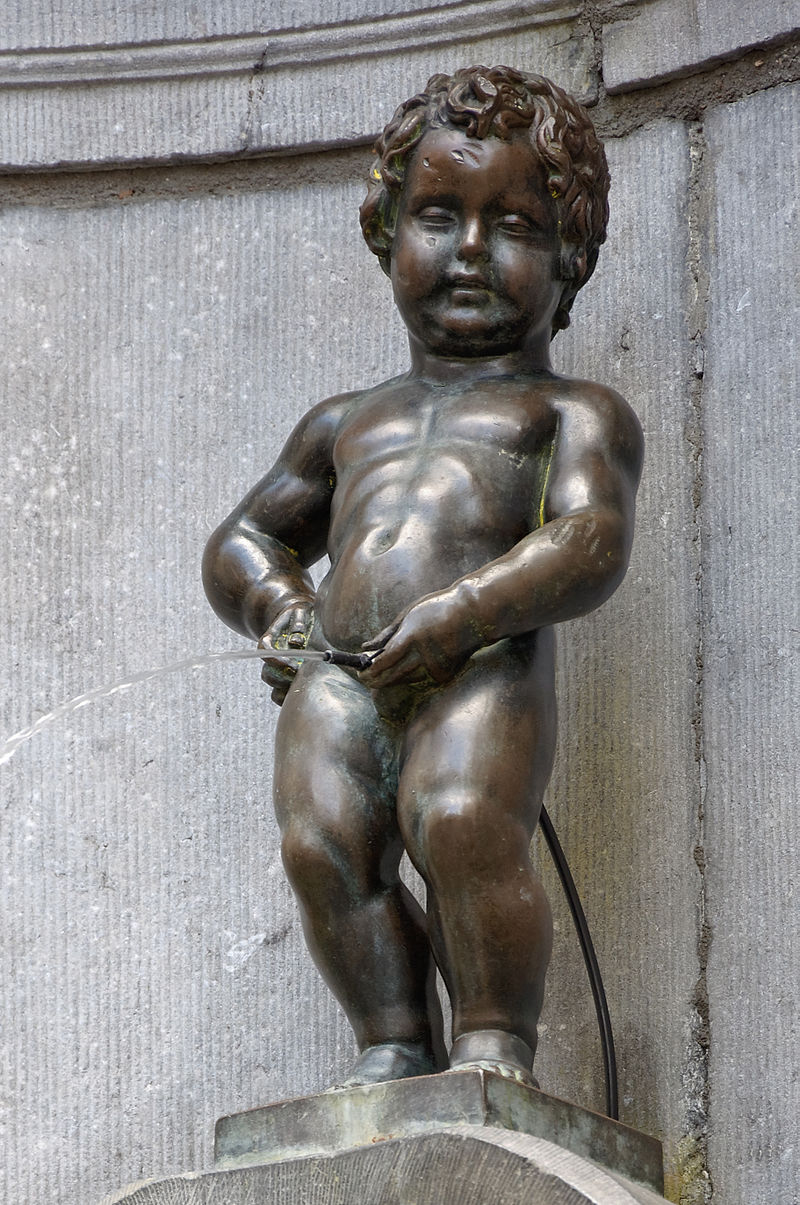
File:Bruxelles_Manneken_Pis_cropped.jpg · Wikimedia Commons · See Wikimedia Commons
Manneken Pis
Sign in to saveAlso known as Little Man Piss, Manneken Pis of Brussels, Little Pissing Man, Little Peeing Man, Ketje of Brussels, Little Julian, Little Man Pee
bronze sculpture and fountain by Jérôme Duquesnoy the Elder in Brussels, Belgium
Manneken Pis is a small bronze sculpture and fountain created by Jérôme Duquesnoy the Elder in Brussels, Belgium, depicting a young boy in a playful pose. It has become one of Brussels' most iconic landmarks and a symbol of the city's irreverent character.
AI-generated from the Wikipedia summary — may contain errors.
Wikidata facts
- Instance of
- heritage site
- Country
- Belgium
- Located in
- Brussels
- Elevation
- 31
- Movement
- Baroque
- Material used
- bronze
- Collection
- Brussels
- Location
- Pentagon
- Mass
- 17
- Image
- Bruxelles Manneken Pis.jpg
- Height
- 61
Show 9 more facts
- nickname
- Petit Julien
- Commons category
- Manneken Pis (Brussels)
- inception
- 1619-01-01
- Commons gallery
- Manneken Pis van Brussel
- pendant of
- Jeanneke Pis
- on focus list of Wikimedia project
- Wikipedia:Vital articles/Level/4
- title
- Manneken Pis
- inventory number
- F005
- P12749
- Anthericum liliago
Sources (9)
via Wikidata · CC0
~26 min read
Encyclopedic overview
Manneken Pis ( pronounced [ˌmɑnəkə(m) ˈpɪs] ; Dutch for 'Little Pissing Man') is a landmark 55.5 cm (21.9 in) bronze fountain sculpture in central Brussels, Belgium, depicting a puer mingens: a nude boy urinating into the fountain's basin. Though its existence is attested as early as the mid-15th century, Manneken Pis was redesigned by the Brabantine sculptor Jérôme Duquesnoy the Elder [fr; nl] and put in place in 1619. Its blue stone niche in rocaille style dates from 1770. The statue has been repeatedly stolen or damaged throughout its history. Since 1965, a replica has been displayed on site, with the original stored in the Brussels City Museum.
Manneken Pis is one of the best-known symbols of Brussels and Belgium, inspiring several legends, as well as numerous imitations and similar statues, both nationally and abroad. The figure is regularly dressed up and its wardrobe consists of around one thousand different costumes. Since 2017, they have been exhibited in a dedicated museum called GardeRobe MannekenPis, located on the same street. Owing to its self-derisive nature, Manneken Pis is also an example of belgitude (French; lit. 'Belgianness'), as well as of folk humour (zwanze) popular in Brussels.
Excerpted from Wikipedia’s “Manneken Pis” article, available under the CC BY-SA 4.0 licence.
Gallery (12)
On the map
Available in 63 languages
- Español
- Français
- Deutsch
- 中文
- 日本語
- Русский
- Português
- Italiano
- العربية
- Afrikaans
- Armenian
- Asturian
- Azerbaijani
- Bahasa Indonesia
- Basque
- Bikol
- Bosnian
- Breton
Show 44 more
- Bulgarian
- Catalan
- Cebuano
- Colognian
- Croatian
- Czech
- Danish
- Egyptian Arabic
- Esperanto
- Estonian
- Finnish
- fiu_vro
- Galician
- Greek
- Hebrew
- Hungarian
- Ido
- Kazakh
- Komi
- Latin
- Latvian
- Lingala
- Luxembourgish
- Macedonian
- Nederlands
- Norwegian
- Norwegian Nynorsk
- Polski
- Romanian
- Scots
- Serbian
- simple
- Slovenian
- Svenska
- Tamil
- Tiếng Việt
- Türkçe
- Ukrainian
- Waray
- Wu Chinese
- zh_yue
- فارسی
- ไทย
- 한국어
via Wikidata sitelinks · CC0