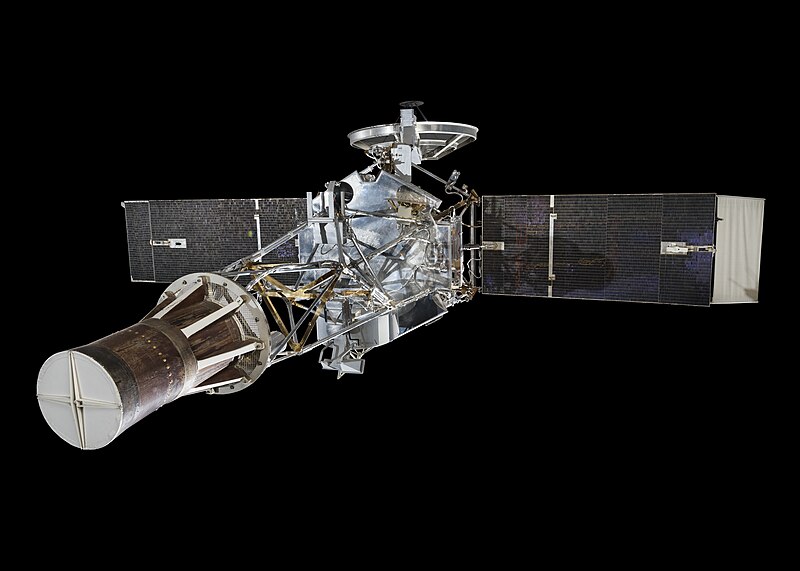
File:Mariner_2_Engineering_Model.jpg · Wikimedia Commons · See Wikimedia Commons
Mariner 1
Sign in to saveFirst US attempt to fly by Venus
Key facts
- Mission type
- Venus flyby
- Operator
- NASA / JPL
- Mission duration
- 4 minutes and 54 seconds, Failed to orbit
- Spacecraft type
- Ranger Block I
- Manufacturer
- Jet Propulsion Laboratory
- Launch mass
- 202.8 kilograms (447 lb)
- Launch date
- July 22, 1962, 09:21:23 ( 1962-07-22UTC09:21:23Z ) GMT
- Rocket
- Atlas LV-3 Agena-B
- Launch site
- Cape Canaveral , LC-12
- Disposal
- Launch failure
- Destroyed
- July 22, 1962, 09:26:17.5 ( 1962-07-22UTC09:26:18Z ) GMT
via Wikipedia infobox
Wikidata facts
- Instance of
- space probe
- Part of
- Mariner program
- Operator
- Jet Propulsion Laboratory
- Followed by
- Mariner 2
- Duration
- 293
- Mass
- 202.8
- Manufacturer
- Jet Propulsion Laboratory
- Image
- Mariner 2 Engineering Model.jpg
- Significant event
- destruction
Show 5 more facts
- Commons category
- Mariner 1
- UTC date of spacecraft launch
- 1962-07-22
- Commons gallery
- Mariner 1
- start point
- Cape Canaveral Launch Complex 12
- cause of destruction
- software bug
Sources (1)
via Wikidata · CC0
~19 min read
Encyclopedic overview
Mariner 1 was the first spacecraft of NASA's interplanetary Mariner program, built to conduct the first American planetary flyby of Venus. Developed by Jet Propulsion Laboratory and originally planned to be a purpose-built probe launched summer 1962, Mariner 1's design was changed when the Centaur proved unavailable at that early date. Mariner 1 and its sibling spacecraft Mariner 2 were then adapted from the lighter Ranger lunar spacecraft. Mariner 1 carried a suite of experiments to determine the temperature of Venus as well to measure magnetic fields and charged particles near the planet and in interplanetary space.
Mariner 1 was launched by an Atlas-Agena rocket from Cape Canaveral's Pad 12 on July 22, 1962. Shortly after liftoff, errors in communication between the rocket and its ground-based guidance systems caused the rocket to veer off course, and it had to be destroyed by range safety. The errors were traced to a mistake in a specification of the hand-written guidance equations which were then subsequently codified in the computer program.
Excerpted from Wikipedia’s “Mariner 1” article, available under the CC BY-SA 4.0 licence.