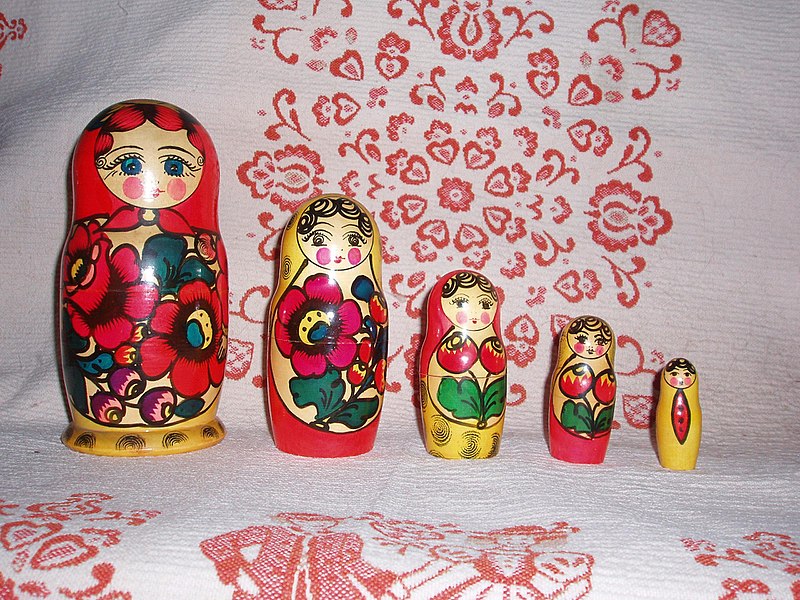
File:Russian-Matroshka.jpg · Wikimedia Commons · See Wikimedia Commons
matryoshka doll
Sign in to saveAlso known as Russian nesting doll, Russian doll, stacking doll, Babushka doll, Russian tea doll, nesting doll
Japanese-created Russian cultural icon: set of wooden dolls of decreasing size placed one inside another
A matryoshka doll is a set of wooden dolls of decreasing size that nest inside one another, originally created in Japan but became an iconic symbol of Russian culture. These dolls are valued as decorative objects and souvenirs that represent the artistic tradition of combining multiple pieces into a single unified whole.
AI-generated from the Wikipedia summary — may contain errors.
Wikidata facts
Show 7 more facts
- Commons category
- Nesting dolls
- Commons gallery
- Matryoshka
- manifestation of
- hierarchy
- Unicode character
- 🪆
- different from
- Matroska
- native label
- матрёшка
- discoverer or inventor
- Vasily Zvyozdochkin
via Wikidata · CC0
~11 min read
Encyclopedic overview
A matryoshka doll or matryoshka (/ˌmætriˈɒʃkə/; Russian: матрёшка), also known as a Russian stacking doll, nesting doll, or simply a Russian doll, is a set of wooden dolls of decreasing size placed one inside another. Matryoshka is a diminutive form of Matryosha (Матрёша), in turn an affectionate form of the Russian female first name Matryona (Матрёна).
A set of matryoshkas consists of a wooden figure, which separates at the middle, top from bottom, to reveal a smaller figure of the same sort inside, which has, in turn, another figure inside of it, and so on.
Excerpted from Wikipedia’s “matryoshka doll” article, available under the CC BY-SA 4.0 licence.
Gallery (9)
Available in 62 languages
- Español
- Français
- Deutsch
- 中文
- 日本語
- Русский
- Português
- Italiano
- العربية
- Afrikaans
- Albanian
- Armenian
- Asturian
- Azerbaijani
- Bahasa Indonesia
- Basque
- Belarusian
- Bulgarian
Show 43 more
- Catalan
- Croatian
- Czech
- Danish
- Esperanto
- Estonian
- Filipino
- Finnish
- Georgian
- Greek
- Hebrew
- Hungarian
- Ido
- kge
- Latvian
- Macedonian
- Malay
- Malayalam
- Minangkabau
- Nederlands
- Northern Frisian
- Norwegian
- Norwegian Nynorsk
- Occitan
- Polski
- Romanian
- Serbian
- Sicilian
- Silesian
- simple
- Slovak
- Slovenian
- Svenska
- Tamil
- Tiếng Việt
- Türkçe
- Ukrainian
- Welsh
- Wu Chinese
- zh_yue
- فارسی
- ไทย
- 한국어
via Wikidata sitelinks · CC0