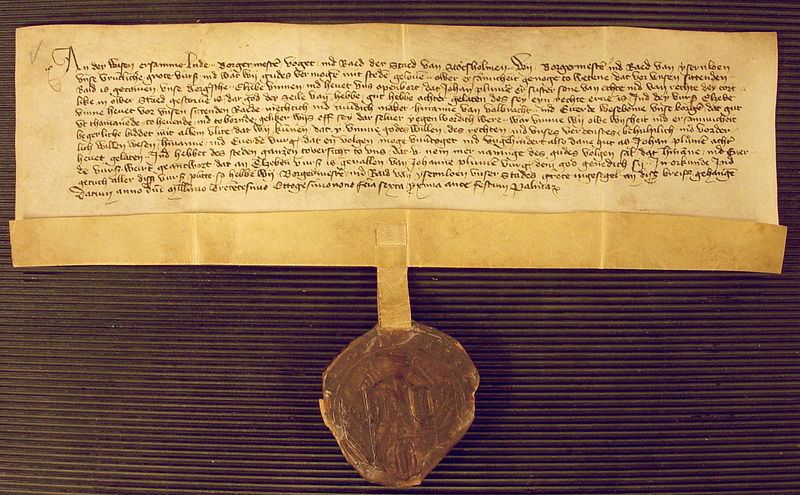
File:1389-09-04,_brev_Iserlohn.jpg · Wikimedia Commons · See Wikimedia Commons
mayor
Sign in to saveIn many countries, a mayor is the highest-ranking official in a municipal government such as that of a city or a town. Worldwide, there is a wide variance in local laws and customs regarding the powers and responsibilities of a mayor as well as the means by which a mayor is elected or otherwise mandated. Depending on the system chosen, a mayor may be the chief executive officer of the municipal government, may simply chair a multi-member governing body with little or no independent power, or may play a solely ceremonial role. A mayor's duties and responsibilities may be to appoint and oversee
A mayor is the highest-ranking official in a city or town's local government, though their exact powers vary significantly depending on the country and local laws. Depending on the system, a mayor might serve as the chief executive officer running the municipal government, chair a governing body with limited independent power, or hold primarily a ceremonial role.
AI-generated from the Wikipedia summary — may contain errors.
In the Vinony graph
Vinony's link graph records 33,882 inbound references to mayor, and connects out to municipality, mayor–council government and council–manager government.
It sits within the topics Government occupations, Heads of local government and Local government in the United States.
Vinony links it to 134 Wikipedia language editions.
Wikidata facts
Show 8 more facts
- male form of label
- meras
- topic's main category
- Category:Heads of local government
- Commons category
- Mayors
- equivalent class
- dbpedia.org/ontology/Mayor
- applies to jurisdiction
- municipality
- female form of label
- alcaldesa
- P8168
- Thanh Hóa
- on focus list of Wikimedia project
- Wikipedia:Vital articles/Level/4
Sources (2)
via Wikidata · CC0
~48 min read
Encyclopedic overview
54 sectionsContents
- History
- United Kingdom
- Directly elected mayors
- Continental Europe
- Scandinavia
- Spain
- Mayors by country
- Armenia
- Australia
- Bangladesh
- Brazil
- Canada
- Reeve
- Dominican Republic
- France
- Germany
- Greece
- India
- Indonesia
- Ireland
- Iran
- Italy
- Japan
- Kazakhstan
- Malaysia
- Malta
- Moldova
- Nepal
- Netherlands
- New Zealand
- Pakistan
- Philippines
- Poland
- Portugal
- Romania
- Russia
- Serbia
- Spain and Hispanic America
- Sweden
- Switzerland
- Taiwan
- Turkey
- Ukraine
- United States
- Uruguay
- Multi-tier local government
- Acting mayor
- See also
- Concepts
- Local government
- Historical
- Citations
- References
- External links
In many countries, a mayor is the highest-ranking official in a municipal government such as that of a city or a town. Worldwide, there is a wide variance in local laws and customs regarding the powers and responsibilities of a mayor as well as the means by which a mayor is elected or otherwise mandated. Depending on the system chosen, a mayor may be the chief executive officer of the municipal government, may simply chair a multi-member governing body with little or no independent power, or may play a solely ceremonial role. A mayor's duties and responsibilities may be to appoint and oversee municipal managers and employees, provide basic governmental services to constituents, and execute the laws and ordinances passed by a municipal governing body (or mandated by a state, territorial or national governing body). Options for selection of a mayor include direct election by the public, or selection by an elected governing council or board.
The term mayor shares a linguistic origin with the military rank of major, both ultimately derived from French , which in turn derives from Latin , the comparative form of the adjective .
Excerpted from Wikipedia’s “mayor” article, available under the CC BY-SA 4.0 licence.
Gallery (6)
Available in 134 languages
- Español
- Français
- Deutsch
- 中文
- 日本語
- Русский
- Português
- Italiano
- العربية
- हिन्दी
- Afrikaans
- Albanian
- Albanian
- Amharic
- Aragonese
- Armenian
- Asturian
- Avaric
Show 115 more
- azb
- Azerbaijani
- Bahasa Indonesia
- Bangla
- Bashkir
- Basque
- bat_smg
- Bavarian
- be_x_old
- Belarusian
- Bikol
- Bosnian
- Breton
- Bulgarian
- Burmese
- Catalan
- Cebuano
- Central Kurdish
- Croatian
- Czech
- Danish
- Esperanto
- Estonian
- Extremaduran
- Faroese
- Filipino
- Finnish
- Galician
- Georgian
- Greek
- Hakka Chinese
- Hebrew
- Icelandic
- Ido
- Iloko
- Interlingua
- Interlingue
- Javanese
- Kashubian
- Kazakh
- Kyrgyz
- Latin
- Latvian
- Ligurian
- Limburgish
- Lithuanian
- Lombard
- Low German
- Luxembourgish
- Macedonian
- Maithili
- Malagasy
- Malay
- Malayalam
- Manx
- Marathi
- Mari
- Mazanderani
- Minangkabau
- Mingrelian
- nds_nl
- Nederlands
- Nepali
- Northern Frisian
- Northern Sami
- Norwegian
- Occitan
- Palatine German
- Pangasinan
- Polski
- Punjabi
- Quechua
- Romanian
- Rusyn
- Scots
- Scottish Gaelic
- Serbian
- Serbian (Latin)
- Shan
- Sicilian
- Silesian
- simple
- Sindhi
- Sinhala
- Slovak
- Slovenian
- Somali
- Sundanese
- Svenska
- Swahili
- Tajik
- Tamil
- Tatar
- Telugu
- Tiếng Việt
- Türkçe
- Tuvinian
- Ukrainian
- Urdu
- Uzbek
- Venetian
- Walloon
- Waray
- Wayuu
- Welsh
- West Flemish
- Western Frisian
- Western Panjabi
- Wu Chinese
- Yiddish
- Yoruba
- zh_yue
- فارسی
- ไทย
- 한국어
via Wikidata sitelinks · CC0