File:Map_Byzantine_Empire_1025-en.svg · Wikimedia Commons · See Wikimedia Commons
medieval Greek
Sign in to saveAlso known as Byzantine, Byzantine Greek, Middle Greek, Medieval Greek language, gkm
medieval stage of the Greek language
Key facts
- Region
- Eastern Mediterranean ( Byzantine Empire ) : Southern Balkans , Asia Minor , Byzantine Crimea , Cyprus , Southern Italy
- Ethnicity
- Byzantine Greeks
- Era
- c. 600–1500 AD
- Language family
- Indo-European Hellenic Greek Attic – Ionic Attic Koine Medieval Greek
- Writing system
- Greek alphabet
- Official language in
- Byzantine Empire
- Iso 639 1
- el
- Iso 639 2
- grc
- Iso 639 3
- grc (i.e. with Ancient Greek )
- Linguist list
- qgk
- Glottolog
- medi1251
via Wikipedia infobox
Wikidata facts
- Instance of
- chronolect
- Subclass of
- Greek
- Country
- Byzantine Empire
- Followed by
- Modern Greek
- Follows
- Koine Greek
Show 3 more facts
- topic's main category
- Category:Byzantine Greek
- writing system
- Greek alphabet
- replaces
- Ancient Greek
via Wikidata · CC0
~40 min read
Encyclopedic overview
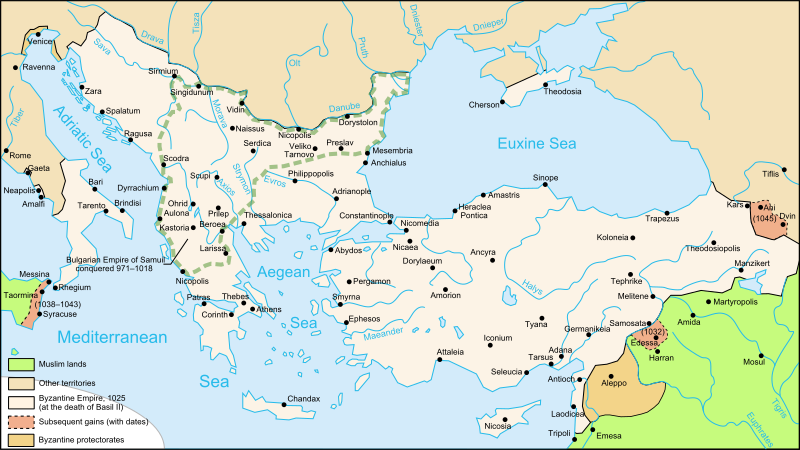
The Byzantine Empire at the death of Basil II in 1025
Medieval Greek (also known as Middle Greek, Byzantine Greek, or Romaic; Greek: Ῥωμαϊκή) is the stage of the Greek language between the end of classical antiquity in the 5th–6th centuries and the end of the Middle Ages, conventionally dated to the Ottoman conquest of Constantinople in 1453.
Excerpted from Wikipedia’s “medieval Greek” article, available under the CC BY-SA 4.0 licence.