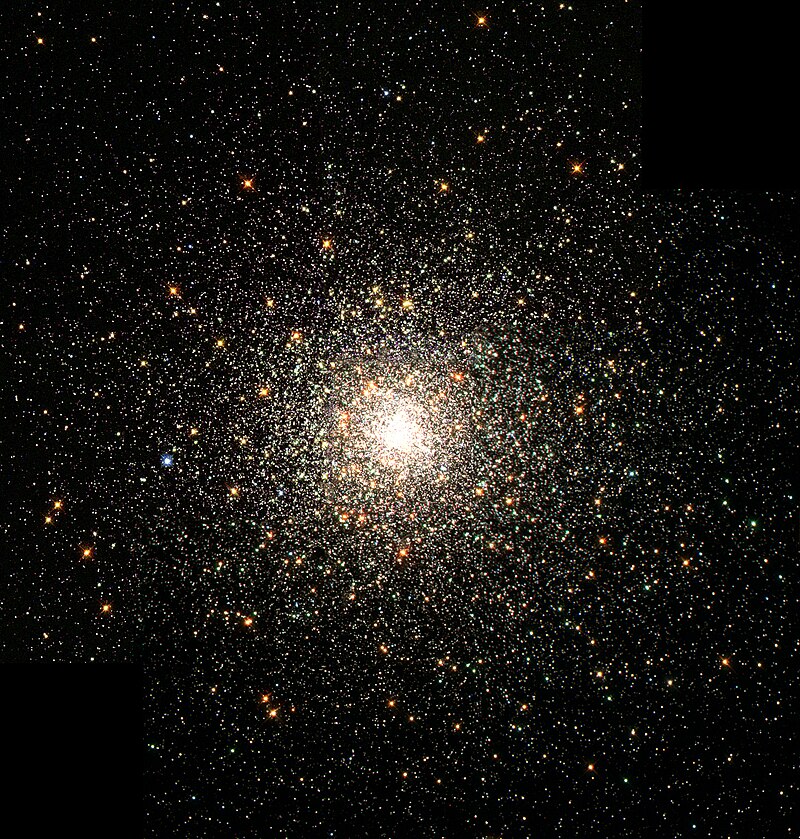
File:A_Swarm_of_Ancient_Stars_-_GPN-2000-000930.jpg · Wikimedia Commons · See Wikimedia Commons
Messier 80 is a globular cluster—a dense, roughly spherical collection of hundreds of thousands of old stars held together by gravity—located about 32,600 light-years from Earth in the constellation Scorpius. It's a notable object for astronomers studying stellar populations and galactic structure, and it remains visible through telescopes to amateur stargazers interested in exploring deep-sky objects.
AI-generated from the Wikipedia summary — may contain errors.
Key facts
- Class
- II
- Constellation
- Scorpius
- Right ascension
- 16 17 02.41
- Declination
- –22 ° 58 ′ 33.9 ″
- Distance
- 32.6 kly (10.0 kpc )
- Apparent dimensions v
- 10.0 ′
- Mass
- 5.02 × 10 M ☉
- Radius
- 48 ly
- Metallicity
- [ Fe/H ] = –1.47 dex
- Estimated age
- 13.5 ± 1.0 Gyr
- Other designations
- M80, NGC 6093, GCl 39
via Wikipedia infobox
Wikidata facts
- Part of
- Milky Way
- Constellation
- Scorpius
- Distance from Earth
- 0.010
- Radius
- 48
- Image
- A Swarm of Ancient Stars - GPN-2000-000930.jpg
Show 15 more facts
- absolute magnitude
- -7.92
- radial velocity
- 9.3
- catalog code
- 2FGL J1616.8-2302
- time of discovery or invention
- 1781-01-04
- Commons category
- Messier 80
- discoverer or inventor
- Charles Messier
- right ascension
- 244.260042
- Commons gallery
- Messier 80
- apparent magnitude
- 6.939
- spectral class
- II
- metallicity
- -1.62
- declination
- -22.976083
- epoch
- J2000.0
- right ascension component of proper motion
- -4.11
- declination component of proper motion
- -4.04
Sources (2)
via Wikidata · CC0
~2 min read
Encyclopedic overview
Messier 80 (also known as M80 or NGC 6093) is a globular cluster located approximately 32,600 light-years (10,000 pc) from Earth in the constellation Scorpius. Discovered by Charles Messier in 1781, it is one of the densest globular clusters in the Milky Way, containing several hundred thousand stars within a spatial diameter of about 95 light-years.
The cluster is situated in the Galactic halo, more than twice as distant as the Galactic Center, and lies midway between the stars α Scorpii (Antares) and β Scorpii in a region rich with nebulæ. With an apparent angular diameter of 10 arcminutes, it can be observed from locations below the 67th parallel north using modest amateur telescopes, where it appears as a mottled ball of light under low light pollution conditions.
Excerpted from Wikipedia’s “Messier 80” article, available under the CC BY-SA 4.0 licence.