File:Iron_electrolytic_and_1cm3_cube.jpg · Wikimedia Commons · See Wikimedia Commons
metal
Sign in to saveAlso known as metals, jin, kin, kine
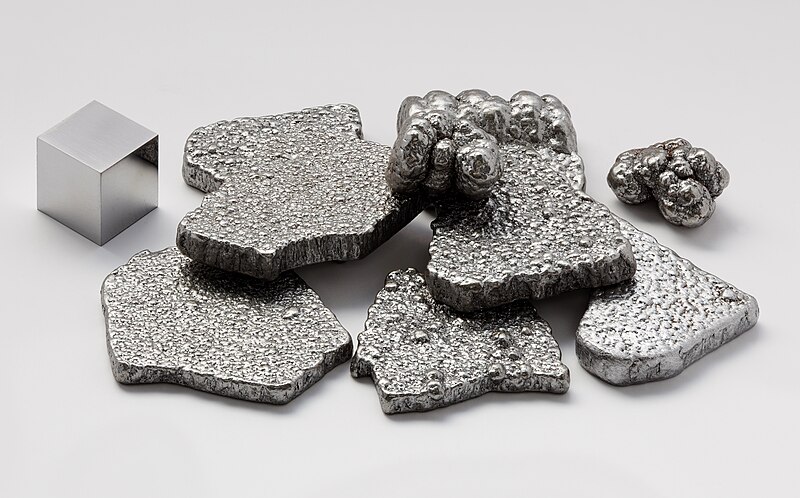
thumb|right|alt=refer to caption|Iron, shown here as fragments and a 1 cm3 cube, is an example of a [[chemical element that is a metal.]] thumb|right|alt=A metal gravy boat|Metal in the form of a gravy boat made from [[stainless steel, an alloy largely composed of iron, chromium and nickel]]
Metals are chemical elements like iron that typically conduct electricity and heat well, can be shaped into useful forms, and often have a shiny appearance. They matter because they can be used alone or combined into alloys to make everyday objects, from tools and cookware to industrial equipment.
AI-generated from the Wikipedia summary — may contain errors.
Wikidata facts
- Has part
- transition metal
- Image
- Métal Hurlant (84368201).jpeg
Show 8 more facts
- Commons category
- Metals
- topic's main category
- Category:Metals
- MCN code
- 7109.00.00
- on focus list of Wikimedia project
- Wikipedia:Vital articles/Level/4
- different from
- metallicity
- hashtag
- metal
- Stack Exchange tag
- mechanics.stackexchange.com/tags/metal
- associated hazard
- metal poisoning
Sources (8)
via Wikidata · CC0
~59 min read
Encyclopedic overview
46 sectionsContents
- Properties
- Form and structure
- Electrical and thermal
- Chemical
- Periodic table distribution of elemental metals
- Alloys
- Categories
- Ferrous and non-ferrous metals
- Brittle elemental metal
- Refractory metal
- White metal
- Heavy and light metals
- Base, noble, and precious metals
- Valve metals
- Metallic ceramics
- Metallic polymers
- Half metal
- Semimetal
- Lifecycle
- Formation
- Abundance and occurrence
- Extraction
- Recycling
- History
- Prehistory
- Antiquity
- Ancient Greece
- Middle Ages
- The Renaissance
- Light metallic elements
- The age of steel
- The last stable metallic elements
- Post-World War II developments
- Superalloys
- Transcurium metals
- Bulk metallic glasses
- Shape-memory alloys
- Quasicrystalline alloys
- Complex metallic alloys
- High-entropy alloys
- MAX phase
- See also
- Note
- References
- Further reading
- External links
thumb|right|alt=refer to caption|Iron, shown here as fragments and a 1 cm3 cube, is an example of a [[chemical element that is a metal.]] thumb|right|alt=A metal gravy boat|Metal in the form of a gravy boat made from [[stainless steel, an alloy largely composed of iron, chromium and nickel]]
A metal () is a material that, when polished or fractured, shows a lustrous appearance, and conducts electricity and heat relatively well. These properties are all associated with having electrons available at the Fermi level, as opposed to nonmetallic materials which do not. Metals are typically ductile (can be drawn into a wire) and malleable (can be shaped via hammering or pressing).
Excerpted from Wikipedia’s “metal” article, available under the CC BY-SA 4.0 licence.
Gallery (52)
Available in 170 languages
- Español
- Français
- Deutsch
- 中文
- 日本語
- Русский
- Português
- Italiano
- العربية
- हिन्दी
- abstract
- Afrikaans
- Albanian
- Albanian
- Aragonese
- Armenian
- Assamese
- Asturian
Show 151 more
- azb
- Azerbaijani
- Bahasa Indonesia
- Bangla
- Bashkir
- Basque
- bat_smg
- Bavarian
- be_x_old
- Belarusian
- Bikol
- blk
- Bosnian
- Breton
- Bulgarian
- Burmese
- Catalan
- cdo
- Cebuano
- Central Kurdish
- Cherokee
- Chuvash
- Croatian
- Czech
- Danish
- Egyptian Arabic
- eml
- Erzya
- Esperanto
- Estonian
- Extremaduran
- Faroese
- Fiji Hindi
- Fijian
- Filipino
- Finnish
- fiu_vro
- Galician
- Gan Chinese
- gcr
- Georgian
- Gilaki
- Greek
- Guarani
- Gujarati
- Haitian Creole
- Hakka Chinese
- Hausa
- Hebrew
- Hungarian
- hyw
- Icelandic
- Ido
- Iloko
- Ingush
- Interlingua
- Interlingue
- Irish
- Jamaican Creole English
- Javanese
- Kabyle
- Kannada
- Kashmiri
- Kazakh
- kbp
- Komi
- Kurdish
- Kyrgyz
- Latin
- Latvian
- Ligurian
- Limburgish
- Lingua Franca Nova
- Lithuanian
- Lojban
- Lombard
- Low German
- Luxembourgish
- Macedonian
- Malagasy
- Malay
- Malayalam
- Marathi
- Minangkabau
- Mongolian
- Moroccan Arabic
- nds_nl
- Nederlands
- Nepali
- Newari
- Northern Frisian
- Norwegian
- Norwegian Nynorsk
- nrm
- Obolo
- Occitan
- Odia
- Oromo
- Ossetic
- Papiamento
- Pashto
- Piedmontese
- Polski
- Punjabi
- Quechua
- roa_rup
- Romanian
- Rusyn
- Saterland Frisian
- Scots
- Scottish Gaelic
- Serbian
- Serbian (Latin)
- Shona
- Sicilian
- simple
- Sindhi
- Sinhala
- Slovak
- Slovenian
- Somali
- Sundanese
- Svenska
- Swahili
- Tamil
- Telugu
- Tiếng Việt
- Toki Pona
- Türkçe
- Tuvinian
- Ukrainian
- Urdu
- Uyghur
- Uzbek
- Venetian
- Veps
- Waray
- Welsh
- Western Panjabi
- Wu Chinese
- Xhosa
- Yakut
- Yiddish
- Yoruba
- zh_classical
- zh_min_nan
- zh_yue
- Zulu
- فارسی
- ไทย
- 한국어
via Wikidata sitelinks · CC0