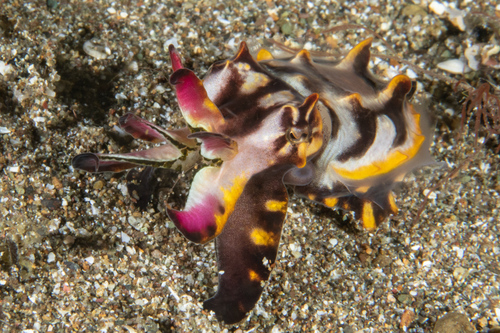
(c) Mark Rosenstein, some rights reserved (CC BY-NC), uploaded by Mark Rosenstein · cc-by-nc
Metasepia
Sign in to saveAscarosepion is a genus of cuttlefish inhabiting the coastal regions of the Indian Ocean and East Pacific (comprising part of the Indo-Pacific region). The genus varies wildly in size, from the two species of small, colorful cuttlefish formerly classified in the genus Metasepia, to the largest species of extant cuttlefish, the giant cuttlefish.
Species
Flamboyant Cuttlefish
GENUS
- KingdomAnimalia
- PhylumMollusca
- ClassCephalopoda
- OrderSepiida
- FamilySepiidae
花墨魚的下屬一個分類,火焰花枝(Metasepia pfefferi) 花墨魚屬(Metasepia)是烏賊科下的一個小屬。其下的生物分佈于太平洋海域,且個體都很小。是烏賊科即為墨魚科、也屬於烏賊。
via GBIF
Museum specimens
- Specimen records
- 5
- Family
- Sepiidae
- Collections
- NMV, WAM, MAGNT
- Recorded in
- Australia, Chinese Taipei
Wikidata facts
Show 4 more facts
- Commons category
- Ascarosepion
- taxon rank
- genus
- taxon name
- Metasepia
- topic's main category
- Category:Metasepia
Sources (1)
via Wikidata · CC0
~3 min read
Encyclopedic overview
4 sectionsContents
- Taxonomy
- Species
- References
- External links
Ascarosepion is a genus of cuttlefish inhabiting the coastal regions of the Indian Ocean and East Pacific (comprising part of the Indo-Pacific region). The genus varies wildly in size, from the two species of small, colorful cuttlefish formerly classified in the genus Metasepia, to the largest species of extant cuttlefish, the giant cuttlefish.
==Taxonomy== Ascarosepion was described in 1884 by French malacologist Alphonse Trémeau de Rochebrune in 1884. He diagnosed it as possessing an "ovoid body, with narrow fins. Arms very short but robust which end abruptly in pointed tips. Suckers of varied size set on 3-4 rows. Buccal membrane narrow and wrinkled. The thin, elliptical cuttlebone resembles to a sandal in shape, with a rugose and convex dorsal surface and very flat bottom; two enormous calcareous "wings", acuminated at the front and very wide at the rear." (transl.) The name is derived from a combination of the Greek words askaros (ἄσκαρος, translated by Rochebrune as slipper ()) and sepion; the type species, A. verreauxi, was collected off Sydney, and the holotype stored in "Mus. Paris", presumably the Natural History Museum. Subsequent authors treated Ascarosepion as a synonym of Sepia for over a century.
Excerpted from Wikipedia’s “Metasepia” article, available under the CC BY-SA 4.0 licence.
Gallery (2)
On the map
2 mapped locations