
Mexique
Sign in to saveAlso known as Mexican United States, Mexican Republic, US of M, United States of Mexico, mx, United Mexican States, MXN
pays d'Amérique du Nord
OverviewAI-generated
Mexico, officially the United Mexican States, is a country in North America. It is part of Latin America and the MIKTA group. The nation operates as a federal, democratic, and constitutional republic, with an empire as a basic form of government in its history. The head of state holds the office of President of Mexico. Its capital is Mexico City, and its official currency is the peso. The country uses the license plate code MEX and the telephone country code +52.
The population is approximately 130 million, with 79.75% living in urban areas. The total fertility rate is 2.8, and the age of majority is 18. Life expectancy is 75.264 years. The economy has a GDP of 1,856,365,616,165.94 USD. Internet usage reaches 83.12% of the population. The forest area covers 33.59% of the land, and renewable energy accounts for 13% of the mix. The unemployment rate is reported as 5% in one dataset and 2.673% in another.
Geographically, Mexico spans an area of 1,964,375 square kilometers. Its highest point is Citlaltepetl, and its lowest point is Laguna Salada. The country observes time zones UTC-08:00, UTC-07:00, and UTC-06:00. Languages used include Spanish, Sayula Popoluca, Coatzospan Mixtec, and Afro-Seminole Creole. The top-level domain is .mx.
Synthesized by Vinony from 67 facts across 9 sources: Wikidata, Open Meteo, Openweathermap, REST Countries, World Bank, OpenStreetMap, PubMed, Vinony graph, Geo. Generated from structured data (not the Wikipedia text) and checked against those facts — may still contain errors.
Weather now
7-day forecast
via Open-Meteo
Country

- Capital
- Mexico City
- Population
- 130,575,786
- Region
- Americas · North America
- Demonym
- Mexican
- Currencies
- MXN ($)
- Languages
- Spanish
- Calling code
- +52
- Drives on
- Right
- Gini
- 45.4 (2018)
- FIFA code
- MEX
- TLD
- .mx
- Timezones
- UTC-08:00 · +2 more
- Borders
- BLZ, GTM, USA
via REST Countries
Indicators · World Bank
- GDP
- $1.9T(2024)
- Population
- 130,861,007(2024)
- Life expectancy
- 75.3 yrs(2024)
- Unemployment
- 2.7 %(2025)
- Urban population
- 79.8 %(2024)
- Internet users
- 83.1 %(2024)
- Forest area
- 33.6 %(2023)
- Renewable energy
- 13 %(2021)
via World Bank Open Data · CC BY 4.0
Wikipedia views (30d)
322,123 totalvia Wikimedia Pageviews API
Key facts
- Country.area_sq_mi
- 761,606
- Country.conventional_long_name
- United Mexican States
- Country.common_name
- Mexico
- Country.image_flag
- Flag of Mexico.svg
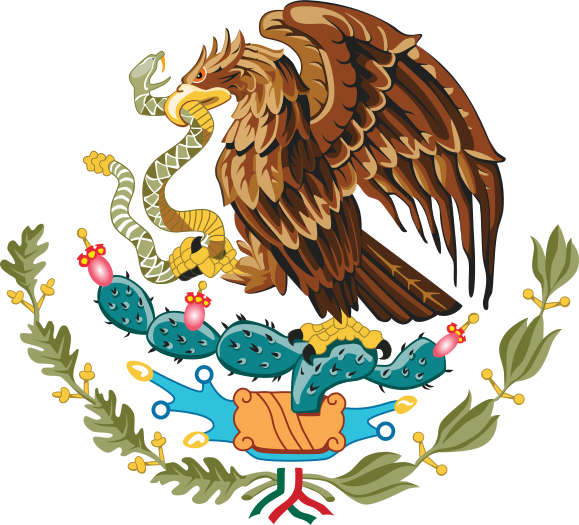
- Country.image_coat
- Coat of arms of Mexico.svg
- Country.symbol_type
- Coat of arms
- Country.national_anthem
- ()File:Himno Nacional Mexicano instrumental.ogg
- Country.capital
- Mexico City
- Country.largest_city
- Mexico City
- Country.languages_type
- Official language
- Country.languages
- Spanish
- Country.languages2_type
- Co-official languages
- Country.languages2
- 68 Indigenous languages
- Country.ethnic_groups
- See below
- Country.religion_year
- 2020
- Country.demonym
- Mexican
- Country.government_type
- Federal presidential republic
- Country.leader_title1
- President
via Wikipedia infobox
Research
289,654 papers- Don't bury Mexico's biodiversity capacity.Science (New York, N.Y.) · 2024Medellin RA, Soberón JDOI: 10.1126/science.adp5399
- Mexico's complex respiratory public health picture.ReviewThe Lancet. Respiratory medicine · 2015Furlow BDOI: 10.1016/S2213-2600(14)70299-1
- Mexico's controversial coronavirus czar.Science (New York, N.Y.) · 2020Ortega RPDOI: 10.1126/science.370.6522.1261
- Unveiling Mexico's Demographic Transitions.Studies in family planning · 2025Arana-Ovalle R, Dillon L, Murua A et al.DOI: 10.1111/sifp.70032
- Mexico.Population today · 1984
- Thousands protest Mexico's new science law.Nature · 2023Vidal Valero MDOI: 10.1038/d41586-023-01665-y
- Mexico's Prospera Program and Indigenous Women's Reproductive Rights.Qualitative health research · 2020Abarbanell LDOI: 10.1177/1049732319882674
- Tilapia Diseases Reported in Mexico: A Systematic Review.Journal of fish diseases · 2025Fimbres-Acedo YE, Maeda-Martínez AN, Garza-Torres RDOI: 10.1111/jfd.14105
via PubMed
Wikidata facts
- Instance of
- nation
- Part of
- MIKTA
- Official name
- メキシコ合衆国
- Demonym
- Meicsiceach
- Religion
- Pentecostalism
- Participant in
- World War II
- Country
- Mexico
- Contains
- Zacatecas
- Continent
- North America
- Capital
- Mexico City
- Official language
- Yucatec Maya
- Currency
- peso
- Population
- 131135337
- Area
- 1964375
- Time zone
- Mountain Time Zone
- Body of water
- Gulf of California
- Head of government
- Claudia Sheinbaum
- Head of state
- Claudia Sheinbaum
- Form of government
- presidential system
- Legislature
- Congress of the Union
- Shares border with
- United States
- Highest point
- Citlaltepetl
- Official website
- en.presidencia.gob.mx
- Image
- Mexico regions map.png
Show 86 more facts
- Perimeter
- 4389
- Life expectancy
- 75
- Nominal GDP
- 1414187193992
- Unemployment rate
- 5
- Calling code
- +52
- Licence plate code
- MEX
- Mains voltage
- 127
- Flag
- flag of Mexico
- Coat of arms
- Mexican coat of arms
- Patron saint
- Our Lady of Guadalupe
- Significant event
- Pastry War
- IPA transcription
- ˈmɛksɪkuː
- total fertility rate
- 2.243
- Commons gallery
- México
- age of majority
- 18
- office held by head of state
- President of Mexico
- lowest point
- Laguna Salada
- on focus list of Wikimedia project
- Wikipedia:Vital articles/Level/4
- number of out-of-school children
- 4473002
- category for people who died here
- Category:Deaths in Mexico
- category for people born here
- Category:Births in Mexico
- category of associated people
- Category:Mexican people
- office held by head of government
- President of Mexico
- topic's main Wikimedia portal
- Portal:Mexico
- described by source
- Granat Encyclopedic Dictionary
- topic's main category
- Category:Mexico
- maintained by WikiProject
- WikiProject Mexico
- category for films shot at this location
- Category:Films shot in Mexico
- Commons category
- Mexico
- retirement age
- 65
- top-level Internet domain
- .mx
- history of topic
- history of Mexico
- driving side
- right
- marriageable age
- 18
- geography of topic
- Geography of Mexico
- GS1 country code
- 750
- category for people buried here
- Category:Burials in Mexico
- native label
- Mexko
- railway traffic side
- right
- Unicode character
- 🇲🇽
- maritime identification digits
- 345
- ethnic group
- Afro Mexicans
- mobile country code
- 334
- inception
- 1821-09-27
- emergency phone number
- 911
- diplomatic relation
- North Korea
- central bank
- Bank of Mexico
- foundational text
- Political Constitution of Mexico
- culture
- culture of Mexico
- VAT rate
- 16
- BTI Status Index
- 6.01
- BTI Governance Index
- 4.69
- economy of topic
- economy of Mexico
- replaces
- Restored Republic
- social media followers
- 371630
- demographics of topic
- demographics of Mexico
- hashtag
- Mi México
- Democracy Index
- 6.07
- owner of
- Palacio de Minería
- main regulatory text
- Political Constitution of Mexico
- topic has template
- Template:Mexico topics
- P8168
- Elkhorn
- Human Development Index
- 0.758
- P11012
- Jenna Jameson
- Happy Planet Index score
- 54.3
- Gini coefficient
- 45.4
- Inequality-adjusted Human Development Index
- 0.621
- suicide rate
- 5.3
- P12749
- Chicago
- birth rate
- 14.636
- male population
- 62194954
- death rate
- 6.705
- rural population
- 23843271
- female population
- 65309171
- urban population
- 103660854
- located in/on physical feature
- North American Plate
- most populous urban area
- Mexico City
- name
- المكسيك
- coastline
- 9330
- mean age
- 30.8
- has cabinet
- cabinet of Mexico
- public holiday
- Independence Day
- official symbol
- Dahlia
- Stack Exchange tag
- travel.stackexchange.com/tags/mexico
- short name
- Мексика
Sources (15)
via Wikidata · CC0
Travel guide
Understand
Mexico, the United Mexican States (Spanish: Estados Unidos Mexicanos), is one of the most visited countries in the world. Much of the tourist industry is centered around the beach resorts as well as the altiplano in the central part of the country. Visiting the northern interior allows visitors to get off the beaten path a bit. U.S. American tourists tend to predominate on the Baja California peninsula and the more modernized beach resorts (Cancún, Puerto Vallarta), while European tourists congregate around the smaller resort areas in the south like Playa del Carmen and colonial towns San Cristobal de las Casas. Canadians often favor smaller beach resorts like Huatulco or Ixtapa.
Get around
Travelling in Mexico is most practical by bus, car, or air. Passenger transport by train is possible in some areas. most extensively in the Yucatán Peninsula, with its modern Tren Maya service. The Chihuahua del Pacifico railroad is one of the most scenic railroads in the world, passing through the Copper Canyon, and departing from Los Mochis on the Pacific coast, or Creel in the east. They cross each other roughly midways at Divisadero and Barrancas Copper Canyon stations at an altitude of 2100 m (7000 ft).
See
thumbnail|Popocatépetl's 16th century monasteries are World Heritage Sites Many travelers come to see Mexico's natural wonders, including: Copper Canyon - ride the train through an enormous canyon system in the northwestern mountains Mesoamerican Barrier Reef - scuba dive the coral reefs in the warm waters of the Mexican Caribbean Sea of Cortez - see migrating whales, sea lions, dolphins and more Volcano Belt - climb Mexico's highest mountain peaks and see active, dormant, and inactive volcanoes
There are 35 UNESCO world heritage sites in Mexico as of 2018, more than anywhere else in the Americas. Most of them are in the cultural category and relate to either the pre-Columbian civilizations in the area or to early colonial cities established by the Spanish conquistadores and missionaries. Much of Mexico is mountainous with some mountains rising higher than 5,000 m over the sea level.
Mexico is on the border of two bioregions; both North American wildlife and Central and South American wildlife can be seen in the country. A number of UNESCO Biosphere Reserves are in Mexico as well as a number of RAMSAR wetlands.
The Mexican Tourism Ministry (SECTUR) has a program called Pueblos Magicos to identify and develop tourist programs in smaller, lesser known destinations. Towns designated as Pueblos Magicos usually are rich in colonial heritage, maintain cultural traditions, or offer spectacular natural wonders. These towns are the kinds of places a couple would go for a romantic …
Do
thumb|300px|Mayan Ruins of Tulum The warm Mexican climate, spectacular nature and long coastline make the country great for outdoor life, especially water sport.
Surfing – Baja California, Vallarta, Oaxaca Sea kayaking – Baja California Snorkeling – Baja California, Cancun, Cozumel, Isla Mujeres, etc. Scuba diving – Cancun, Cozumel, Isla Mujeres, Acapulco, Cabo San Lucas etc., and cave diving in the cenotes of the Yucatán Peninsula. Whale watching – Baja California, Guerrero Negro, Mazunte, Zipolite White water rafting – Veracruz Visit a volcano – Mexico, Toluca etc. Take a ride on the Copper Canyon Railway Enjoy the beautiful coast line and beaches of Oaxaca – Huatulco, Mazunte, Zipolite, Puerto Angel, Puerto Escondido, etc. Go for a horseback ride in the Copper Canyon Visit the archaeological sites like Chichen Itza, Tulum, Coba, Monte Alban, Calakmul, Palenque, etc. Volunteering – Chiapas, Xalapa, Veracruz or many other destinations Visit ecological parks – Mayan Riviera, Chiapas, Tamaulipas Trekking and viewing cave paintings Baja California
Eat
thumbnail|Taco stalls thumbnail|Gordita
Mexican cuisine can be described better as a collection of various regional cuisines rather than a standard list of dishes for the whole country. Because of climate, geography and ethnic differences, we can classify Mexican cuisine broadly in 4 great categories according to the region:
Northern – Mostly meat dishes done mainly from beef and goat. This includes Cabrito, Carne Asada (Barbecue) and Arrachera. Is influenced by international cuisine (mostly from the United States and Europe), but it retains the essential Mexican flavor. Central – This region is influenced by the rest of the country, but has its own well-developed local flavor in dishes such as Pozole, Menudo and Carnitas. Dishes are mostly corn-based and with different spices. Southeastern – Is known for its spicy vegetable and chicken-based dishes. Caribbean cuisine have influences here because of the location. Coast – Has a strong emphasis on seafood and fish, but corn-based recipes can be easily found as well.
Ask for the "platillo tipico" of the town, which is the local speciality that may not be found elsewhere, a variation, or the birthplace of a recipe. Also consider that most of the recipes change from place to place: for example, tamales in the south are made with the banana plant leaves, and in the Huasteca region tamales are very big (they are called "Zacahuil"); one is OK for a complete family.
If you are travelling here from Spain or elsewhere in Latin Ameri…
Drink
thumbnail|Tequila store in [[Tequila]] Tap water is potable, but generally not recommended for drinking. Hotels usually give guests one (large) bottle of drinking water per room per night. Bottled water is also readily available in supermarkets and at tourist attractions.
Absinthe is legal in Mexico. Tequila, distilled from Agave (a specific type of cactus) Pulque, ferment made from Maguey Mezcal, similar to tequila but distilled from Maguey Raicilla, a type of mezcal made in Jalisco Pox, whisky meets rum, distilled from grains and cane sugar, made in Chiapas Tepache, ferment made from pineapple Tuba, made from coconut palm tree thumb|A Mexican dark lager (Modelo Negra) and golden lager (Victoria) There are also several Mexican beers, most of which are available outside Mexico, these include Corona (popular, but not necessarily as overwhelmingly popular in Mexico as many foreigners think), Dos Equis (XX) and Modelo Especial.
Lighter Mexican beers are often served with lime and salt, though many Mexicans do not drink beer in this fashion. In some places you will find beer served as a prepared drink called "Michelada" or simply "Chelada". The formula varies depending on the place, but it's usually beer mixed with lime juice and various sauces and spices on ice served in a salt rim glass. Spicy beer is available in supermarkets; try it, it will be an experience. Other variation called "Cubana" includes Clamato cocktail, soybean sauce, salt and a little bit of hot sauce.
Mexic…
Sleep
thumbnail|Plaza de liberación and the cathedral, Guadalajara Several hotel chains are available throughout Mexico, including Palace Resorts, Le Blanc Spa Resort, Best Western, Holiday Inn, CityExpress, Fiesta Inn, Fairmont, Hilton, Ritz, Camino Real, Marriott (Sheraton, W, Westin, Four Points) and many others. Rates have risen considerably, though most are still reasonable compared to similar U.S. or European hotels. Chain accommodations are usually clean and comfortable, good for business travelers, but not necessarily for those wanting to experience Mexico itself. There are also many all-inclusive resorts for those visiting the major beach destinations.
Boutique hotels are found all over the country; price range varies but all of them are rich in Mexican traditions, elegance and charm, the perfect way to experience the cultural heritage of each state. A great source of information is Melba Levick's book Mexicasa, found in many libraries and online bookstores. Otherwise an authentic accommodation can usually be found by asking locals or gringos, especially in the smaller towns.
Smaller hotels and motels along the roadside may not be safe or comfortable. If you are unsure about conditions or the safety of the room, ask to see it before paying. This will not be considered rude. Decent hotels for a low budget are usually found around the central bus station of a town. If you are going to stay at cheaper hotels in cooler areas in the winter consider bringing extra clothes, an…
Stay safe
thumbnail|Mounted tourist police, Mexico City
Mexico has a reputation for being a dangerous country — a reputation that's not entirely unwarranted — but the average traveller should not be too overly concerned or cautious of their surroundings. A lot of the crime occurs between those involved in the drug trade or organised crime. (See drug traffic issues for more information)
In most cities, location is very important as security changes from place to place. Areas close to downtown (centro) are safer to walk at night, especially on the "Plaza", "Zócalo" or "Jardín" (main square) and areas nearby. Stay in populated areas, avoid poor neighborhoods, especially at night, and don't walk there at any time if you are alone. Vicious beatings have been reported at resorts by people who have travelled alone, so stay alert for any suspicious-looking individual. If you wish to visit one of the slums, you should only go as part of a guided tour with a reputable guide or tour company.
Political violence in Chiapas and Oaxaca has abated, and is far less of a threat than drug-related crime. However, Mexican authorities do not look approvingly on foreigners who participate in demonstrations (even peaceful ones) or voice support for groups such as the Ejército Zapatista de Liberación Nacional and its leader, Subcomandante Marcos, even if their images and slogans are commonly sold on t-shirts and caps in markets.
Do not wave cash or credit cards around. Use them discreetly and put them away…
Stay healthy
Some parts of Mexico are known for travelers' diarrhea, often called "Montezuma's Revenge" (Venganza de Moctezuma). The reason for this is not so much the spicy food but the contamination of the water supply in some of the poorer zones in Mexico. In most of the small towns that are less industrialized, only the poorest Mexicans will drink tap water. The best policy is to only drink bottled or purified water, both of which are readily available. Be sure to specify bottled water in restaurants and avoid ice (which is often not made from purified water). Just like in the US, in most major Mexican cities the water is purified at the cities' water company. In most restaurants in these poor zones, the only water served comes from large jugs of purified water. If you get sick, visit your local clinic as soon as possible. There is medicine available that will counter the bacteria.
Medicine in urban areas is highly developed, public hospitals are just as good as public hospitals in US, and just as the American public hospitals, they are always full. It's recommended going to private hospitals for faster service.
Before traveling to rural areas of Mexico, it might be a good idea to obtain anti-malarial medications from your health care provider.
It is strongly advised that the traveler be sure that any meats they are consuming have been thoroughly cooked due to an increasing rate of roundworm infections, particularly in the Acapulco area.
Along with the risk for malaria, mosquitoes…
Respect
thumb|Festival in [[San Miguel de Allende]] Mexicans have a somewhat relaxed sense of time so it's vital to be patient. Arriving half an hour late is common and should not be taken in a negative light.
When anyone, even a total stranger, sneezes, you always say "¡salud!" ("bless you!" or more literally, "your health!"): otherwise, it is considered rude. In rural areas, particularly in the Mexican heartland (Jalisco, Zacatecas, Aguascalientes, etc.), the even more pious "Jesús te bendiga" (May Jesus bless you) will follow a sneeze.
Attitudes towards LGBT travellers can be hostile in more rural states, but Mexico City is very LGBT friendly as are popular beach resort areas such as Cancun, Puerto Vallarta, and Acapulco. By court order, all states in Mexico either allow the performance of same-sex marriages, or recognize such marriages when performed in other states. Same-sex marriage is performed in Mexico City and in the states of Aguascalientes, Baja California, Baja California Sur, Campeche, Chiapas, Chihuahua, Coahuila, Colima, Hidalgo, Jalisco, Michoacán, Morelos, Nayarit, Nuevo León, Oaxaca, Puebla, Quintana Roo, San Luis Potosí, Sinaloa, Sonora and Tlaxcala as well as in certain municipalities in Guerrero and Zacatecas. It is pending publication in Querétaro, and being prepared for legislation in Yucatán. Southern Mexico City is the best place in terms of tolerance.
When entering churches, always take off any sunglasses, caps or hats. Wearing shorts is rarely a proble…
Travel guide from Wikivoyage (CC BY-SA 4.0)
Article · Français
Le Mexique, officiellement et en forme longue les États-Unis mexicains (en espagnol : México et Estados Unidos Mexicanos), est un pays situé dans la partie méridionale de l'Amérique du Nord. Délimité à l'est-sud-est par le Guatemala et le Belize, et au nord-nord-ouest par les États-Unis d'Amérique, il est bordé à l'est par le golfe du Mexique et la mer des Caraïbes et au sud-ouest par l'océan Pacifique. C'est le quatorzième pays en superficie, avoisinant deux millions de kilomètres carrés. Avec une population estimée en 2020 à 128 649 565 d'habitants, le Mexique se classe ainsi au dixième rang mondial des pays les plus peuplés. Plus de 99 % des Mexicains parlent l'espagnol mexicain (soit comme langue maternelle ou langue seconde), et plus de 7 millions (environ 6 %) parlent une langue autochtone dont moins de 1 % était monolingue ; la loi mexicaine les reconnaît comme langues nationales depuis 2003, mais aucune ne possède le statut de langue officielle. Le Mexique est donc le pays le plus peuplé du monde hispanophone. Politiquement, le Mexique est une république fédérale, composée de trente-deux entités fédératives dont trente et une ont le statut d'État, Mexico ayant un statut spécial (qui lui permet une autonomie accrue comparable à celle d'un État) car abritant la capitale politique du pays. La présence humaine au Mexique remonte à plus de 30 000 ans avant le présent. Après des millénaires de développement culturel sont apparues les cultures mésoaméricaines, aridaméricaines et oasisaméricaines. Diverses civilisations fleurissent ; les Olmèques, les Toltèques, les Zapotèques, les Mayas et les Aztèques. Certaines d'entre elles avaient déjà disparu avant l'arrivée des Espagnols. En 1521, l'Espagne conquiert et colonise le territoire depuis Mexico-Tenochtitlan, qui devient la capitale de la vice-royauté de Nouvelle-Espagne. En 1810, la révolte des espagnols nés au Mexique partisans de Ferdinand VII (Grito de Dolores) menée par Miguel Hidalgo contre le gouvernement imposé à l'Espagne par Napoléon Ier marque le début d'un processus menant à la guerre d'indépendance contre l'Espagne, les insurgés déclarant la séparation en 1813 pour établir un nouveau pays souverain avant d'en sortir victorieux en 1821. Le pays connaît ensuite un demi-siècle d'instabilité politique et financière, caractérisé par divers conflits dont une tentative de reconquête par l'Espagne en 1829, un blocus naval français connu sous le nom de guerre des Pâtisseries entre 1838 et 1839, une guerre contre les États-Unis entre 1846 et 1848 aboutissant à la perte de la moitié du territoire du pays, une guerre civile pour séculariser le pays entre 1857 et 1861, une intervention française entre 1861 et 1867, deux républiques fédérales, une république unitaire et deux empires. Durant l'administration du président Porfirio Díaz, héritière d'un pays exsangue, le pays a connu une période de modernisation et de croissance économique importante. Díaz fut renversé par la révolution et quitta le pays en 1911. La guerre civile entre factions révolutionnaires culmina avec la proclamation de la constitution de 1917 et la mise en place du système politique actuel ; bien que, entre 1930 et 2000, le pays vive sous un régime autoritaire, une lente transition démocratique inachevée a été mise en œuvre entre 1977 et 1997. L'Indice de démocratie marque une lente dégradation de la situation depuis 2006, encore classé démocratie imparfaite en 2020 le Mexique est passé au statut de régime hybride en 2021 Le pays a connu des périodes de grande prospérité dans les années 1950-1960 et des crises économiques dévastatrices dans les années 1980-1990. Le Mexique fait partie des vingt premières puissances économiques mondiales (quinzième avec un PIB nominal de 1 149 milliards de dollars en 2017). Mesuré en parité de pouvoir d'achat, son PIB arrive à la onzième place, derrière la France (dixième) . En 2019, le Mexique est le douzième plus grand producteur de pétrole au monde et le premier producteur d'argent. Puissance émergente, puissance moyenne à l'échelle mondiale et puissance régionale en Amérique latine, le Mexique est le premier pays d'Amérique latine à avoir rejoint l'OCDE. Classé parmi les nouveaux pays industrialisés, il s'agit, selon la Banque mondiale, d'un pays à revenu intermédiaire supérieur. Son économie est fortement liée à celle des États-Unis, par son appartenance à l'ALENA jusqu’en 2018 et le nouvel ACEUM (T-MEC en espagnol) après 2018. En 2018, le Mexique est la deuxième destination touristique des Amériques et la première, devançant les États-Unis en 2021 . Il est l'un des dix-sept pays mégadivers de la planète (il abrite de 10 à 12 % de la biodiversité mondiale et comprend plus de douze mille espèces endémiques), il compte 33 sites culturels ou naturels inscrits par l'UNESCO au patrimoine de l'humanité. L'indice de développement humain du Mexique s'élève à 0,758 en 2021, à la 86e place mondiale, devant le Brésil (0,754) et derrière l'Iran (0,774), la Chine (0,768) et Cuba (0,764). En 1990, cet indice ne s'élevait qu'à 0,662. En 2022, le Mexique est classé en 58e position pour l'indice mondial de l'innovation. Le Mexique est également membre d'institutions internationales de grande envergure, telles que l'ONU, l'OMC et le G20.
Abstract from DBpedia / Wikipedia · CC BY-SA
Gallery (39)
On the map
4 mapped locations
Available in 322 languages
- Español
- Français
- Deutsch
- 中文
- 日本語
- Русский
- Português
- Italiano
- العربية
- हिन्दी
- Abkhazian
- abstract
- Achinese
- Adyghe
- Afrikaans
- Akan
- Albanian
- Albanian
Show 303 more
- Amharic
- ami
- Angika
- Aragonese
- Aramaic
- Armenian
- Arpitan
- Assamese
- Asturian
- Atikamekw
- Avaric
- Awadhi
- Aymara
- azb
- Azerbaijani
- Bahasa Indonesia
- Balinese
- Bambara
- Bangla
- Banjar
- Bashkir
- Basque
- bat_smg
- Batak Toba
- Bavarian
- be_x_old
- Belarusian
- Betawi
- Bhojpuri
- Bikol
- Bishnupriya
- Bislama
- Bosnian
- Breton
- btm
- Buginese
- Bulgarian
- Buriat
- Burmese
- Catalan
- cbk_zam
- cdo
- Cebuano
- Central Dusun
- Central Kurdish
- Chamorro
- Chechen
- Cherokee
- Cheyenne
- Church Slavic
- Chuvash
- Colognian
- Cornish
- Corsican
- Crimean Tatar
- Croatian
- Czech
- dag
- Danish
- Divehi
- dty
- Dzongkha
- Egyptian Arabic
- eml
- Erzya
- Esperanto
- Estonian
- Ewe
- Extremaduran
- Faroese
- Fiji Hindi
- Fijian
- Filipino
- Finnish
- fiu_vro
- Friulian
- Fula
- Gagauz
- Galician
- Gan Chinese
- Ganda
- gcr
- Georgian
- Gilaki
- Goan Konkani
- Gorontalo
- Gothic
- gpe
- Greek
- Guarani
- Gujarati
- guw
- Haitian Creole
- Hakka Chinese
- Hausa
- Hawaiian
- Hebrew
- Hungarian
- hyw
- Iban
- Icelandic
- Ido
- Igbo
- Iloko
- Inari Sami
- Ingush
- Interlingua
- Interlingue
- Inuktitut
- Inupiaq
- Irish
- Jamaican Creole English
- Javanese
- Jju
- Kabardian
- Kabyle
- Kalmyk
- Kannada
- Kanuri
- Kara-Kalpak
- Karachay-Balkar
- Kashmiri
- Kashubian
- Kazakh
- kbp
- kge
- Khmer
- Kinyarwanda
- Komi
- Komi-Permyak
- Kongo
- Kotava
- Kurdish
- kus
- Kyrgyz
- Ladino
- Lao
- Latgalian
- Latin
- Latvian
- Lezghian
- Ligurian
- Limburgish
- Lingala
- Lingua Franca Nova
- Lithuanian
- lld
- Lojban
- Lombard
- Low German
- Lower Sorbian
- Luxembourgish
- Macedonian
- Madurese
- Malagasy
- Malay
- Malayalam
- Maltese
- Manipuri
- Manx
- Māori
- map_bms
- Marathi
- Mari
- Mazanderani
- Minangkabau
- Mingrelian
- Mirandese
- mnw
- Moksha
- Mongolian
- Moroccan Arabic
- N’Ko
- nah
- Navajo
- nds_nl
- Neapolitan
- Nederlands
- Nepali
- Newari
- Nias
- Northern Frisian
- Northern Sami
- Northern Sotho
- Norwegian
- Norwegian Nynorsk
- Novial
- nrm
- Nyanja
- Occitan
- Odia
- Old English
- olo
- Oromo
- Ossetic
- Palatine German
- Pampanga
- Pangasinan
- Papiamento
- Pashto
- Pennsylvania German
- Picard
- Piedmontese
- Polski
- ppl
- Punjabi
- Quechua
- roa_rup
- roa_tara
- Romanian
- Romansh
- Romany
- Rundi
- Rusyn
- Samoan
- Sango
- Sanskrit
- Santali
- Sardinian
- Saterland Frisian
- Scots
- Scottish Gaelic
- Serbian
- Serbian (Latin)
- Shan
- Shona
- Sicilian
- Silesian
- simple
- Sindhi
- Sinhala
- skr
- Slovak
- Slovenian
- Somali
- South Ndebele
- Southern Altai
- Southern Sotho
- Sranan Tongo
- Standard Moroccan Tamazight
- Sundanese
- Svenska
- Swahili
- Swati
- syl
- szy
- Tachelhit
- Tajik
- Talysh
- Tamil
- Taroko
- Tatar
- tay
- Telugu
- Tetum
- Tibetan
- Tiếng Việt
- Tigrinya
- Tok Pisin
- Toki Pona
- Tongan
- Tsonga
- Tswana
- Tulu
- Tumbuka
- Türkçe
- Turkmen
- Tuvinian
- Tyap
- Udmurt
- Ukrainian
- Upper Sorbian
- Urdu
- Uyghur
- Uzbek
- Venda
- Venetian
- Veps
- Volapük
- Walloon
- Waray
- Wayuu
- Welsh
- West Flemish
- Western Frisian
- Western Mari
- Western Panjabi
- Wolof
- Wu Chinese
- Xhosa
- Yakut
- Yiddish
- Yoruba
- Zaza
- Zeelandic
- zh_classical
- zh_min_nan
- zh_yue
- Zhuang
- Zulu
- فارسی
- ไทย
- 한국어
via Wikidata sitelinks · CC0