
AI overview
Montenegro is a small Southeast European country on the Balkan Peninsula with a population of about 633,000 people, bordered by five countries and the Adriatic Sea. It matters as a regional player in the Balkans with its own distinct identity, centered around the capital city Podgorica and the culturally significant former capital Cetinje.
AI-generated from the Wikipedia summary — may contain errors.
Weather now
cached 6h ago23°clear sky
41% 4.6 m/s OpenWeatherMap
7-day forecast
via Open-Meteo
Country

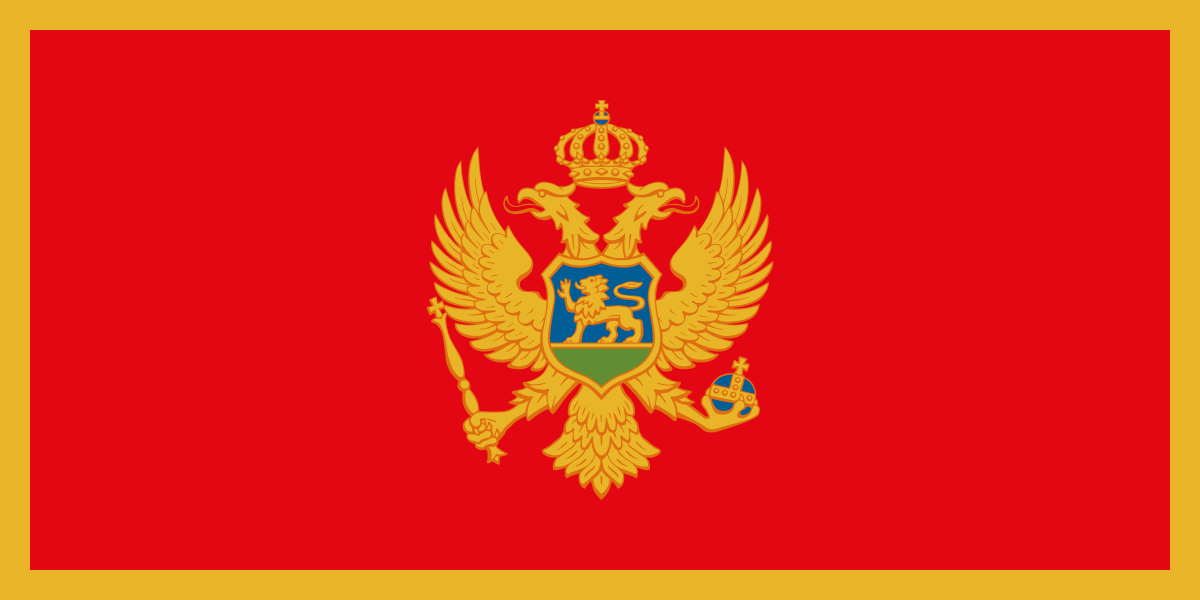
- Capital
- Podgorica
- Population
- 623,327
- Region
Travel guide
Get in
Most foreign tourists enter Montenegro directly by air, by road from Croatia, or occasionally by sea from Italy. Land routes from Bosnia, Serbia, Kosovo, and Albania are mainly used by tourists from those respective countries.
thumb|450px|Visa policy of Montenegro
See
While Montenegro may be a small country, it has so much diverse history and nature to see. There are stunning mountainous landscapes, dramatic coastlines, historic monuments and truly beautiful walled towns. The Montenegro coast is just as gorgeous as that of its better known neighbour, Croatia, and it is for good reason that its main tourist destinations get crowded in summer. Nevertheless, if you can't visit at another time, don't let their popularity hold you back. Even the largest of cruise ship crowds will not stop you from enjoying this country's magnificent Riviera and Medieval coast towns, especially if you're willing to get up early and do your sightseeing ahead of the others.
Of the country's many churches and monasteries, the Serbian Orthodox Ostrog Monastery deserves special attention. It's spectacularly located against a practically vertical background, some 10 km from Danilovgrad. Founded in the 17th century, it's one of the most visited pilgrimage destinations on the Balkans and boasts a magnificent view over the Bjelopavlići plain.
Eat
thumb|Njeguški pršut Apart from the hotels located in towns and summer resorts offering half-board and full-board accommodation, and those along the roads and communication lines such as restaurants, pizza places, taverns, fast food restaurants and cafes, there is a choice of national restaurants offering traditional Montenegrin cuisine.
In addition to the standard European and Mediterranean cuisine, Montenegro offers a variety of healthy food products and local specialities.
Cold hors-d'oeuvres include the famous njeguški pršut (smoked ham) and njeguški cheese, pljevaljski cheese, mushrooms, donuts and dried bleak. The main courses specific for the northern mountainous region are boiled lamb, lamb cooked in milk, cicvara in fresh milk cream (buttered corn porridge), boiled potatoes with cheese and fresh cream. A selection of traditional recipes of the central and coastal parts will include the kastradina (dried mutton), smoked and fresh carp (from Skadar lake) and a variety of fresh sea fish and seafood dishes. Donuts served with honey and dried figs are traditional desserts in these parts of Montenegro.
Article · Español
Montenegro (en montenegrino, Crna Gora, que significa lo mismo que el nombre en véneto, Montenegro) es un país del sureste de Europa situado en la península balcánica, que cuenta con casi 300 km de costa a orillas del mar Adriático. Limita por el norte con Bosnia y Herzegovina y Serbia; Albania por el sureste; Croacia por el oeste; y con Kosovo por el este. Tiene una superficie de 13 812 km², en los que habitan 625 266 personas de acuerdo al último censo realizado en 2011. Oficialmente, y según el Artículo 5 de la Constitución de Montenegro, existen dos capitales oficiales: la principal y ciudad más poblada que es Podgorica, y la capital monárquica e histórica que es Cetiña, a la cual se le considera la Antigua Capital Real. Durante muchos siglos, el territorio, como Principado de Zeta, fue gobernado por una sucesión de dinastías, obteniendo su estatuto internacional como nación independiente en el Congreso de Berlín (1878), convirtiéndose luego en el Reino de Montenegro. Tras la Primera Guerra Mundial, el país alcanzó un acuerdo con Serbia para formar una federación que culminaría con la formación del Estado conocido como el Reino de los Serbios, Croatas y Eslovenos y con el fin de la Segunda Guerra Mundial, dicho reino pasó a formar parte de la República Federal Socialista de Yugoslavia, en la que Montenegro permanecería hasta su desintegración en 1992. Tras dicha desintegración se integró en la República Federal de Yugoslavia y desde 2003 constituyó junto a Serbia la federación de Serbia y Montenegro. Se celebró un referéndum en 2006, en el que el 55.5 % de la población apoyó la independencia y la constitución de un nuevo Estado, proclamado en junio de ese año, con la aprobación del gobierno Serbio. El país es miembro de la OTAN y candidato oficial al ingreso en la Unión Europea.
Abstract from DBpedia / Wikipedia · CC BY-SA
Gallery (59)
On the map
6 mapped locations