Moscou
Also known as Moskva, Moscow, Russia, Moskva Federal City, Russia, Moscow, USSR, Moskva, Russia, City of Moscow, Moscow, Russian Federation, Moscow, Soviet Union
capitale de la Russie
AI overview
Moscow is the capital and largest city of Russia, located on the Moskva River in Central Russia, with a population of over 13 million people within the city itself and over 21.5 million in its metropolitan area. It is Europe's most populous city and largest urban area, making it one of the world's most significant cities by size and influence.
AI-generated from the Wikipedia summary — may contain errors.
Weather now
18°overcast clouds
69% 2.8 m/s OpenWeatherMap
7-day forecast
via Open-Meteo
Place details
- Locality
- Москва
- Region
- Москва
- Country
- Россия
- Population
- 10,381,222
- Timezone
- Europe/Moscow
Travel guide
Understand
thumb|right|Red Square, painting by Fedor Alekseev, 1802 Moscow is the financial and political centre of Russia and the countries formerly comprising the Soviet Union. It has a population of around 13 million and an area of after an expansion in 2012. Moscow is the second most populous city in Europe, after Istanbul, and has the most populous metropolitan area in Europe, with some 21 million residents, comprising roughly one-seventh of the population of Russia. Moscow is in the UTC+3 time zone; there is no daylight saving time.
Many years since the break up of the Soviet Union, the economy has improved, and the modern era has brought upon a wide variety of construction projects, modern architecture and newer transport systems. The Moscow Metro, in particular, is the longest and busiest subway system in Europe. The city also features Europe's largest concentration of skyscrapers.
Get in
See Russia#Get in for visa requirements to Russia.
See
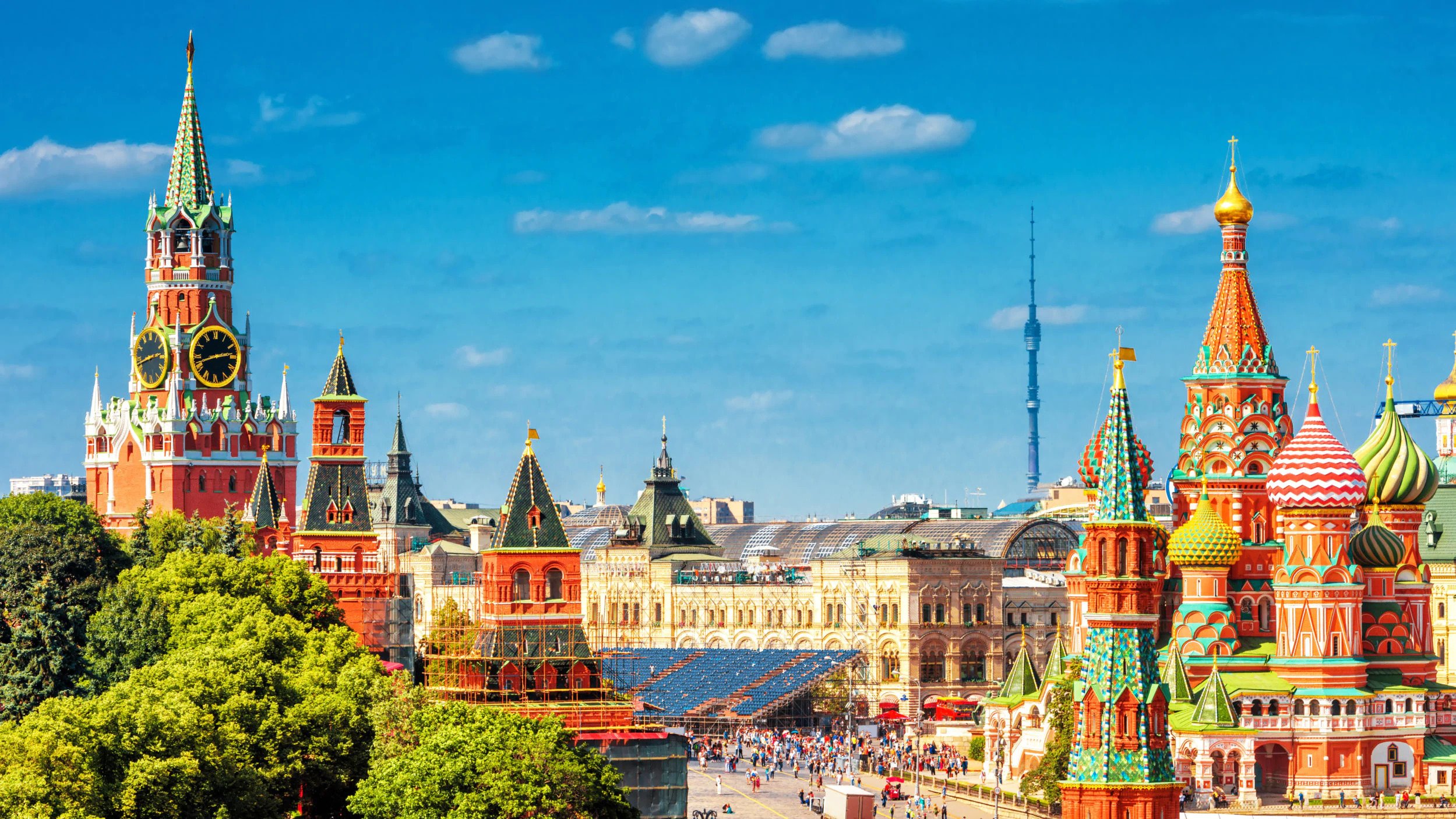
Moscow's architecture is world-renowned. Moscow is the site of Saint Basil's Cathedral, with its elegant onion domes, as well as the Cathedral of Christ the Savior. and the Seven Sisters. Look out for the monumental Stalinist architecture, most famously the Seven Sisters. Also check out a preserved collection of monumental buildings centred within the historic areas of the Kremlin and Red Square.
Moscow is a very green city: Gorky Park along the Moskva river contains estrades, children's attraction, dancing, tennis courts and other sports facilities.
Moscow has many notable art museums. The Tretyakov Gallery houses works in the classic Russian tradition and the works of Soviet artists. The Pushkin Museum of Fine Arts has a cross-section of exhibits on world civilisations, and paintings from every major Western era; works by Claude Monet, Paul Cézanne, and Pablo Picasso are present in the museum's collection. The State Historical Museum of Russia has exhibitions that range from relics of the prehistoric tribes inhabiting present-day Russia, through priceless artworks acquired by members of the Romanov dynasty.
Do
Moscow has many attractions, but many of them are not friendly to a non-Russian-speaker. The Moscow Times is an English-language newspaper help to navigate towards English-language friendly attractions and services; however, it may be hard to access due to its political stance.
Article · Français
Moscou (en russe : Москва, Moskva, [mɐˈskva] ) est la capitale de la Russie et compte environ 12 600 000 habitants intra muros (2017) sur une superficie de 2 510 km2, ce qui en fait la ville la plus peuplée à la fois du pays et d'Europe. Sur le plan administratif Moscou fait partie du district fédéral central et a le statut de ville d'importance fédérale qui lui donne le même niveau d'autonomie que les autres sujets de la Russie. Elle est quasiment enclavée dans l'oblast de Moscou, mais en est administrativement indépendante. Ses habitants sont les Moscovites. Moscou se situe dans la partie européenne de la Russie au milieu d'une région de plaine. Sa latitude élevée lui vaut un climat froid et continental. Le Kremlin, son cœur historique, est édifié sur une colline qui domine la rive gauche de la rivière Moskova. Moscou a joué un rôle central dans l'histoire de la Russie. Petit point d'appui militaire créé vers 1150 dans le nord de la Rus' de Kiev, elle prend progressivement le relais de Kiev, après la décomposition politique de cet État et les invasions mongoles du XIIIe siècle. Elle devient la capitale du Grand-duché de Moscou, Tsarat de Russie puis de l'Empire russe qui étend progressivement son territoire jusqu'à la frontière avec la Pologne à l'ouest, la Crimée au sud et l'océan Pacifique à l'est. Elle perd son rôle de capitale au profit de Saint-Pétersbourg lorsque Pierre le Grand au début du XVIIIe siècle décide de moderniser son pays à marche forcée. Néanmoins, au cours des XVIIIe et XIXe siècles, Moscou devient un centre industriel majeur et le cœur du réseau de communications ferré et routier d'un pays qui compte désormais parmi les grandes puissances européennes. La révolution d'Octobre en 1917 redonne le rôle de capitale à Moscou et met en place un régime communiste qui accélère en deux décennies l'industrialisation de la ville et quadruple la population qui passe de un à quatre millions d'habitants. Ayant échappé de peu à l'occupation allemande durant la Seconde Guerre mondiale, la ville renoue avec une croissance économique et démographique effrénée à l'issue de celle-ci. Elle devient la capitale d'une des deux superpuissances mondiales. L'effondrement du régime communiste en 1991 entraîne une profonde transformation de la ville qui abandonne presque complètement son rôle de centre industriel au profit d'une position de pôle tertiaire complètement converti à l'économie de marché. La construction du Centre de commerce international de Moscou est le symbole de cette transformation. Moscou concentre une part particulièrement importante de la richesse économique du pays : elle produit 25 % du PIB de la Russie. La ville est le siège de nombreuses institutions universitaires et culturelles du pays. Mais cette mutation ne s'est pas faite sans poser de problèmes, les écarts socio-économiques étant devenus considérables : une part de la population s'est fortement enrichie, tandis que l'augmentation du coût de la vie a aggravé les conditions de vie des plus modestes. Moscou a du mal à adapter ses structures routières à l'explosion du parc des véhicules des particuliers et à une croissance démographique qui se poursuit dans un contexte national pourtant déprimé sur ce plan. Moscou dispose d'un important patrimoine artistique et architectural dont trois ensembles inscrits au Patrimoine mondial de l'Unesco. Ce sont notamment le Kremlin avec ses palais et églises, la cathédrale Saint-Basile-le-Bienheureux sur la place Rouge, la galerie Tretiakov, le couvent de Novodievitchi, l'église de Kolomenskoïe ainsi que les sept gratte-ciel staliniens.
Gallery (54)
On the map
4 mapped locations