File:Ramses_I_Mummy.jpg · Wikimedia Commons · See Wikimedia Commons
mummy
Sign in to saveAlso known as mummies
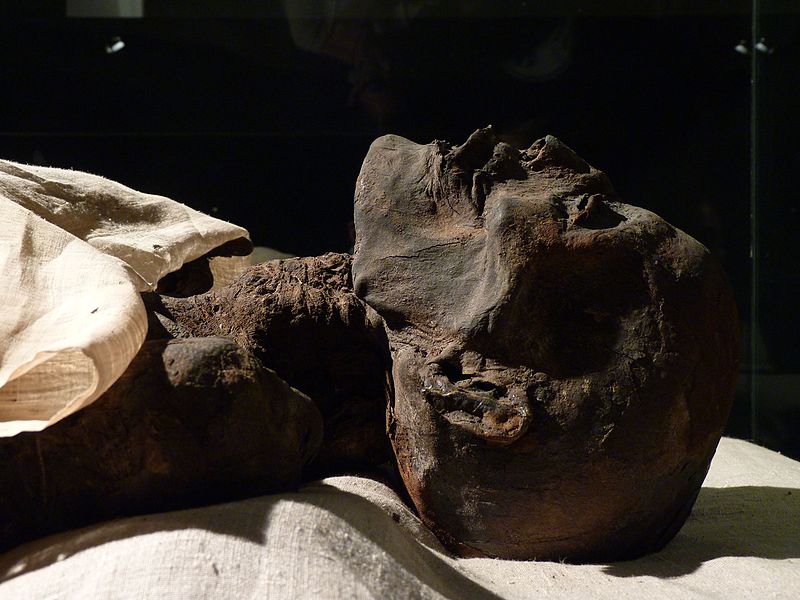
300px|thumb|A mummified man likely to be Ramesses I A mummy is a dead human or an animal whose soft tissues and organs have been preserved by either intentional or accidental exposure to chemicals, extreme cold, very low humidity, or lack of air, so that the recovered body does not decay further if kept in cool and dry conditions. Some authorities restrict the use of the term to bodies deliberately embalmed with chemicals, but the use of the word to cover accidentally desiccated bodies goes back to at least the early 17th century.
A mummy is a preserved dead body—human or animal—whose soft tissues have survived through intentional chemical treatment or accidental exposure to extreme conditions like cold, dryness, or lack of air. Mummies matter because they provide rare direct evidence of how people and animals looked and lived in the past, offering insights that written records alone cannot supply.
AI-generated from the Wikipedia summary — may contain errors.
Research
2,303 papers- Methods in mummy research.ReviewAnthropologischer Anzeiger; Bericht uber die biologisch-anthropologische Literatur · 2009Lynnerup NDOI: 10.1127/0003-5548/2009/0028
- Multidisciplinary analysis of a mummy from the War of the Pacific.Anthropologischer Anzeiger; Bericht uber die biologisch-anthropologische Literatur · 2022Saldías E, Valdebenito G, Zamora L et al.DOI: 10.1127/anthranz/2022/1543
- Mummy DNA unravels ancient Egyptians' ancestry.Nature · 2017Watson TDOI: 10.1038/546017a
- Short Review: The Use of Conventional X-rays in Mummy Studies.ReviewAnatomical record (Hoboken, N.J. : 2007) · 2015Lynnerup N, Rühli FDOI: 10.1002/ar.23147
- Mummy DNA fragment identified.Nature · 1989Del Pozzo G, Guardiola JDOI: 10.1038/339431b0
- Meningeal Preservation in a Child Mummy from Ancient Egypt.ReviewWorld neurosurgery · 2017Isidro A, Herrerin JDOI: 10.1016/j.wneu.2017.01.058
- Mummy studies and the bioarchaeology of care.International journal of paleopathology · 2019Nystrom KC, Tilley LDOI: 10.1016/j.ijpp.2018.06.004
- Mummy 1911-210-1.Journal of the Royal College of Surgeons of Edinburgh · 2000Macleod RI, Wright AR, McDonald J et al.
via PubMed
Wikidata facts
- Subclass of
- animal mummy
- Image
- Ramses I Mummy.jpg
Show 7 more facts
- topic has template
- Template:The Mummy
- Commons gallery
- Mummies
- Commons category
- Mummies
- described by source
- Encyclopædia Britannica 11th edition
- topic's main category
- Category:Mummies
- has cause
- mummification
- different from
- Mummy
via Wikidata · CC0
~59 min read
Encyclopedic overview
59 sectionsContents
- Etymology and meaning
- History of mummy studies
- {{anchor|Anthropogenic|Spontaneous|Natural}}Types
- Egyptian mummies
- Mummification and rank
- "Most perfect" method
- Avoiding expense
- Inexpensive method
- Christian mummies
- Mummification in other cultures
- Africa
- Canary Islands
- Libya
- South Africa
- Asia
- China
- Iran
- Lebanon
- Korea
- Philippines
- Siberia
- Europe
- Bog bodies
- Czech Republic
- Denmark
- Hungary
- Italy
- North America
- Canada
- Greenland
- Mexico
- United States
- Oceania
- Australia
- New Guinea
- Torres Strait
- New Zealand
- South America
- Chauchilla Cemetery
- Chinchorro mummies
- Inca mummies
- Self-mummification
- Modern mummies
- Jeremy Bentham
- Vladimir Lenin
- Gottfried Knoche
- Summum
- Alan Billis
- Amélie of Leuchtenberg
- Plastination
- Treatment of ancient mummies in modern times
- In popular culture
- See also
- Notes
- References
- Books
- TV and video
- Further reading
- External links
300px|thumb|A mummified man likely to be Ramesses I A mummy is a dead human or an animal whose soft tissues and organs have been preserved by either intentional or accidental exposure to chemicals, extreme cold, very low humidity, or lack of air, so that the recovered body does not decay further if kept in cool and dry conditions. Some authorities restrict the use of the term to bodies deliberately embalmed with chemicals, but the use of the word to cover accidentally desiccated bodies goes back to at least the early 17th century.
Mummies of humans and animals have been found on every continent, both as a result of natural preservation through unusual conditions, and as cultural artifacts. Over one million animal mummies have been found in Egypt, many of which are cats. Many of the Egyptian animal mummies are sacred ibis, and radiocarbon dating suggests the Egyptian ibis mummies that have been analyzed were from a time frame that falls between approximately 450 and 250 BC.
Excerpted from Wikipedia’s “mummy” article, available under the CC BY-SA 4.0 licence.
Gallery (52)
Available in 91 languages
- Español
- Français
- Deutsch
- 中文
- 日本語
- Русский
- Português
- Italiano
- العربية
- हिन्दी
- Afrikaans
- Armenian
- Assamese
- Asturian
- Azerbaijani
- Bahasa Indonesia
- Bangla
- Basque
Show 72 more
- Belarusian
- Bikol
- Bosnian
- Breton
- Bulgarian
- Burmese
- Catalan
- Central Kurdish
- Croatian
- Czech
- Danish
- Egyptian Arabic
- Esperanto
- Estonian
- Filipino
- Finnish
- Galician
- Georgian
- Greek
- Guarani
- Gujarati
- Hebrew
- Hungarian
- Icelandic
- Ido
- Irish
- Javanese
- Kannada
- Kashmiri
- Kazakh
- kge
- Kyrgyz
- Latin
- Latvian
- Limburgish
- Lithuanian
- Macedonian
- Malagasy
- Malay
- Malayalam
- Manx
- Mongolian
- Nederlands
- Nepali
- Norwegian
- Norwegian Nynorsk
- Occitan
- Pashto
- Polski
- Romanian
- Serbian
- Serbian (Latin)
- Sicilian
- simple
- Sinhala
- Slovenian
- Svenska
- Swahili
- Tajik
- Tamil
- Tiếng Việt
- Türkçe
- Ukrainian
- Urdu
- Waray
- Western Frisian
- Wu Chinese
- Yoruba
- zh_yue
- فارسی
- ไทย
- 한국어
via Wikidata sitelinks · CC0