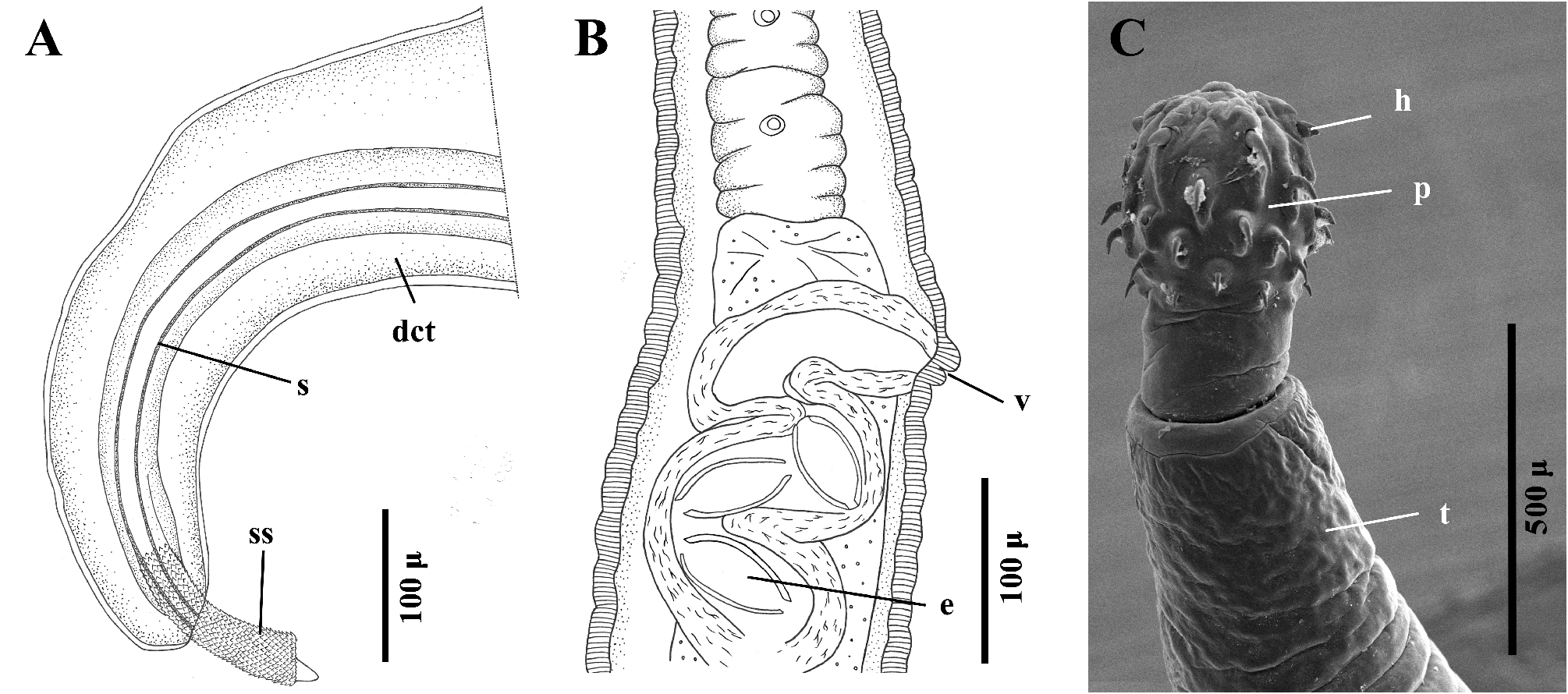
Panti-May, Jesús Alonso;Chan-Casanova, Anyela Jackelin;Canche-Pool, Elsy;Tello-Martín, Raúl;Ruiz-Piña, Hugo;Concha-Guillermo, Henry;Guiascón, Oscar Retana-;Vega, Pedro Pablo Martínez;Chablé-Santos, Juan;Martínez, Erendira Estrella-;Moguel-Chin, Wilson Isaias;Hernández-Orts, Jesús S.;Hernández-Mena, David I.;Mendoza-Garfias, Berenit;García-Prieto, Luis
Trichuris
Sign in to saveTrichuris (synonym Trichocephalus), often referred to as whipworms or the silent serpent (which typically refers to T. trichiura only in medicine, and to any other species in veterinary medicine), is a genus of parasitic helminths from the roundworm family Trichuridae. The name whipworm refers to the shape of the worm; they look like whips with wider "handles" at the posterior end.
Species
GENUS
- KingdomAnimalia
- PhylumNematoda
- ClassEnoplea
- OrderTrichinellida
- FamilyTrichuridae
Peitschenwürmer (Trichuris ssp., von altgriechisch θρίξ thríx, Gen. τριχός trichós, vgl. ngr. τρίχα ‚Haar‘ und ουρά ourá ‚Schwanz‘[1]) sind eine Gattung der Fadenwürmer, die parasitisch im Dickdarm verschiedener Säugetiere leben. Sie haben einen langen dünnen Vorderkörper, der etwa zwei Drittel der Gesamtlänge ausmacht, und ein verdicktes Hinterende, was ihnen das Aussehen einer Peitsche verleiht. Der Ösophagus ist in einen vorderen muskulösen und einen hinteren drüsigen Abschnitt gegliedert. Den drüsigen Abschnitt bilden spezifische Zellen, sogenannte Stichozyten.[2] Das Vorderende des Parasiten ist in die Darmschleimhaut eingesenkt, während das verdickte Ende mit den Geschlechtsorganen in das Darmlumen des Wirtes ragt.[3] Die Mundöffnung zeigt keine Lippen, die Vulva liegt am Übergang vom fadenförmigen in den dicken Teil. Die dickschaligen Eier haben eine typische Fassform mit Polpfröpfen.[4] Ei von T. trichiura (links) und T. vulpis (rechts) Die Gattung enthält etwa 60 bis 70 Arten.[3] Die parasitologische Diagnostik erfolgt durch Nachweis der Eier im Stuhl. Der Befall mit Peischenwürmern (Trichuriose) kann beim Menschen mit Mebendazol behandelt werden. Für die Behandlung von Ti
via GBIF
Museum specimens
- Specimen records
- 813
- With media
- 40
- Family
- Trichuridae
- Collections
- USNM, MSB
- Recorded in
- United States
Research
5,123 papers- Trichuris trichiura.QJM : monthly journal of the Association of Physicians · 2019
- Trichuris and trichuriasis in humans.Advances in parasitology · 1989
- Trichuris muris research revisited: a journey through time.Parasitology · 2013
- Trichuris muris: a model of gastrointestinal parasite infection.Seminars in immunopathology · 2012
- The global prevalence of Trichuris trichiura infection in humans (2010-2023): A systematic review and meta-analysis.Journal of infection and public health · 2024
via PubMed
Wikidata facts
- Instance of
- taxon
- Parent taxon
- Trichuridae
- Image
- Trichuris sp.JPG
Show 4 more facts
- topic's main category
- Category:Trichuris
- taxon name
- Trichuris
- taxon rank
- genus
- Commons category
- Trichuris
Sources (2)
via Wikidata · CC0
~10 min read
Encyclopedic overview
5 sectionsContents
- Species
- History
- Life cycle
- In domestic animals
- References
Trichuris (synonym Trichocephalus), often referred to as whipworms or the silent serpent (which typically refers to T. trichiura only in medicine, and to any other species in veterinary medicine), is a genus of parasitic helminths from the roundworm family Trichuridae. The name whipworm refers to the shape of the worm; they look like whips with wider "handles" at the posterior end.
==Species== The genus Trichuris includes over 70 species, which infect the large intestine of their host, including: Trichuris trichiura (sometimes Trichocephalus trichiurus) – causes trichuriasis in humans Trichuris campanula (cat whipworm) Trichuris serrata (cat whipworm) Trichuris suis (pig whipworm) Trichuris muris (mouse whipworm) Trichuris vulpis (dog whipworm)
Excerpted from Wikipedia’s “Trichuris” article, available under the CC BY-SA 4.0 licence.
Gallery (3)
Available in 16 languages
- Français
- Deutsch
- 中文
- 日本語
- Português
- العربية
- Bahasa Indonesia
- Belarusian
- Czech
- Egyptian Arabic
- Finnish
- Malayalam
- Nederlands
- Polski
- Svenska
via Wikidata sitelinks · CC0