File:Roman_Empire_125.png · Wikimedia Commons · See Wikimedia Commons
Nabataeans
Sign in to saveAlso known as Nabatene
The Nabataeans, also spelled Nabateans (; Nabataean Aramaic / , vocalized: ; ), were an ancient Arab people who inhabited northern Arabia and the southern Levant. Their settlements—most prominently the assumed capital city of Raqmu (present-day Petra, Jordan)—gave the name Nabatene () to the Arabian borderland that stretched from the Euphrates to the Red Sea. The Nabateans emerged as a distinct civilization and political entity between the 4th and 2nd centuries BC, with their kingdom centered around a loosely controlled trading network that brought considerable wealth and influence across the
The Nabataeans were an ancient Arab people who lived in northern Arabia and the southern Levant and built a powerful civilization around a trading network that made them wealthy and influential between the 4th and 2nd centuries BC. Their most famous city was Petra (in present-day Jordan), and they controlled a vast region called Nabatene that stretched from the Euphrates River to the Red Sea.
AI-generated from the Wikipedia summary — may contain errors.
Key facts
- Ethnic group.group
- Nabataeans
- Ethnic group.image
- Roman Empire 125.png
- Ethnic group.image_caption
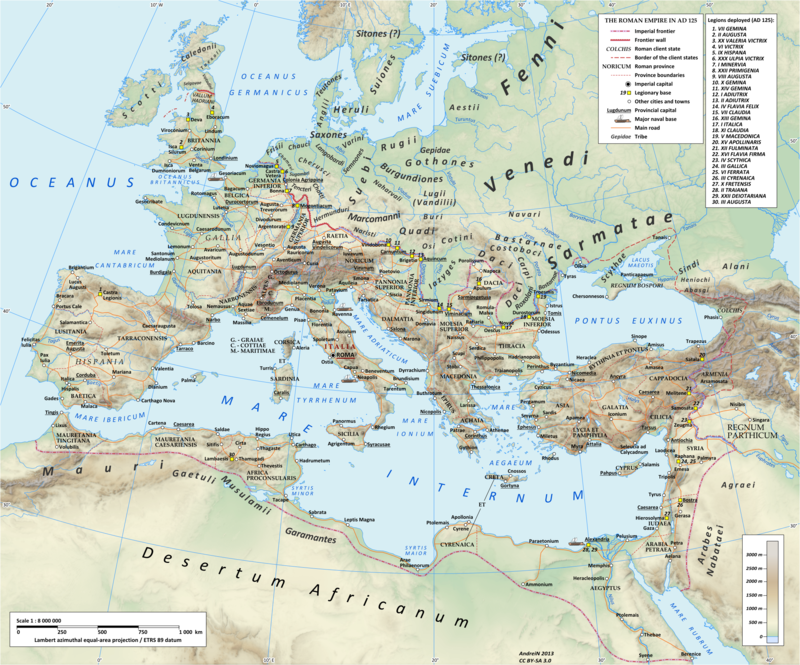
- A map of the Roman Empire under Hadrian (ruled AD 117–138), showing the location of the Arabes Nabataei in the desert regions around the Roman province of Arabia Petraea (lower right)
- Ethnic group.related_groups
- Arabs
via Wikipedia infobox
Wikidata facts
- Subclass of
- Semitic people
- Country
- Nabataean kingdom
- Image
- Madain Saleh.jpg
Show 3 more facts
- Commons category
- Nabataeans
- topic's main category
- Category:Nabataea
- described by source
- Encyclopædia Britannica 11th edition
Sources (1)
via Wikidata · CC0
~26 min read
Encyclopedic overview
32 sectionsContents
- Name
- History
- Hellenistic period
- The Abgarids and Osroene in Mesopotamia
- Nabataean Kingdom
- Roman period
- Culture
- Women
- Fashion
- Religion
- Main god: Dushara
- Female deities (al-Uzza etc.)
- Worship
- Language
- Script
- Archeological sites
- Middle East
- Jordan
- Syria
- Northwest Saudi Arabia
- Negev Desert, Israel
- South Sinai, Egypt
- Outside the Middle East
- Architects and stonemasons
- The architect Apollodorus
- Hegra stonemasons
- Gallery: architecture
- See also
- Notes
- References
- Bibliography
- External links
The Nabataeans, also spelled Nabateans (; Nabataean Aramaic / , vocalized: ; ), were an ancient Arab people who inhabited northern Arabia and the southern Levant. Their settlements—most prominently the assumed capital city of Raqmu (present-day Petra, Jordan)—gave the name Nabatene () to the Arabian borderland that stretched from the Euphrates to the Red Sea. The Nabateans emerged as a distinct civilization and political entity between the 4th and 2nd centuries BC, with their kingdom centered around a loosely controlled trading network that brought considerable wealth and influence across the ancient world.
Described as fiercely independent by contemporary Greco-Roman accounts, the Nabataeans were annexed into the Roman Empire by Emperor Trajan in 106 AD. Nabataeans' individual culture, easily identified by their characteristic finely potted painted ceramics, was adopted into the larger Greco-Roman culture. They converted to Christianity during the Byzantine period. They have been described as one of the most gifted peoples of the ancient world and one of the "most unjustly forgotten".
Excerpted from Wikipedia’s “Nabataeans” article, available under the CC BY-SA 4.0 licence.