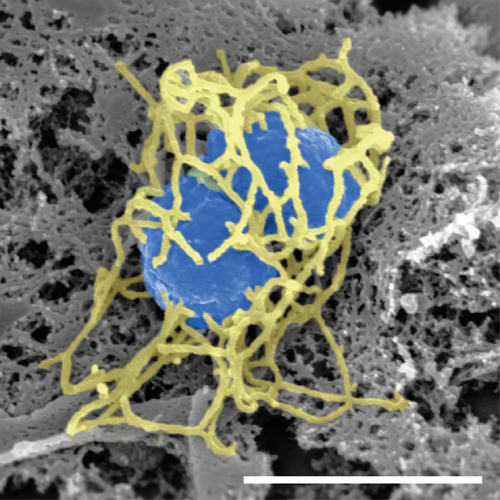
(c) Arthur Charles-Orszag, some rights reserved (CC BY-SA) · cc-by-sa
Neisseria
Sign in to saveNeisseria is a large genus of bacteria that colonize the mucous membranes of many animals. Of the 11 species that colonize humans, only two are pathogens: N. meningitidis and N. gonorrhoeae.
Species
meningococcus
GENUS
- KingdomBacteria
- PhylumProteobacteria
- ClassGammaproteobacteria
- OrderBurkholderiales
- FamilyNeisseriaceae
via GBIF
Research
32,832 papers- Commensal Neisseria and Antimicrobial-Resistant Gonorrhea.Annual review of microbiology · 2025
- Emergence of Ceftriaxone-Resistant Neisseria gonorrhoeae Through Horizontal Gene Transfer Among Neisseria Species.The Journal of infectious diseases · 2025
- Cysteine biosynthesis in Neisseria species.Microbiology (Reading, England) · 2018
- Et tu, Neisseria? Conflicts of Interest Between Neisseria Species.Frontiers in cellular and infection microbiology · 2022
- Sweet complexity: O-linked protein glycosylation in pathogenic Neisseria.Frontiers in cellular and infection microbiology · 2024
via PubMed
Wikidata facts
- Instance of
- taxon
- Parent taxon
- Neisseriaceae
- Named after
- Albert Neisser
- Image
- Neisseria gonorrhoeae 02.png
Show 8 more facts
- taxon name
- Neisseria
- Commons category
- Neisseria
- taxon rank
- genus
- topic's main category
- Category:Neisseria
- taxon common name
- 奈瑟菌屬
- Gram staining
- gram-negative bacteria
- LPSN URL
- lpsn.dsmz.de/genus/neisseria
- taxonomic type
- Neisseria gonorrhoeae
Sources (2)
via Wikidata · CC0
~9 min read
Encyclopedic overview
11 sectionsContents
- Pathogenesis and classification
- Pathogens
- Nonpathogens
- Biochemical identification
- History
- Genomes
- Vaccine
- Antibiotic resistance
- Genetic transformation
- International Pathogenic ''Neisseria'' Conference
- References
Neisseria is a large genus of bacteria that colonize the mucous membranes of many animals. Of the 11 species that colonize humans, only two are pathogens: N. meningitidis and N. gonorrhoeae.
Neisseria species are Gram-negative bacteria included among the Pseudomonadota, a large group of Gram-negative forms. Neisseria diplococci resemble coffee beans when viewed microscopically.
Excerpted from Wikipedia’s “Neisseria” article, available under the CC BY-SA 4.0 licence.