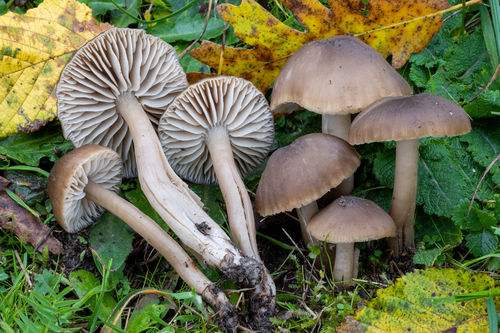
(c) Nicolò Oppicelli, some rights reserved (CC BY-NC), uploaded by Nicolò Oppicelli · cc-by-nc
Neohygrocybe
Sign in to saveNeohygrocybe is a genus of agaric fungi in the family Hygrophoraceae. Neohygrocybe species belong to a group known as waxcaps in English, sometimes also waxy caps in North America or waxgills in New Zealand. In Europe, Neohygrocybe species are typical of waxcap grasslands, a declining habitat due to changing agricultural practices. As a result, three species, Neohygrocybe ingrata, Neohygrocybe nitrata, and Neohygrocybe ovina, are of global conservation concern and are listed as "vulnerable" on the IUCN Red List of Threatened Species.
Species
Nitrous Waxcap
GENUS
- KingdomFungi
- PhylumBasidiomycota
- ClassAgaricomycetes
- OrderAgaricales
- FamilyHygrophoraceae
via GBIF
Museum specimens
- Specimen records
- 10
- With media
- 1
- Family
- Hygrophoraceae
- Collections
- INSTITUTO NACIONAL DE PESQUISAS DA AMAZÔNIA (INPA), UCSC, CUP, MNHN, UFSC, ILLS
- Recorded in
- Brasil, United States, Guyane FrançAise, Norway
Wikidata facts
- Instance of
- taxon
- Parent taxon
- Hygrophoraceae
Show 5 more facts
- taxon name
- Neohygrocybe
- taxon rank
- genus
- taxonomic type
- Neohygrocybe ovina
- Commons category
- Neohygrocybe
- taxon author citation
- Herink
Sources (1)
via Wikidata · CC0
~1 min read
Encyclopedic overview
3 sectionsContents
- Taxonomy
- Habitat and Distribution
- References
Neohygrocybe is a genus of agaric fungi in the family Hygrophoraceae. Neohygrocybe species belong to a group known as waxcaps in English, sometimes also waxy caps in North America or waxgills in New Zealand. In Europe, Neohygrocybe species are typical of waxcap grasslands, a declining habitat due to changing agricultural practices. As a result, three species, Neohygrocybe ingrata, Neohygrocybe nitrata, and Neohygrocybe ovina, are of global conservation concern and are listed as "vulnerable" on the IUCN Red List of Threatened Species.
==Taxonomy== The genus was described by Czech mycologist Josef Herink in 1958. It was formerly synonymized with Hygrocybe by many authorities, but recent molecular research, based on cladistic analysis of DNA sequences, indicates that Neohygrocybe is monophyletic and forms a natural group distinct from Hygrocybe sensu stricto.
Excerpted from Wikipedia’s “Neohygrocybe” article, available under the CC BY-SA 4.0 licence.