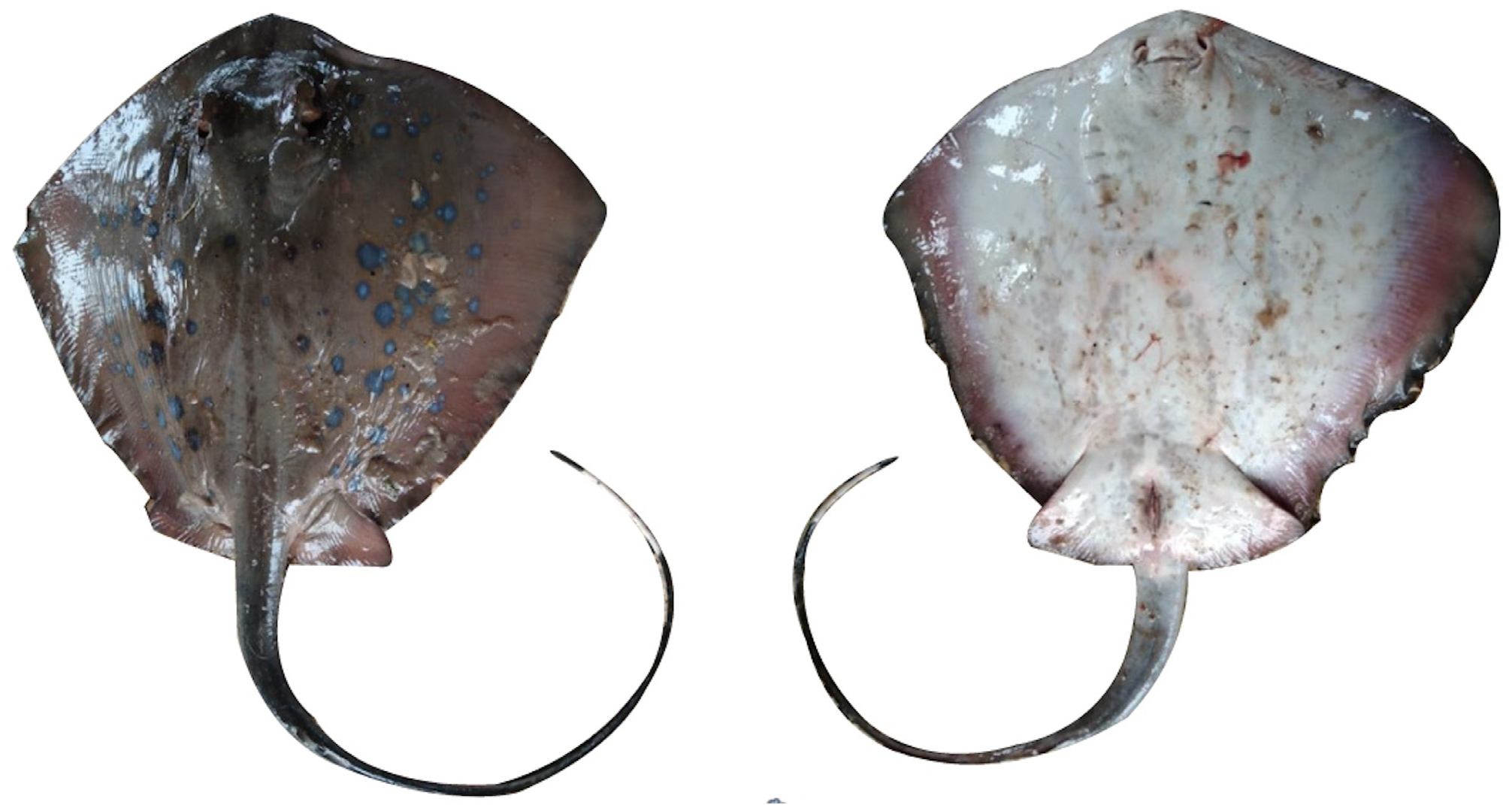
Haque, Alifa Bintha;White, William T.;Cavanagh, Rachel D.;Biswas, Aparna Riti;Hossain, Nazia
Neotrygon
Sign in to saveNeotrygon is a genus of stingrays in the family Dasyatidae commonly known as the maskrays, native to the Indo-West Pacific. They are so named because of a distinctive color pattern around their eyes, resembling a mask. The species in this genus were originally placed in the genus Dasyatis by most authors. However, recent morphological and molecular analyses have conclusively showed that they represent a distinct group and so the genus Neotrygon was resurrected for them.
Species
ヤッコエイ属
GENUS
- KingdomAnimalia
- PhylumChordata
- ClassElasmobranchii
- OrderMyliobatiformes
- FamilyDasyatidae
via GBIF
Museum specimens
- Specimen records
- 35
- With media
- 4
- Family
- Dasyatidae
- Collections
- UF, MNHN, CSIRO, AM
- Recorded in
- Thailand, Taiwan, Australia, Chinese Taipei, Indonesia
Wikidata facts
- Instance of
- taxon
- Parent taxon
- Dasyatidae
- Image
- Blue-spotted Stingray (Neotrygon kuhlii) (8465011759).jpg
Show 6 more facts
- Commons category
- Neotrygon
- taxon rank
- genus
- taxon name
- Neotrygon
- topic's main category
- Category:Neotrygon
- taxon common name
- Mask Rays
- taxonomic type
- Neotrygon kuhlii
Sources (1)
via Wikidata · CC0
~5 min read
Encyclopedic overview
2 sectionsContents
- Species
- References
Neotrygon is a genus of stingrays in the family Dasyatidae commonly known as the maskrays, native to the Indo-West Pacific. They are so named because of a distinctive color pattern around their eyes, resembling a mask. The species in this genus were originally placed in the genus Dasyatis by most authors. However, recent morphological and molecular analyses have conclusively showed that they represent a distinct group and so the genus Neotrygon was resurrected for them.
Aside from their mask-like color pattern, the maskrays are variable in coloration and can be plain or ornate. Their pectoral fin discs are largely smooth, with a single row of thorns along the dorsal midline. The mouth is small with two central papillae and a row of enlarged, long-cusped teeth halfway along the upper jaw on both sides. The nasal curtain, formed by the merging of the nasal flaps, is long and narrow. The tail is very short with well-developed dorsal and ventral fin folds and a filamentous tip, and is banded black and white past the stinging spine. In addition, Neotrygon species also differ from other stingrays in their buccal and skeletal morphology, as well as in the CO1 and NADH2 gene sequences.
Excerpted from Wikipedia’s “Neotrygon” article, available under the CC BY-SA 4.0 licence.
Gallery (3)
Available in 16 languages
- Français
- Deutsch
- Русский
- Bahasa Indonesia
- Catalan
- Cebuano
- Egyptian Arabic
- Hungarian
- Nederlands
- Polski
- Svenska
- Ukrainian
- Waray
- فارسی
- ไทย
via Wikidata sitelinks · CC0