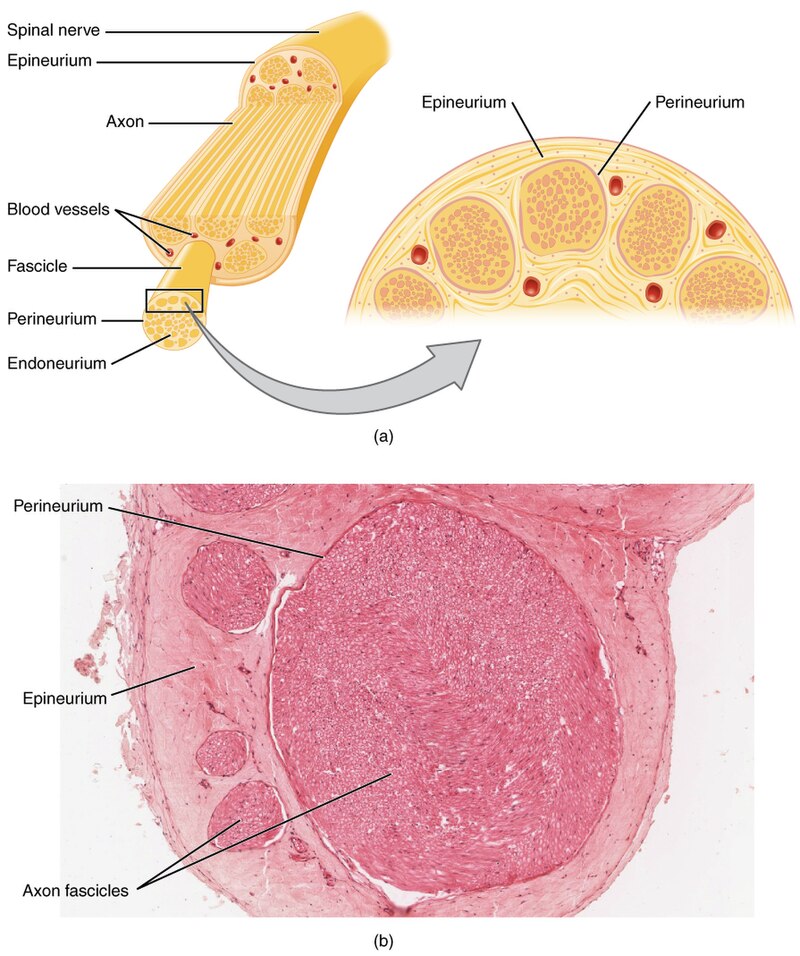
File:1319_Nerve_StructureN.jpg · Wikimedia Commons · See Wikimedia Commons
nervo
Sign in to saveA nerve is an enclosed, cable-like bundle of nerve fibers (called axons). Nerves have historically been considered the basic units of the peripheral nervous system. A nerve provides a common pathway for the electrochemical nerve impulses called action potentials that are transmitted along each of the axons to peripheral organs or, in the case of sensory nerves, from the periphery back to the central nervous system. Each axon is an extension of an individual neuron, along with other supportive cells such as some Schwann cells that coat the axons in myelin.
A nerve is a cable-like bundle of fibers that carries electrical signals between your brain and body, allowing information to travel to and from your organs and senses. Nerves matter because they form the communication system that connects your central nervous system to the rest of your body, enabling movement, sensation, and bodily functions.
AI-generated from the Wikipedia summary — may contain errors.
Key facts
- Nerve.Name
- Nerve
- Nerve.Latin
- nervus
- Nerve.Image
- 1319 Nerve StructureN.jpg
- Nerve.Caption
- Cross-section of a nerve
- Nerve.System
- Nervous system
via Wikipedia infobox
Wikidata facts
- Part of
- peripheral nervous system
- Has part
- axon
- Image
- Nerves of the left upper extremity.gif
Show 9 more facts
- equivalent class
- schema.org/Nerve
- topic's main category
- Category:Nerves
- topic has template
- Template:Infobox nerve
- on focus list of Wikimedia project
- Wikipedia:Vital articles/Level/4
- described by source
- Encyclopædia Britannica 11th edition
- Commons category
- Nerves
- different from
- vein
- NCI Thesaurus ID
- C12466
- WordLift URL
- data.wordlift.io/wl01714/entity/nerves
via Wikidata · CC0
Article · Português
Os nervos são estruturas anatômicas, formadas a partir do prolongamento de múltiplos axônios, responsáveis por conduzir os impulsos elétricos nervosos aferentes, de todas as partes do corpo para o sistema nervoso central (denomina-se sistema nervoso central o conjunto formado pelo encéfalo e pela medula espinhal) e eferentes, que saem do sistema nervoso central e enviam impulsos nervosos para diversas partes do corpo. Os nervos, juntamente com gânglios nervosos e os órgãos terminais, constituem o sistema nervoso periférico. Os nervos podem ser classificados de acordo com sua origem: nervos cranianos (doze pares de nervos ligados ao encéfalo) e nervos espinhais (31 pares ligados à medula). Os nervos também podem ser classificados de acordo com a função que desempenham: nervos sensitivos (aferentes) e nervos motores (eferentes). Os nervos sensitivos são aqueles que conduzem mensagens de órgãos do corpo (como a pele, músculos, articulações e também os outros órgãos dos sentidos) para o sistema nervoso central. Já os nervos motores, ou nervos eferentes, levam mensagens do sistema nervoso central para os órgãos efetores, como músculos ou glândulas. Também existem os nervos mistos, que contém prolongamentos sensitivos e motores,
Abstract from DBpedia / Wikipedia · CC BY-SA
Gallery (4)
Available in 121 languages
- Español
- Français
- Deutsch
- 中文
- 日本語
- Русский
- Português
- Italiano
- العربية
- हिन्दी
- abstract
- Afrikaans
- Albanian
- Albanian
- Aragonese
- Aramaic
- Armenian
- Assamese
Show 102 more
- Asturian
- Atikamekw
- Avaric
- Azerbaijani
- Bahasa Indonesia
- Bangla
- Bashkir
- Basque
- bat_smg
- be_x_old
- Belarusian
- Bikol
- Bosnian
- Bulgarian
- Burmese
- Catalan
- Central Kurdish
- Chuvash
- Cornish
- Croatian
- Czech
- Danish
- Divehi
- Egyptian Arabic
- Esperanto
- Estonian
- Fiji Hindi
- Fijian
- Finnish
- fiu_vro
- Galician
- Georgian
- Greek
- Hebrew
- Hungarian
- Iban
- Icelandic
- Ido
- Interlingua
- Irish
- Kannada
- Kazakh
- Kikuyu
- Kurdish
- Kyrgyz
- Lao
- Latin
- Latvian
- lbe
- Lingua Franca Nova
- Lithuanian
- Lombard
- Low German
- Luxembourgish
- Macedonian
- Madurese
- Malay
- Malayalam
- Manx
- Mingrelian
- Nederlands
- Norwegian
- Norwegian Nynorsk
- Occitan
- Oromo
- Pashto
- Piedmontese
- Polski
- Punjabi
- Quechua
- rki
- Romanian
- Sanskrit
- Scottish Gaelic
- Serbian
- Serbian (Latin)
- Shona
- simple
- Sindhi
- Slovak
- Slovenian
- Sundanese
- Svenska
- Swahili
- Tachelhit
- Tamil
- Telugu
- Tiếng Việt
- Türkçe
- Ukrainian
- Urdu
- Uzbek
- Waray
- Welsh
- Wu Chinese
- Yiddish
- zh_classical
- zh_min_nan
- zh_yue
- فارسی
- ไทย
- 한국어
via Wikidata sitelinks · CC0