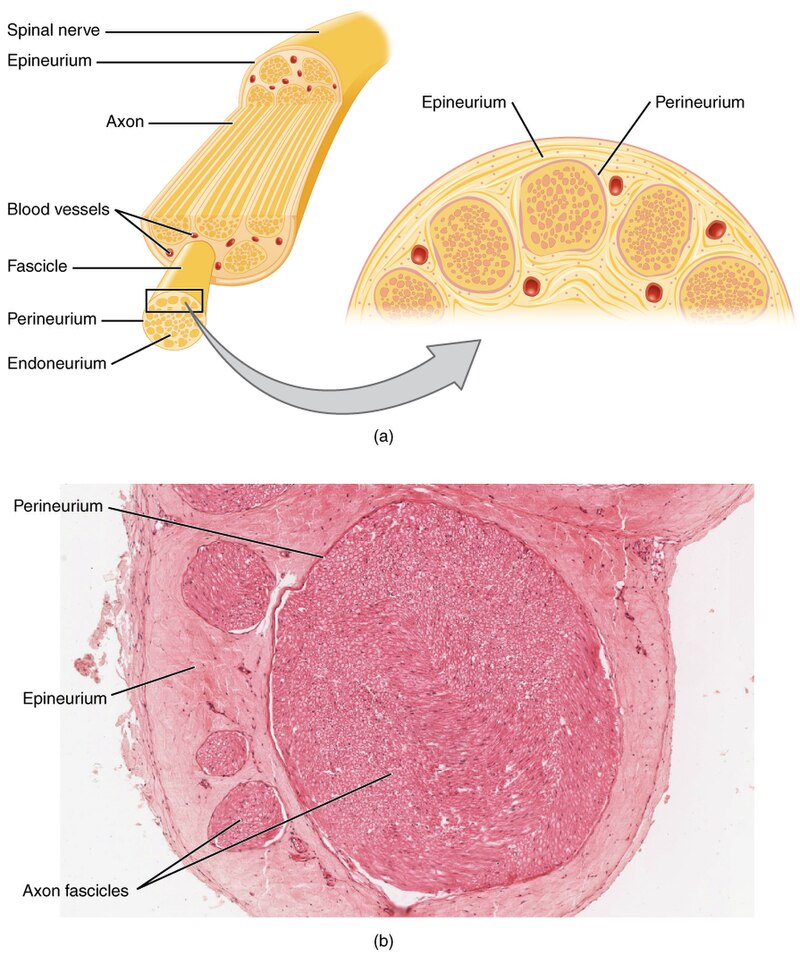
File:1319_Nerve_StructureN.jpg · Wikimedia Commons · See Wikimedia Commons
A nerve is an enclosed, cable-like bundle of nerve fibers (called axons). Nerves have historically been considered the basic units of the peripheral nervous system. A nerve provides a common pathway for the electrochemical nerve impulses called action potentials that are transmitted along each of the axons to peripheral organs or, in the case of sensory nerves, from the periphery back to the central nervous system. Each axon is an extension of an individual neuron, along with other supportive cells such as some Schwann cells that coat the axons in myelin.
A nerve is a cable-like bundle of fibers that carries electrical signals between your brain and body, allowing information to travel to and from your organs and senses. Nerves matter because they form the communication system that connects your central nervous system to the rest of your body, enabling movement, sensation, and bodily functions.
AI-generated from the Wikipedia summary — may contain errors.
Key facts
- Nerve.Name
- Nerve
- Nerve.Latin
- nervus
- Nerve.Image
- 1319 Nerve StructureN.jpg
- Nerve.Caption
- Cross-section of a nerve
- Nerve.System
- Nervous system
via Wikipedia infobox
Wikidata facts
- Part of
- peripheral nervous system
- Has part
- axon
- Image
- Nerves of the left upper extremity.gif
Show 9 more facts
- equivalent class
- schema.org/Nerve
- topic's main category
- Category:Nerves
- topic has template
- Template:Infobox nerve
- on focus list of Wikimedia project
- Wikipedia:Vital articles/Level/4
- described by source
- Encyclopædia Britannica 11th edition
- Commons category
- Nerves
- different from
- vein
- NCI Thesaurus ID
- C12466
- WordLift URL
- data.wordlift.io/wl01714/entity/nerves
via Wikidata · CC0
Article · 中文
神經(英語:Nerve)是在周围神经系统中由聚集成束的神經纖維所组成的结构,一条神经内可包含一个或多个神经纤维束,神经外部有神经外膜包裹、内部有神经束膜隔开各纤维束。 神經纖維本身是指神經元的轴突,軸突外被神經膠質細胞所形成的髓鞘包覆、起到保护和绝缘等作用。 因此神經能將訊息准确從動物身體一處傳遞到另外一處,使動物能協調指揮動作與進行各種工作。 按照结构和功能,神经可分为传入神经(含有传入神经纤维)、传出神经(含有传出神经纤维)以及混合神经(含有传入及传出神经纤维)。 按照位置,人体的神经可分脑神经和脊神经。 神經元的轴突常聚集成神经纤维束,进而构成神經、能傳遞電子信號,而神经元的细胞体则常聚集形成神经节。 軸突是从神經元细胞体延伸出的长線狀部分,能傳送神經衝動,其長度可達1公尺以上,神經衝動總是沿著軸突朝一個方向傳遞。 此外,神经元的樹突與軸突相似,但長度短許多且有許多分支,神經元利用樹突接收鄰近细胞通过突觸傳來的訊號。 在從另外一個細胞接收到信號或刺激后,神经元可沿著軸突傳遞動作電位(即神經衝動)。 脊椎動物的軸突常被其他細胞所包覆,這些像鞘的細胞含有髓磷脂、可形成髓鞘,幫助神經衝動傳遞。
Abstract from DBpedia / Wikipedia · CC BY-SA
Gallery (4)
Available in 121 languages
- Español
- Français
- Deutsch
- 中文
- 日本語
- Русский
- Português
- Italiano
- العربية
- हिन्दी
- abstract
- Afrikaans
- Albanian
- Albanian
- Aragonese
- Aramaic
- Armenian
- Assamese
Show 102 more
- Asturian
- Atikamekw
- Avaric
- Azerbaijani
- Bahasa Indonesia
- Bangla
- Bashkir
- Basque
- bat_smg
- be_x_old
- Belarusian
- Bikol
- Bosnian
- Bulgarian
- Burmese
- Catalan
- Central Kurdish
- Chuvash
- Cornish
- Croatian
- Czech
- Danish
- Divehi
- Egyptian Arabic
- Esperanto
- Estonian
- Fiji Hindi
- Fijian
- Finnish
- fiu_vro
- Galician
- Georgian
- Greek
- Hebrew
- Hungarian
- Iban
- Icelandic
- Ido
- Interlingua
- Irish
- Kannada
- Kazakh
- Kikuyu
- Kurdish
- Kyrgyz
- Lao
- Latin
- Latvian
- lbe
- Lingua Franca Nova
- Lithuanian
- Lombard
- Low German
- Luxembourgish
- Macedonian
- Madurese
- Malay
- Malayalam
- Manx
- Mingrelian
- Nederlands
- Norwegian
- Norwegian Nynorsk
- Occitan
- Oromo
- Pashto
- Piedmontese
- Polski
- Punjabi
- Quechua
- rki
- Romanian
- Sanskrit
- Scottish Gaelic
- Serbian
- Serbian (Latin)
- Shona
- simple
- Sindhi
- Slovak
- Slovenian
- Sundanese
- Svenska
- Swahili
- Tachelhit
- Tamil
- Telugu
- Tiếng Việt
- Türkçe
- Ukrainian
- Urdu
- Uzbek
- Waray
- Welsh
- Wu Chinese
- Yiddish
- zh_classical
- zh_min_nan
- zh_yue
- فارسی
- ไทย
- 한국어
via Wikidata sitelinks · CC0