Nimatron
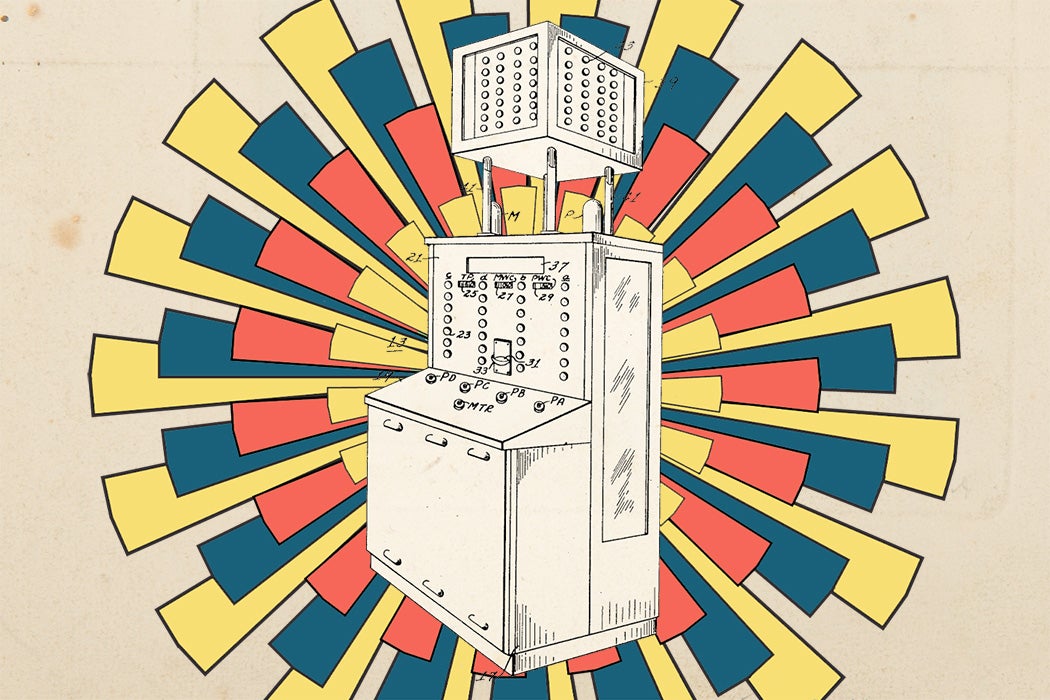
Sign in to saveThe Nimatron was an electro-mechanical machine that played Nim. It was first exhibited in April–October 1940 by the Westinghouse Electric Corporation at the 1939-1940 New York World's Fair to entertain fair-goers. Conceived of some months prior by Edward Condon and built by Gerald L. Tawney and Willard A. Derr, the device was a non-programmable digital computer composed of electro-mechanical relays which could respond to players' choices in the game in a dozen different patterns. The machine, which weighed over a metric ton, displayed four lines of seven light bulbs both in front of the player
Described at
The Nimatron - JSTOR Daily
The world’s first video game made its debut at the Westinghouse pavilion at the New York World's Fair in 1939. Read all about it!
daily.jstor.org →The world’s first video game made its debut at the Westinghouse pavilion at the New York World’s Fair in 1939. Read all about it! Dreamed up as an emotional and financial antidote to the Depression, the 1939-1940 New York World’s Fair built a futuristic paradise on the site of a former ash dump in Queens, and labeled it “The World of Tomorrow .” A sprawling fairground, with more than a passing resemblance to Walt Disney’s eventual dream Experimental Prototype Community of Tomorrow (EPCOT ), the Fair was wildly popular and offered a wide range of attractions and amusements for more than forty million visitors over two seasons. A good time was especially attractive when you consider a population saddled with Depression fatigue and the threat of war: the New York Daily News , ahead of opening day, noted excitedly that “The World’s Fair 1940 whirled with activity yesterday as hundreds of showgirls, swimmers, acrobats and freaks arrived to begin rehearsals for Saturday’s opening. Five new girlie shows went through their paces, with 150 swimmers rehearsing the new version of Billy Rose’s Aquacade.” A 61-foot statue of George Washington presided over a man-made lagoon, in celebration of the 150th anniversary of Washington’s inaugural . Franklin D. Roosevelt gave a televised address from the Fair, making him the first president to appear on television . Salvador Dali was engaged to produce a surrealist burlesque called “The Dream of Venus” that involved not a small number of bare breasted swimsuits. And lobsters . It was not all girlie shows and patriotism and concession booths, though: the World’s Fair purported to offer a tour of America’s technological future. With a giant modernist globe and spire looming in the distance, visitors could experience real-world innovations with practical applications: things like color photography, Formica, television sets and fluorescent lights. And at the Westinghouse pavilion, patrons could take a shot at beating the world’s first video game. Traditionally, Nim is played by setting up piles of coins or tokens. There are two players, and each takes a turn by removing some number of coins from a single pile. There are two versions of Nim, and the object (depending on which you’re playing) is to either take the last move, leaving no coins behind, or to avoid being the player who moves last. For the math-minded player Nim is an easy game, because its course can be predicted from the first move. Condon and his Westinghouse colleagues, who were very much math-minded players, decided to build themselves a mechanical opponent . Get your fix of JSTOR Daily’s best stories in your inbox each Thursday. This opponent, a sturdy chrome-edged cabinet topped with rows of light bulbs representing the game tokens, was dubbed “The Nimatron.” A non-programmable digital computer, the Nimatron stood eight feet tall, weighed a ton and involved 116 electrical relays threaded with two miles of copper wire. Unlike other technologies on display throughout the Fair, the eight-foot-tall Nimatron served “no other useful purpose than to entertain .” Wildly popular and a real attention-getter, Westinghouse invited any and all comers at the Fair to take a shot at beating the machine. According to Science magazine, the Nimatron was a quick and brutal adversary: “players at the Fair were exasperated by the diabolical rapidity and sureness of the machine, and noisy delays were added to the monster so that human players–still usually defeated–could have the satisfaction of making the Nimatron grunt and heave appropriately .” Any human player who could manage to best the Nimatron received a commemorative coin labeled “Nim Champ ,” but most of the machine’s defeats were said to be at the hands of staff members, who conducted demonstrations to assure crowds that the game wasn’t a gaff. The direct impact of the Nimatron on computing is debatable. Condon himself later admitted to an interviewer that he had allowed his own judgment t
Excerpt from a page describing this subject · 12,390 chars · not written by Vinony
Wikidata facts
- Instance of
- electro-mechanical game
- Genre
- Nim
- Location
- 1939 New York World's Fair
- Producer
- Westinghouse Electric Company
- Developer
- Edward Condon
- Image
- Nimetron-picture.png
Show 2 more facts
- publication date
- 1940-00-00
- described at URL
- daily.jstor.org/the-nimatron
Sources (2)
via Wikidata · CC0
~8 min read
Encyclopedic overview
5 sectionsContents
- Development
- Presentation
- Legacy
- References
- Sources
The Nimatron was an electro-mechanical machine that played Nim. It was first exhibited in April–October 1940 by the Westinghouse Electric Corporation at the 1939-1940 New York World's Fair to entertain fair-goers. Conceived of some months prior by Edward Condon and built by Gerald L. Tawney and Willard A. Derr, the device was a non-programmable digital computer composed of electro-mechanical relays which could respond to players' choices in the game in a dozen different patterns. The machine, which weighed over a metric ton, displayed four lines of seven light bulbs both in front of the player and on four sides of an overhead cube. Players alternated turns with the machine in removing one or more lights from one of the rows until the lights were all extinguished. The calculations were purposely delayed to give the illusion that the machine was considering moves, and winners received a token.
The reception of the machine during the fair was positive, with around 100,000 games of Nim played. After the fair it was moved to the Buhl Planetarium and Institute of Popular Science Building in Pittsburgh. Despite this success, Condon considered the Nimatron a failure, because he had designed and intended it to be solely a piece of entertainment for fair-goers, but within years of the exhibition programmable digital computers began to be produced around the world by other companies and groups that used some of the same principles around storing digital information. The Nimatron is considered one of the first electro-mechanical games and a precursor to the video game, but its direct impact on the early history of video games and beyond is minimal. It may, however, have inspired the Nimrod computer, which was demonstrated at the 1951 Festival of Britain playing Nim using banks of lightbulbs like the Nimatron eleven years prior.
Excerpted from Wikipedia’s “Nimatron” article, available under the CC BY-SA 4.0 licence.