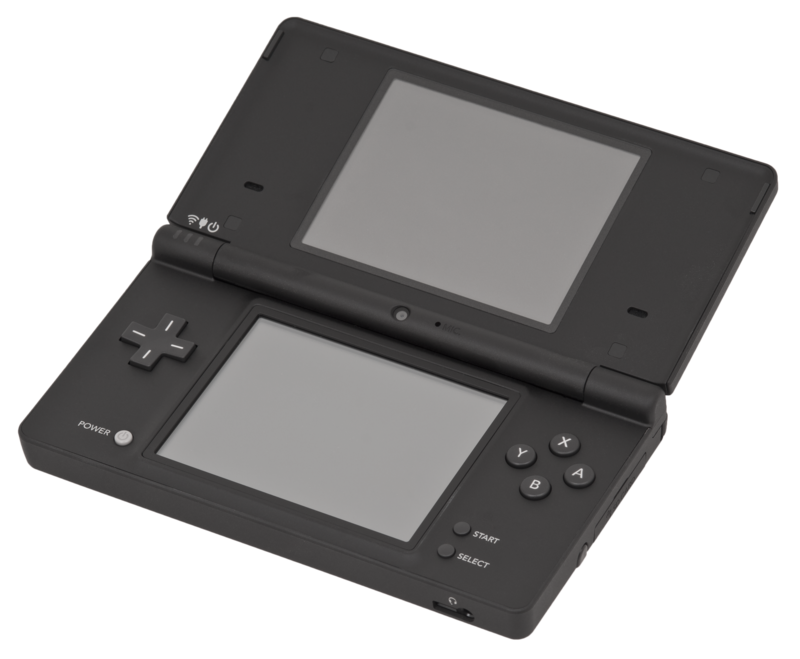
File:Nintendo-DSi-Bl-Open.png · Wikimedia Commons · See Wikimedia Commons
Key facts
- Manufacturer
- Nintendo
- Product family
- Nintendo DS
- Type
- Handheld game console
- Generation
- Seventh
- Released
- November 1, 2008 Nintendo DSi: JP : November 1, 2008 AU : April 2, 2009 EU : April 3, 2009 NA : April 5, 2009 Nintendo DSi XL: JP : November 21, 2009 EU : March 5, 2010 NA : March 28, 2010 AU : April 15, 2010
- Discontinued
- Yes; date undisclosed
- Units shipped
- 41 million combined (as of September 30, 2014)
- Media
- Nintendo DS Game Card Nintendo DSi Game Card Nintendo DSi Shop ( digital distribution ) SD card
- Operating system
- Nintendo DSi system software
- Cpu
- 133 MHz ARM9 , 33 MHz ARM7
- Memory
- 16 MB RAM
- Storage
- 256 MB internal flash memory , SD card (up to 32 GB ), Cartridge save
- Connectivity
- Wi-Fi (802.11b/g)
- Online services
- Nintendo Wi-Fi Connection , Nintendo DSi Shop, Nintendo Zone
- Predecessor
- Game Boy Advance
- Successor
- Nintendo 3DS
via Wikipedia infobox
Described at
Search | Pegi Public Site
pegi.info →Link to a page describing this subject · 15,438 chars · not written by Vinony
Wikidata facts
- Subclass of
- handheld game console
- Series
- Nintendo DS
- Followed by
- Nintendo 3DS
- Follows
- Nintendo DS Lite
- Developer
- Nintendo
- Manufacturer
- Nintendo
- Image
- Nintendo-DSi-XL-Burg.jpg
Show 8 more facts
- units sold
- 28440000
- operating system
- Nintendo DSi system software
- publication date
- 2008-11-01
- Commons category
- Nintendo DSi
- topic's main category
- Category:Nintendo DSi
- online service
- DSiWare
- discontinuation date
- 2014-09-30
Sources (3)
via Wikidata · CC0
~34 min read
Encyclopedic overview
The Nintendo DSi is a foldable dual-screen handheld game console released by Nintendo. The console launched in Japan on November 1, 2008, and worldwide beginning in April 2009. It is the third iteration of the Nintendo DS, and its primary market rival was Sony's PlayStation Portable (PSP). The fourth iteration, titled Nintendo DSi XL, is a larger model that launched in Japan on November 21, 2009, and worldwide beginning in March 2010. Development of the DSi began in late 2006, and the handheld was unveiled during an October 2008 Nintendo conference in Tokyo. Consumer demand convinced Nintendo to produce a slimmer handheld with larger screens than the DS Lite. Consequently, Nintendo removed the Game Boy Advance (GBA) cartridge slot to improve portability without sacrificing durability.
While the DSi's design is similar to that of the DS Lite, it features two digital cameras, supports internal and external content storage, and connected to an online store called the Nintendo DSi Shop. Nintendo stated that families often share DS and DS Lite consoles. Its new functionality was intended to facilitate personalization, so as to encourage each member of a household to purchase a DSi. The handheld supports exclusive physical media in addition to DS games with DSi-specific features and standard DS titles. The only exception to its backward compatibility are earlier DS games that required the GBA slot. Nintendo sold over 41 million DSi and DSi XL units combined. They were succeeded by the Nintendo 3DS in 2011.
Excerpted from Wikipedia’s “Nintendo DSi” article, available under the CC BY-SA 4.0 licence.