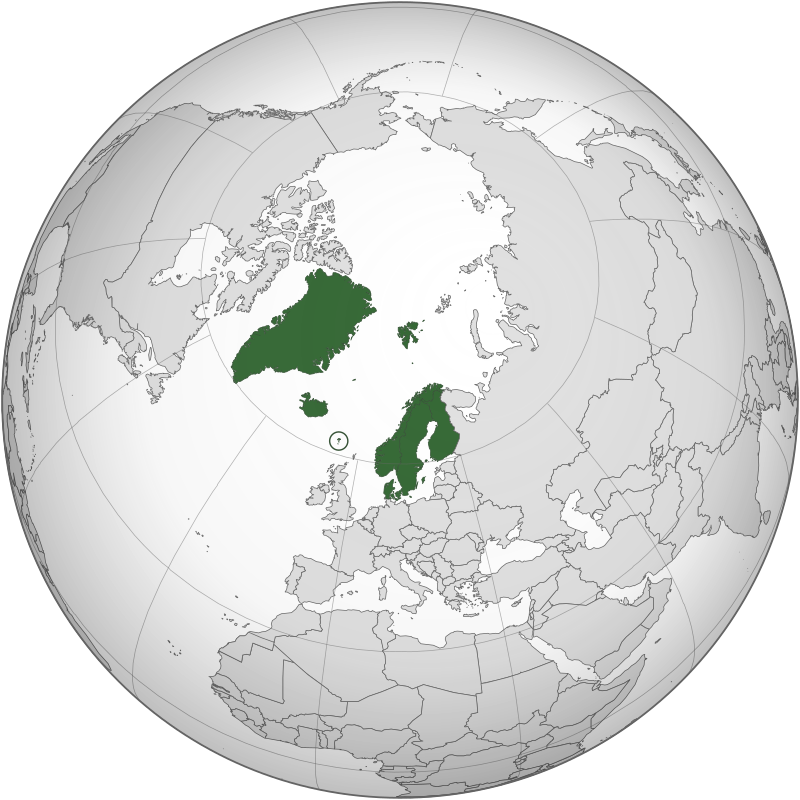
File:Nordic_countries_orthographic.svg · Wikimedia Commons · See Wikimedia Commons
Nordic countries
Sign in to saveAlso known as Nordic region, Scandinavian and Nordic Countries, The Nordics, Nordics, Norse countries
geographical and cultural region in Northern Europe and the North Atlantic
The Nordic countries are a geographical and cultural region in Northern Europe and the North Atlantic. This region matters because it represents a distinct area with shared geographical characteristics and cultural connections that influence politics, economics, and society across the northern part of the European continent.
AI-generated from the Wikipedia summary — may contain errors.
Research
242,856 papers- Mental health problems among Syrian refugees in Nordic countries: a systematic review.Nordic journal of psychiatry · 2024Ojha S, Thapa S, Thapa SBDOI: 10.1080/08039488.2024.2403600
- Specialist training for cardiothoracic surgery in the Nordic countries.ReviewThe Journal of thoracic and cardiovascular surgery · 2020Mennander A, Gudbjartsson T, Jeppsson A et al.DOI: 10.1016/j.jtcvs.2019.07.110
- Antibiotic stewardship: following in the footsteps of Nordic countries?Expert review of anti-infective therapy · 2024Frimodt-Møller N, Hertz FBDOI: 10.1080/14787210.2024.2323122
- Mental health: Current trends and challenges in the Nordic countries and beyond.Scandinavian journal of public health · 2019Olafsdottir SDOI: 10.1177/1403494819830340
- Obesity Prevention in the Nordic Countries.ReviewCurrent obesity reports · 2016Stockmarr A, Hejgaard T, Matthiessen JDOI: 10.1007/s13679-016-0206-y
- Alcohol policy in the Nordic countries.BMJ (Clinical research ed.) · 1997Chenet L, McKee M, Osler M et al.DOI: 10.1136/bmj.314.7088.1142
- Avoidable cancers in the Nordic countries. Biological agents.ReviewAPMIS. Supplementum · 1997Winther JF, Møller H, Tryggvadottir L et al.
- Homicide in the Nordic countries.ReviewActa psychiatrica Scandinavica · 1990Gudjónsson GH, Pétursson HDOI: 10.1111/j.1600-0447.1990.tb01354.x
via PubMed
Wikidata facts
Show 5 more facts
- topic's main category
- Category:Nordic countries
- different from
- Fennoscandia
- Commons category
- Nordic region
- social media followers
- 33383
- located in/on physical feature
- Northern Europe
Sources (2)
via Wikidata · CC0
~40 min read
Encyclopedic overview
The Nordic countries (also known as the Nordics or Norden; lit. 'the North') are a geographical and cultural region in Northern Europe and North America, as well as the Arctic and North Atlantic oceans. It includes the sovereign states of Denmark, Finland, Iceland, Norway and Sweden; the autonomous territories of the Faroe Islands and Greenland; and the autonomous region of Åland.
The Nordic countries have much in common in their way of life, history, religion and social and economic model. They have a long history of political unions and other close relations but do not form a singular state or federation today. The Scandinavist movement sought to unite Denmark, Norway and Sweden into one country in the 19th century. With the dissolution of the union between Norway and Sweden (Norwegian independence), the independence of Finland in the early 20th century and the 1944 Icelandic constitutional referendum, this movement expanded into the modern organised Nordic cooperation. Since 1962, this cooperation has been based on the Helsinki Treaty that sets the framework for the Nordic Council and the Nordic Council of Ministers.
Excerpted from Wikipedia’s “Nordic countries” article, available under the CC BY-SA 4.0 licence.
Gallery (12)
On the map
Available in 82 languages
- Español
- Français
- Deutsch
- 中文
- 日本語
- Русский
- Português
- Italiano
- العربية
- हिन्दी
- Albanian
- Aragonese
- Armenian
- Arpitan
- Asturian
- Azerbaijani
- Bahasa Indonesia
- Bangla
Show 63 more
- Basque
- Belarusian
- Bhojpuri
- Bosnian
- Bulgarian
- Catalan
- Central Kurdish
- Croatian
- Czech
- Danish
- Esperanto
- Estonian
- Faroese
- Filipino
- Finnish
- fiu_vro
- Galician
- Greek
- Hebrew
- Icelandic
- Ido
- Interlingua
- Irish
- Javanese
- Latvian
- Lithuanian
- Luxembourgish
- Macedonian
- Malagasy
- Malay
- Malayalam
- Maltese
- Manx
- Mazanderani
- Nederlands
- Northern Sami
- Norwegian
- Norwegian Nynorsk
- Polski
- Sardinian
- Scots
- Serbian
- Serbian (Latin)
- simple
- Sindhi
- Slovak
- Slovenian
- Svenska
- Tamil
- Telugu
- Tiếng Việt
- Toki Pona
- Türkçe
- Ukrainian
- Urdu
- Waray
- Welsh
- Wu Chinese
- zh_min_nan
- zh_yue
- فارسی
- ไทย
- 한국어
via Wikidata sitelinks · CC0