File:Making_a_Nova.jpg · Wikimedia Commons · See Wikimedia Commons
Tân tinh
Sign in to saveAlso known as Bovae, Classical nova
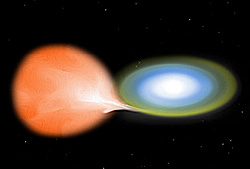
frame|right|Artist's conception of a white dwarf, right, Accretion (astrophysics)|accreting hydrogen from the [[Roche lobe of its larger companion star]]
AI overview
A nova is a sudden, dramatic brightening of a star system caused by a thermonuclear explosion on the surface of a white dwarf that is pulling material from a nearby companion star. Novas matter to astronomers because they help us understand stellar evolution, binary star systems, and the physics of extreme conditions in space.
AI-generated from the Wikipedia summary — may contain errors.
Wikidata facts
- Instance of
- astronomical phenomenon
- Subclass of
- variable star
- Image
- Making a Nova.jpg
Show 6 more facts
- Commons gallery
- Nova
- topic's main category
- Category:Novae
- Commons category
- Novae
- catalog code
- N
- on focus list of Wikimedia project
- Wikipedia:Vital articles/Level/4
via Wikidata · CC0
Gallery (12)
Available in 69 languages
- Español
- Français
- Deutsch
- 中文
- 日本語
- Русский
- Português
- Italiano
- العربية
- हिन्दी
- Afrikaans
- Armenian
- Asturian
- Bahasa Indonesia
- Bangla
- Basque
- Belarusian
- Bosnian
Show 50 more
- Bulgarian
- Burmese
- Catalan
- Chuvash
- Croatian
- Czech
- Esperanto
- Estonian
- Filipino
- Finnish
- Galician
- Greek
- Hebrew
- Hungarian
- Igbo
- Irish
- Latin
- Latvian
- Lithuanian
- Luxembourgish
- Macedonian
- Malay
- Malayalam
- Mingrelian
- Nederlands
- Norwegian
- Norwegian Nynorsk
- Occitan
- Polski
- Romanian
- Scots
- Serbian
- Serbian (Latin)
- Sicilian
- simple
- Slovak
- Svenska
- Swahili
- Tamil
- Tiếng Việt
- Türkçe
- Ukrainian
- Uzbek
- Waray
- Western Panjabi
- Wu Chinese
- zh_yue
- فارسی
- ไทย
- 한국어
via Wikidata sitelinks · CC0