File:Making_a_Nova.jpg · Wikimedia Commons · See Wikimedia Commons
nova
Sign in to saveAlso known as Bovae, Classical nova
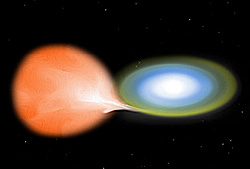
frame|right|Artist's conception of a white dwarf, right, Accretion (astrophysics)|accreting hydrogen from the [[Roche lobe of its larger companion star]]
A nova is a sudden, dramatic brightening of a star system caused by a thermonuclear explosion on the surface of a white dwarf that is pulling material from a nearby companion star. Novas matter to astronomers because they help us understand stellar evolution, binary star systems, and the physics of extreme conditions in space.
AI-generated from the Wikipedia summary — may contain errors.
Wikidata facts
- Instance of
- astronomical phenomenon
- Subclass of
- variable star
- Image
- Making a Nova.jpg
Show 6 more facts
- Commons gallery
- Nova
- topic's main category
- Category:Novae
- Commons category
- Novae
- catalog code
- N
- on focus list of Wikimedia project
- Wikipedia:Vital articles/Level/4
via Wikidata · CC0
~14 min read
Encyclopedic overview
13 sectionsContents
- Etymology
- Stellar evolution of novae
- Helium novae
- Occurrence rate and astrophysical significance
- Subtypes
- Remnants
- Novae as distance indicators
- <!-- 'Recurrent nova', 'Recurrent novae', 'Recurrent Nova', and 'Recurrent Novae' redirect here --> Recurrent novae
- Extragalactic novae
- See also
- References
- Further reading
- External links
frame|right|Artist's conception of a white dwarf, right, Accretion (astrophysics)|accreting hydrogen from the [[Roche lobe of its larger companion star]]
A nova is a transient astronomical event that causes the sudden appearance of a bright, apparently "new" star (hence the name "nova", Latin for "new"; the shortened form of "stella nova", Latin for "new star") that slowly fades over weeks or months. All observed novae involve white dwarfs in close binary systems, but causes of the dramatic appearance of a nova vary, depending on the circumstances of the two progenitor stars. The main sub-classes of novae are classical novae, recurrent novae (RNe), and dwarf novae. They are all considered to be cataclysmic variable stars.
Excerpted from Wikipedia’s “nova” article, available under the CC BY-SA 4.0 licence.
Gallery (12)
Available in 69 languages
- Español
- Français
- Deutsch
- 中文
- 日本語
- Русский
- Português
- Italiano
- العربية
- हिन्दी
- Afrikaans
- Armenian
- Asturian
- Bahasa Indonesia
- Bangla
- Basque
- Belarusian
- Bosnian
Show 50 more
- Bulgarian
- Burmese
- Catalan
- Chuvash
- Croatian
- Czech
- Esperanto
- Estonian
- Filipino
- Finnish
- Galician
- Greek
- Hebrew
- Hungarian
- Igbo
- Irish
- Latin
- Latvian
- Lithuanian
- Luxembourgish
- Macedonian
- Malay
- Malayalam
- Mingrelian
- Nederlands
- Norwegian
- Norwegian Nynorsk
- Occitan
- Polski
- Romanian
- Scots
- Serbian
- Serbian (Latin)
- Sicilian
- simple
- Slovak
- Svenska
- Swahili
- Tamil
- Tiếng Việt
- Türkçe
- Ukrainian
- Uzbek
- Waray
- Western Panjabi
- Wu Chinese
- zh_yue
- فارسی
- ไทย
- 한국어
via Wikidata sitelinks · CC0