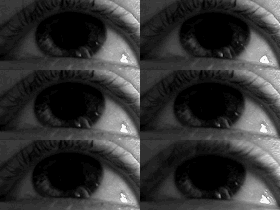
File:Optokinetic_nystagmus.gif · Wikimedia Commons · See Wikimedia Commons
nystagmus
Sign in to saveNystagmus is a condition of involuntary (or voluntary, in some cases) eye movement. People can be born with it but more commonly acquire it in infancy or later in life. In many cases it may result in reduced or limited vision.
Key facts
- Medical condition (new).name
- Nystagmus
- Medical condition (new).synonyms
- Dancing eyes, Instabilitas oculorum
- Medical condition (new).image
- Optokinetic nystagmus.gif
- Medical condition (new).caption
- Horizontal optokinetic nystagmus, a normal (physiological) form of nystagmus
- Medical condition (new).field
- Neurology, ophthalmology, optometry
via Wikipedia infobox
Wikidata facts
- Instance of
- symptom or sign
- Image
- Optokinetic nystagmus.gif
Show 5 more facts
- Commons category
- Nystagmus
- health specialty
- audiology
- exact match
- purl.obolibrary.org/obo/SYMP_0000338
- NCI Thesaurus ID
- C3282
- studied by
- neurology
Sources (8)
via Wikidata · CC0
~18 min read
Encyclopedic overview
20 sectionsContents
- Causes
- Early-onset nystagmus
- Acquired nystagmus
- General diseases and conditions
- Toxicity or intoxication, metabolic disorders and combination
- Thiamine deficiency
- Central nervous system (CNS) diseases and disorders
- Other causes
- Diagnosis
- Pathological nystagmus
- Variations
- Physiological nystagmus
- Variations
- Treatment
- Epidemiology
- Law enforcement
- Media
- See also
- References
- External links
Nystagmus is a condition of involuntary (or voluntary, in some cases) eye movement. People can be born with it but more commonly acquire it in infancy or later in life. In many cases it may result in reduced or limited vision.
In normal eyesight, while the head rotates about an axis, distant visual images are sustained by rotating eyes in the opposite direction of the respective axis. The semicircular canals in the vestibule of the ear sense angular acceleration, and send signals to the nuclei for eye movement in the brain. From here, a signal is relayed to the extraocular muscles to allow one's gaze to fix on an object as the head moves. Nystagmus occurs when the semicircular canals are stimulated (e.g., by means of the caloric test, or by disease) while the head is stationary. The direction of ocular movement is related to the semicircular canal that is being stimulated.
Excerpted from Wikipedia’s “nystagmus” article, available under the CC BY-SA 4.0 licence.