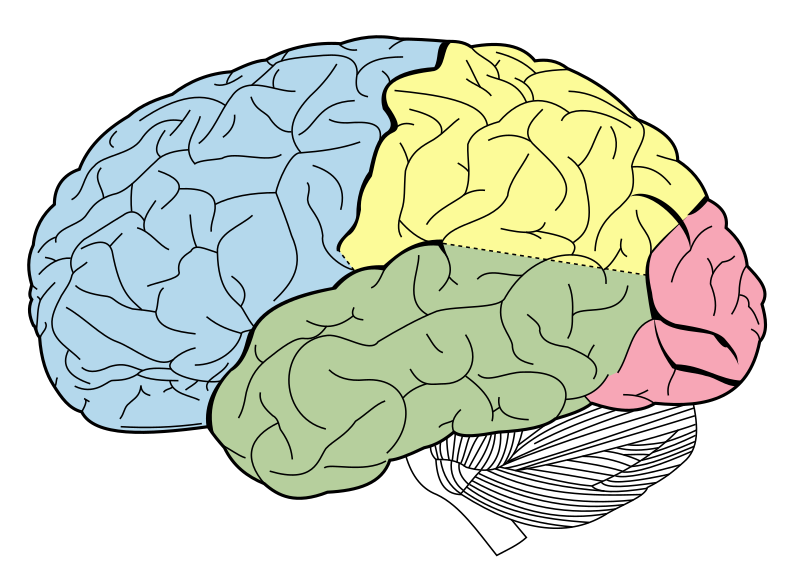
File:Lobes_of_the_brain_NL.svg · Wikimedia Commons · See Wikimedia Commons
occipital lobe
Sign in to savePart of the brain that is located at the back of the head and is responsible for visual perception. That includes colour, form and motion. Damage to the occipital lobe can cause difficulty with locating objects in environment.
Key facts
- Part of
- Cerebrum
- Artery
- Posterior cerebral artery
- Latin
- lobus occipitalis
- Mesh
- D009778
- Neurolex id
- birnlex_1136
- Ta98
- A14.1.09.132
via Wikipedia infobox
Research
46,468 papers- Symptomatic occipital lobe epilepsy.Epilepsia · 1998
- Occipital lobe seizures and epilepsies.Journal of clinical neurophysiology : official publication of the American Electroencephalographic Society · 2012
- Occipital lobe epilepsy: clinical characteristics, seizure spread patterns, and results of surgery.Annals of neurology · 1992
- Visual phenomena and anatomo-electro-clinical correlations in occipital lobe seizures.Revue neurologique · 2022
- Alterations of the occipital lobe in schizophrenia.Neurosciences (Riyadh, Saudi Arabia) · 2015
via PubMed
Wikidata facts
- Part of
- cerebral hemisphere
- Has part
- visual cortex
- Image
- Occipital lobe animation small.gif
Show 3 more facts
- Commons category
- Occipital lobe
- NCI Thesaurus ID
- C12355
- topic's main category
- Category:Occipital lobe
via Wikidata · CC0
~8 min read
Encyclopedic overview
The occipital lobe is one of the four major lobes of the cerebral cortex in the brain of mammals. The name derives from its position at the back of the head, from the Latin ob, 'behind', and caput, 'head'.
The occipital lobe is the visual processing center of the mammalian brain, containing most of the anatomical region of the visual cortex. The primary visual cortex is Brodmann area 17, commonly called V1 (visual one). Human V1 is located on the medial side of the occipital lobe within the calcarine sulcus; the full extent of V1 often continues onto the occipital pole. V1 is often also called striate cortex because it can be identified by a large stripe of myelin, the stria of Gennari. Visually driven regions outside V1 are called extrastriate cortex. There are many extrastriate regions, and these are specialized for different visual tasks, such as visuospatial processing, color differentiation, and motion perception. Bilateral lesions of the occipital lobe can lead to cortical blindness (see Anton's syndrome).
Excerpted from Wikipedia’s “occipital lobe” article, available under the CC BY-SA 4.0 licence.