File:OhmsLaw.svg · Wikimedia Commons · See Wikimedia Commons
Ohm's law
Sign in to saverelationship between voltage and current across an ideal resistor
Ohm's law describes how voltage, current, and resistance are related in an electrical circuit: the current flowing through a resistor is directly proportional to the voltage applied across it. This relationship is fundamental to understanding and designing electrical circuits, since it allows engineers and technicians to predict how much current will flow when a specific voltage is applied.
AI-generated from the Wikipedia summary — may contain errors.
Wikidata facts
- Instance of
- physical law
- Named after
- Georg Simon Ohm
- Main subject
- resistor
- Image
- OhmsLaw.svg
Show 3 more facts
- Commons category
- Ohm's law
- on focus list of Wikimedia project
- Wikipedia:Vital articles/Level/4
- maintained by WikiProject
- WikiProject Mathematics
via Wikidata · CC0
~32 min read
Encyclopedic overview
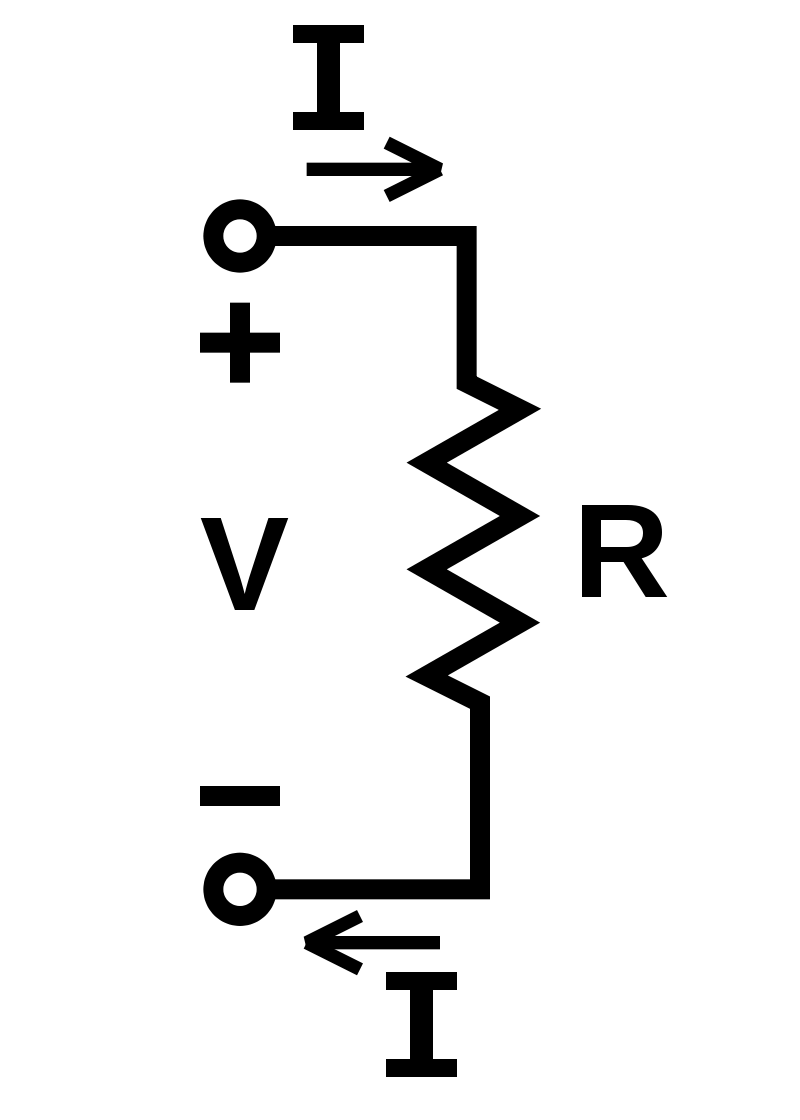
V, I, and R, the parameters of Ohm's law
Ohm's law states that the electric current through a conductor between two points is directly proportional to the voltage across the two points. Introducing the constant of proportionality, the resistance, one arrives at the three mathematical equations used to describe this relationship:
Excerpted from Wikipedia’s “Ohm's law” article, available under the CC BY-SA 4.0 licence.
Gallery (10)
Available in 99 languages
- Español
- Français
- Deutsch
- 中文
- 日本語
- Русский
- Português
- Italiano
- العربية
- हिन्दी
- Afrikaans
- Albanian
- Armenian
- Asturian
- Azerbaijani
- Bahasa Indonesia
- Bangla
- Basque
Show 80 more
- Belarusian
- Bhojpuri
- Bosnian
- Breton
- Bulgarian
- Burmese
- Catalan
- Central Kurdish
- Chuvash
- Croatian
- Czech
- Danish
- eml
- Esperanto
- Estonian
- Extremaduran
- Faroese
- Filipino
- Finnish
- Galician
- Greek
- Haitian Creole
- Hebrew
- Hungarian
- Icelandic
- Irish
- Kazakh
- Kurdish
- Kyrgyz
- Latvian
- Limburgish
- Lithuanian
- Lombard
- Low German
- Macedonian
- Malagasy
- Malay
- Malayalam
- Marathi
- Mongolian
- Nederlands
- Nepali
- Norwegian
- Norwegian Nynorsk
- Occitan
- Odia
- Piedmontese
- Polski
- Punjabi
- Romanian
- Scots
- Scottish Gaelic
- Serbian
- Serbian (Latin)
- Sicilian
- simple
- Sindhi
- Sinhala
- skr
- Slovak
- Slovenian
- Svenska
- Tamil
- Tatar
- Telugu
- Tiếng Việt
- Türkçe
- Ukrainian
- Urdu
- Uzbek
- Waray
- Welsh
- Western Panjabi
- Wu Chinese
- zh_classical
- zh_min_nan
- zh_yue
- فارسی
- ไทย
- 한국어
via Wikidata sitelinks · CC0