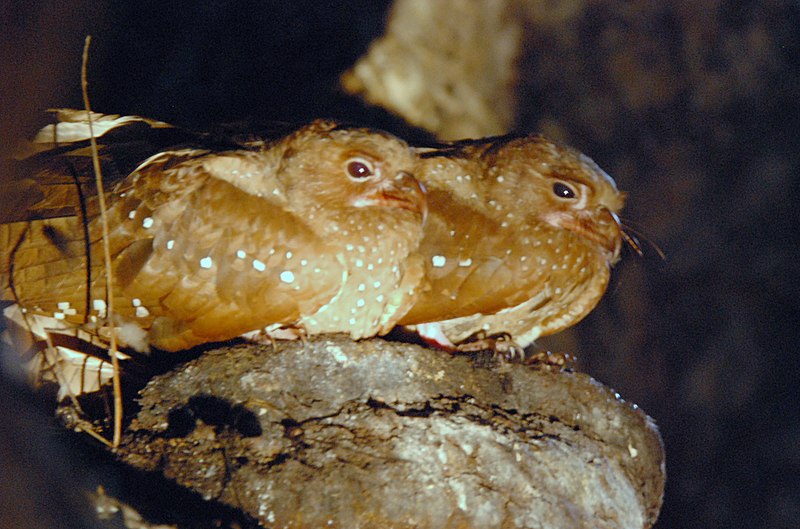
File:Oilbirds.jpg · Wikimedia Commons · See Wikimedia Commons
The Oilbird is a nocturnal bird species (*Steatornis caripensis*) found in South America that navigates caves using echolocation, making it one of the few birds capable of this sophisticated ability. It is notable for feeding on the oily fruits of palm and laurel trees and for its unique role as an ecosystem indicator, as it roosts in caves where its guano accumulation has historically been harvested.
AI-generated from the Wikipedia summary — may contain errors.
Species
Least Concern油鸱(学名:Steatornis caripensis)是单型科油鸱科中的唯一一种,为南美洲特有种。体长41–48厘米,双翼展开宽达0.91米。喙强壮有力,末端带钩。爪很小。通体大部分红棕色,颈背和翅膀带有白色斑点。栖息于洞穴中,拥有回声定位功能。夜行性,以植物的果实为食。 因为油鸱主要以油棕的果实为食,所以体内脂肪较多,特别是幼鸟体脂含量更高。所以南美当地的土著居民会在油鸱的繁殖季节大量捕捉油鸱幼鸟后煮制炼油,供照明使用。 油鸱科在分类上存在分歧,目前一般放在夜鹰目下。
via IUCN
Wikidata facts
- Instance of
- taxon
- Parent taxon
- Steatornis
- Image
- Oilbirds.jpg
Show 12 more facts
- taxon rank
- species
- IUCN conservation status
- Least Concern
- taxon name
- Steatornis caripensis
- Commons category
- Steatornis caripensis
- taxon common name
- uljašica
- litter size
- 2.8
- egg incubation period
- 33
- longest observed lifespan
- 12
- different from
- lipoma
- taxon range
- South America
- described by source
- Encyclopædia Britannica 11th edition
- short name
- S. caripensis
via Wikidata · CC0
~9 min read
Encyclopedic overview
9 sectionsContents
- Taxonomy and etymology
- Description
- Distribution and habitat
- Behaviour
- Breeding
- Status and conservation
- Footnotes
- References
- External links
thumb| Steatornis caripensis – MHNT
The oilbird (Steatornis caripensis), locally known as the ', is a bird species found in the northern areas of South America including the Caribbean island of Trinidad. It is the only living species in the genus Steatornis''', the family Steatornithidae, and the order Steatornithiformes. Nesting in colonies in caves, oilbirds are nocturnal feeders on the fruits of the oil palm and tropical laurels. They are the only nocturnal flying fruit-eating birds in the world (the kākāpō, also nocturnal, is flightless). They forage at night, with specially adapted eyesight. However, they navigate by echolocation in the same way as bats, one of the few birds to do so. They produce a high-pitched clicking sound of around 2 kHz that is audible to humans.
Excerpted from Wikipedia’s “Oilbird” article, available under the CC BY-SA 4.0 licence.