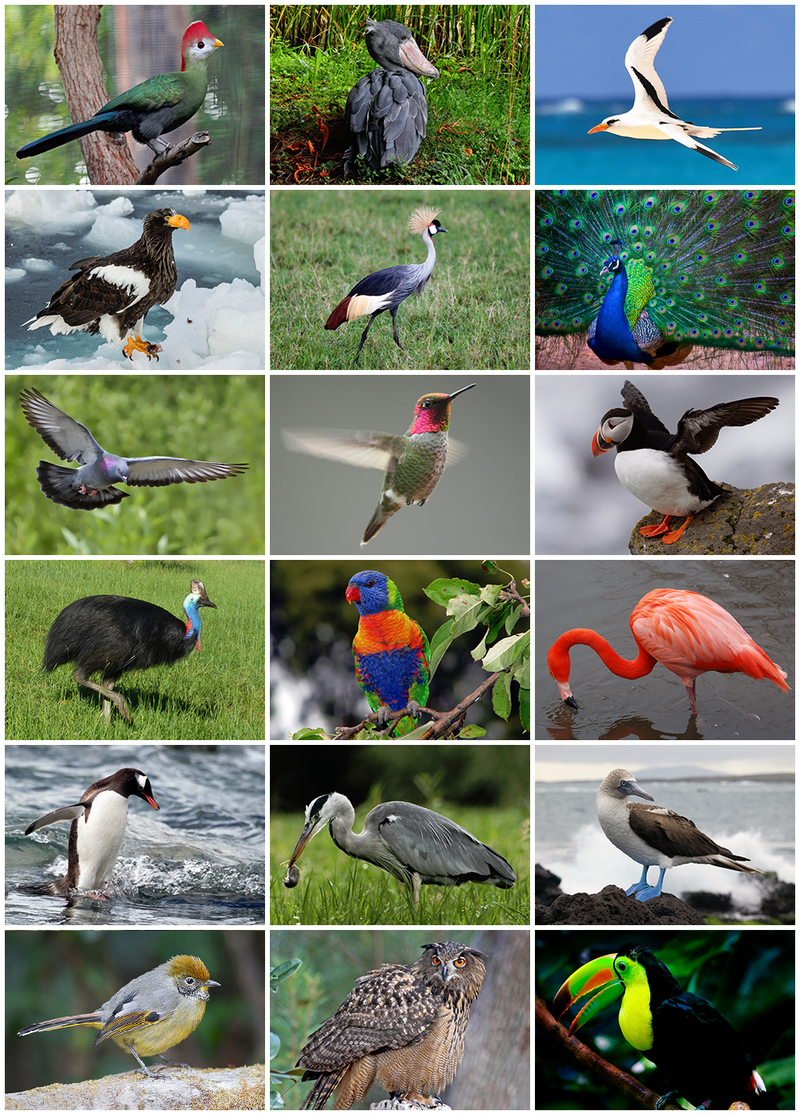
File:Bird_Diversity_2013.png · Wikimedia Commons · See Wikimedia Commons
bird
Sign in to saveAlso known as avian species, birds
Birds are a group of warm-blooded theropod dinosaurs constituting the class Aves, characterised by feathers, toothless beaked jaws, the laying of hard-shelled eggs, a high metabolic rate, a four-chambered heart, and a strong yet lightweight skeleton. Birds live worldwide and range in size from the bee hummingbird to the common ostrich. There are over 11,000 living species and they are split into 44 orders. More than half are passerine or "perching" birds. Birds have wings whose development varies according to species; the only known groups without wings are the extinct moa and elephant birds.
OverviewAI-generated
Aves is a taxon of the class rank within the parent taxon Ornithurae and the subclass Vertebrata. The organism is commonly known as birds, fugler, chiáu, or 鳥. It is an accepted class in the phylum Chordata. The habitat includes marine, brackish, and freshwater environments.
The taxon reproduces via oviparity. It produces bird vocalization and is studied by ornithology. Uses include bird flight, bird food, and broodiness. The taxon is a source of egg as food and meat. It is described by sources such as the Granat Encyclopedic Dictionary, Brockhaus and Efron Encyclopedic Dictionary, Encyclopædia Britannica 11th edition, and New International Encyclopedia.
Synthesized by Vinony from 31 facts across 4 sources: Wikidata, PubMed, WoRMS, Vinony graph. Generated from structured data (not the Wikipedia text) and checked against those facts — may still contain errors.
Species
birds
Class
- PhylumChordata
- ClassAves
關於与「鸟」名称相近或相同的条目,請見「鸟 (消歧义)」。 鸟主题 鸟是鸟纲(学名:Aves)动物的通称,为两足、恒温、卵生、身披羽毛、前肢演化成翅膀、具有坚硬的喙、擁有色彩鮮艷的羽毛或者流線型的身軀,根據品種的不同可陸生、飛行或者潛水的一種有脊椎動物。现代定义的鸟纲包括了现生鸟类的最近共同祖先及其后代,目前鳥類共有8600種,如果算入未被分類和不確定的有9000多種。过去广义的鸟纲曾笼统地包括始祖鳥、孔子鳥、黃昏鳥等已灭绝的史前类群,但現在比較常用鳥翼類(Avialae)来包括这些不再属于鸟纲的史前近亲,它们又被称為鳥形恐龍,是在地球上一個僅存的、存活到现代的恐龙总目直系,用科學上最嚴謹的說法,鸟纲就是鳥翼類的冠群。所有鳥類都是從1億5,000万年前的侏羅紀到2億年前白堊紀這一段時間內,由恐龍總目中的獸腳亞目虛骨龍類近鳥型恐龍進化而來。 鸟的体型大小不一,最大的鴕鳥體高可達2.5米,而最小的吸蜜蜂鳥體長僅5厘米。目前已知的现存鸟类共有一万多种,中国境内有分布记录的鸟类有1,300多种,其中特有种至少有70多种。与其他陆生脊椎动物相比,鸟是一个拥有很多独特生理特点的种类。鸟的食物多种多样,包括植物的花蜜、种子、果实、叶、芽、根、茎等各种组织,昆虫、甲壳类的各种无脊椎动物,鱼、鸟及其它中小型脊椎动物,甚至包括其他动物的蛋、腐肉、动物粪便和生活垃圾。多数的鸟在日间活动,也有一些鸟在夜间或者黄昏的时候活动(例如夜鷹、猫头鹰等)。许多鸟都会进行长距离迁徙以寻找最佳栖息地(例如北极燕鸥),也有一些鸟大部分时间都在海上度过(例如信天翁)。大多数鸟类都会飞行,不能飞的鸟包括古颚总目下的鸵鸟、鸸鹋、几维鸟等多数种类,企鹅目的全部鸟类,某些生活在没有地面捕猎者的孤立海岛上的鸟类如鹦鹉目的鸮鹦鹉,也在进化过程失去了飞行能力。许多不能飞行的鸟类因人类到来后的过度狩猎捕捉或农业生产破坏其栖息地而灭绝,如渡渡鸟、大海雀、恐鸟等。史前时期也有大量鸟类在演化过程灭亡,只留下化石痕迹,如冠恐鸟形目。
via
Research
318,754 papers- Bird Species Involved in West Nile Virus Epidemiological Cycle in Southern Québec.ReviewInternational journal of environmental research and public health · 2020Taieb L, Ludwig A, Ogden NH et al.DOI: 10.3390/ijerph17124517
- A comprehensive review of edible bird's nest.ReviewFood research international (Ottawa, Ont.) · 2021Dai Y, Cao J, Wang Y et al.DOI: 10.1016/j.foodres.2020.109875
- The potential cutaneous benefits of edible bird's nest.ReviewArchives of dermatological research · 2024Wang J, Patel P, Mineroff J et al.DOI: 10.1007/s00403-024-02824-5
- The bird's immune response to avian pathogenic Escherichia coli.ReviewAvian pathology : journal of the W.V.P.A · 2021Alber A, Stevens MP, Vervelde LDOI: 10.1080/03079457.2021.1873246
- Secondary Metabolites of Bird's Nest Fungi: Chemical Structures and Biological Activities.ReviewJournal of agricultural and food chemistry · 2023Qi J, Gao YQ, Kang SJ et al.DOI: 10.1021/acs.jafc.3c00904
- Evolution of bird genomes-a transposon's-eye view.ReviewAnnals of the New York Academy of Sciences · 2017Kapusta A, Suh ADOI: 10.1111/nyas.13295
- A bird's migration decoded.Nature · 2021Lisovski S, Liedvogel MDOI: 10.1038/d41586-021-00510-4
- Bird-pollinated flowers in an evolutionary and molecular context.ReviewJournal of experimental botany · 2008Cronk Q, Ojeda IDOI: 10.1093/jxb/ern009
via PubMed
~85 min read
Encyclopedic overview
47 sectionsContents
- Evolution and classification
- Definition
- Dinosaurs and the origin of birds
- Early evolution
- Early diversity of bird ancestors
- Diversification of modern birds
- Classification of bird orders
- Genomics
- Distribution
- Anatomy and physiology
- Skeletal system
- Excretory system
- Reproductive system
- Respiratory and circulatory systems
- Heart type and features
- Organisation
- Nervous system
- Defence and intraspecific combat
- Feathers, plumage, and scales
- Flight
- Behaviour
- Diet and feeding
- Water and drinking
- Feather care
- Migration
- Communication
- Flocking and other associations
- Resting and roosting
- Breeding
- Social systems
- Territories, nesting and incubation
- Parental care and fledging
- Brood parasites
- Sexual selection
- Inbreeding depression
- Inbreeding avoidance
- Ecology
- Relationship with humans
- Economic importance
- In religion and mythology
- In culture and folklore
- In music
- Threats and conservation
- See also
- References
- Further reading
- External links
Birds are a group of warm-blooded theropod dinosaurs constituting the class Aves, characterised by feathers, toothless beaked jaws, the laying of hard-shelled eggs, a high metabolic rate, a four-chambered heart, and a strong yet lightweight skeleton. Birds live worldwide and range in size from the bee hummingbird to the common ostrich. There are over 11,000 living species and they are split into 44 orders. More than half are passerine or "perching" birds. Birds have wings whose development varies according to species; the only known groups without wings are the extinct moa and elephant birds. Wings, which are modified forelimbs, gave birds the ability to fly, although further evolution has led to the loss of flight in some birds, including ratites, penguins, and diverse endemic island species. The digestive and respiratory systems of birds are also uniquely adapted for flight. Some bird species of aquatic environments, particularly seabirds and some waterbirds, have further evolved for swimming. The study of birds is called ornithology.
Birds evolved from earlier theropods, and thus constitute the only known living dinosaurs. Likewise, birds are considered reptiles in the modern cladistic sense of the term, and their closest living relatives are the crocodilians. Birds are descendants of the primitive avialans (whose members include Archaeopteryx) which first appeared during the Late Jurassic. According to some estimates, modern birds (Neornithes) evolved in the Late Cretaceous or between the Early and Late Cretaceous (100 Ma) and diversified dramatically around the time of the Cretaceous–Paleogene extinction event 66 million years ago, which killed off the pterosaurs and all non-ornithuran dinosaurs.
Excerpted from Wikipedia’s “bird” article, available under the CC BY-SA 4.0 licence.
Gallery (634)
Available in 256 languages
- Español
- Français
- Deutsch
- 中文
- 日本語
- Русский
- Português
- Italiano
- العربية
- हिन्दी
- abstract
- Achinese
- Adyghe
- Afrikaans
- Akan
- Albanian
- Albanian
- Amharic
Show 237 more
- Angika
- Aragonese
- Aramaic
- Armenian
- Arpitan
- Assamese
- Asturian
- Atikamekw
- Avaric
- Aymara
- azb
- Azerbaijani
- Bahasa Indonesia
- Balinese
- Bangla
- Banjar
- Bashkir
- Basque
- bat_smg
- Batak Toba
- Bavarian
- bdr
- be_x_old
- Belarusian
- Betawi
- Bhojpuri
- Bikol
- Bislama
- Bosnian
- Breton
- Bulgarian
- Buriat
- Burmese
- Catalan
- cdo
- Cebuano
- Central Dusun
- Central Kurdish
- Chechen
- Cherokee
- Cheyenne
- Chuvash
- Cornish
- Croatian
- Czech
- dag
- Danish
- Dinka
- Egyptian Arabic
- eml
- Erzya
- Esperanto
- Estonian
- Ewe
- Extremaduran
- Faroese
- Fiji Hindi
- Fijian
- Filipino
- Finnish
- fiu_vro
- Galician
- Gan Chinese
- gcr
- Georgian
- Gothic
- Greek
- Guarani
- Gujarati
- Haitian Creole
- Hakka Chinese
- Hausa
- Hebrew
- Hungarian
- hyw
- Iban
- Icelandic
- Ido
- Iloko
- Inari Sami
- Ingush
- Interlingua
- Interlingue
- Inupiaq
- Irish
- Jamaican Creole English
- Javanese
- Kabardian
- Kabyle
- Kalmyk
- Kannada
- Kanuri
- Kara-Kalpak
- Kashmiri
- Kashubian
- Kazakh
- kbp
- kge
- Khmer
- Kinyarwanda
- Komi-Permyak
- Kotava
- Kurdish
- kus
- Kyrgyz
- Lao
- Latgalian
- Latin
- Latvian
- lbe
- Lezghian
- Ligurian
- Limburgish
- Lingala
- Lingua Franca Nova
- Lithuanian
- lld
- Lojban
- Lombard
- Low German
- Lower Sorbian
- Luxembourgish
- Macedonian
- Madurese
- Malagasy
- Malay
- Malayalam
- Maltese
- Manipuri
- Manx
- Marathi
- Mari
- Mazanderani
- Minangkabau
- Mingrelian
- Moksha
- Mongolian
- Moroccan Arabic
- Navajo
- nds_nl
- Neapolitan
- Nederlands
- Nepali
- Newari
- Northern Frisian
- Northern Sami
- Norwegian
- Norwegian Nynorsk
- nrm
- Occitan
- Odia
- Old English
- olo
- Oromo
- Ossetic
- Pampanga
- Papiamento
- Pashto
- Pennsylvania German
- Picard
- Piedmontese
- Polski
- ppl
- Punjabi
- Quechua
- roa_rup
- Romanian
- Romansh
- Rusyn
- Sanskrit
- Santali
- Sardinian
- Saterland Frisian
- Scots
- Scottish Gaelic
- Serbian
- Serbian (Latin)
- Shan
- Shona
- Sicilian
- Silesian
- simple
- Sindhi
- Sinhala
- Slovak
- Slovenian
- Somali
- Sundanese
- Svenska
- Swahili
- Swati
- szy
- Tachelhit
- Tajik
- Tamil
- Tatar
- tay
- tdd
- Telugu
- Tibetan
- Tiếng Việt
- Tok Pisin
- Toki Pona
- Tulu
- Tumbuka
- Türkçe
- Turkmen
- Udmurt
- Ukrainian
- Upper Sorbian
- Urdu
- Uyghur
- Uzbek
- Venetian
- Veps
- Volapük
- Walloon
- Waray
- Welsh
- West Flemish
- Western Frisian
- Western Mari
- Western Panjabi
- Wu Chinese
- Yakut
- Yiddish
- Yoruba
- Zaza
- Zeelandic
- zh_classical
- zh_min_nan
- zh_yue
- Zhuang
- Zulu
- فارسی
- ไทย
- 한국어
via Wikidata sitelinks · CC0