Ophelia
Sign in to savepainting by John Everett Millais
Key facts
- Artist
- John Everett Millais
- Year
- 1851–1852
- Medium
- Oil on canvas
- Dimensions
- 30.0 inches (76.2 cm) × 44.0 inches (111.8 cm)
- Location
- Tate Britain , London
via Wikipedia infobox
Described at
The Story of Ophelia | Tate
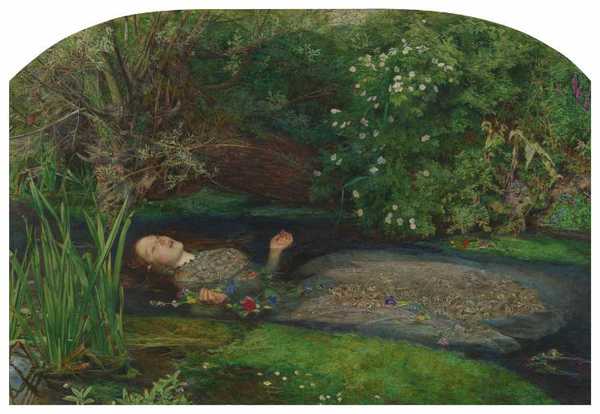
tate.org.uk →Ophelia is one of the most popular Pre-Raphaelite works in the Tate collection. The painting was part of the original Henry Tate Gift in 1894. Millais’s image of the tragic death of Ophelia, as she falls into the stream and drowns, is one of the best-known illustrations from Shakespeare’s play Hamlet . The Pre-Raphaelites focused on serious and significant subjects and were best known for painting subjects from modern life and literature often using historical costumes. They painted directly from nature itself, as truthfully as possible and with incredible attention to detail. Millais painted Ophelia between 1851 and 1852 in two separate locations. He painted the landscape part of the painting outside, by the Hogsmill River at Ewell in Surrey; and painted the figure of Ophelia inside in his Gower Street studio in London. At the time Millais was painting, it was common for artists to work outside to produce sketches. They then took these back to their studio and used them as reference to create a larger finished painting. However, Millais and his Pre-Raphaelite friends completed their paintings outside in the open air, which was unusual for the time. Millais did not give himself as long to paint the figure of Ophelia as he did to paint the landscape. Traditionally, the landscape was often considered the less important part of painting and therefore painted second. Millais and the Pre-Raphaelites believed the landscape was of equal importance to the figure, and so for Ophelia , it was painted first. Millais’s model was a young woman aged nineteen called Elizabeth Siddall. She was discovered by his friend, Walter Deverell, working in a hat shop. She later married one of Millais’s friends, Dante Gabriel Rossetti, in 1860. To create the effect of Elizabeth pretending to be Ophelia drowning in the river, she posed for Millais in a bath full of water. To keep the water warm some oil lamps were placed underneath. On one occasion, the lamps went out and Millais was so engrossed by his painting that he didn’t even notice! During her time posing for the painting, Elizabeth got very cold and became quite ill. With no National Health Service or readily available medicine, Elizabeth was looked after by a private doctor paid for by Elizabeth’s father who then ordered Millais to pay the fifty medical bills. The matter was settled and Miss Siddall recovered quickly. While posing, Elizabeth wore a very fine silver embroidered dress bought by Millais from a second-hand shop for four pounds. For such an important painting, Millais only made a few preparatory sketches for Ophelia . An oil study Head of Ophelia (with Wreath) was produced in 1852, but its current whereabouts are unknown. Ophelia is a character in Hamlet , by William Shakespeare. She is driven mad when her father, Polonius, is murdered by her lover, Hamlet. She dies while still very young, suffering from grief and madness. The events shown in Millais’s Ophelia are not actually seen on stage. Instead they are referred to in a conversation between Queen Gertrude and Ophelia’s brother Laertes. Gertrude describes how Ophelia fell into the river while picking flowers and slowly drowned, singing all the while. Queen Gertrude: There is a willow grows askant the brook, That shows his hoar leaves in the glassy stream. Therewith fantastic garlands did she make Of crowflowers, nettles, daisies, and long purples That liberal shepherds give a grosser name, But our cold maids do dead-men’s-fingers call them. There on the pendent boughs her crownet weeds Clambering to hang, an envious sliver broke, When down her weedy trophies and herself Fell in the weeping brook. Her clothes spread wide, And mermaid-like awhile they bore her up; Which time she chanted snatches of old tunes, As one incapable of her own distress, Or like a creature native and indued Unto that element. But long it could not be Till that her garments, heavy with their drink, Pulled the poor wretch from her melodious lay To
Excerpt from a page describing this subject · 29,904 chars · not written by Vinony
Wikidata facts
- Instance of
- painting
- Country
- United Kingdom
- Located in
- City of Westminster
- Owned by
- Tate
- Genre
- history painting
- Based on
- Hamlet
- Main subject
- Ophelia
- Depicts
- Viola
- Movement
- Pre-Raphaelite Brotherhood
- Material used
- canvas
- Creator
- John Everett Millais
- Collection
- Tate Britain
- Location
- Tate Britain
- Image
- John Everett Millais - Ophelia - Google Art Project.jpg
- Height
- 111.8
- Width
- 76.2
Show 8 more facts
- described at URL
- www.tate.org.uk/art/artworks/millais-ophelia-n01506
- inventory number
- NG1506
- Commons category
- Ophelia (painting) by John Everett Millais
- model
- Elizabeth Siddal
- title
- Ophelia
- copyright status
- public domain
- native label
- Ophelia
- fabrication method
- oil painting
Sources (8)
via Wikidata · CC0
~11 min read
Encyclopedic overview
Ophelia is an 1851–52 painting by British artist John Everett Millais in the collection of Tate Britain, London. It depicts the young Danish noblewoman Ophelia in William Shakespeare's play Hamlet, who, due to Hamlet's actions, loses her sanity and drowns.
The painting, modelled by Elizabeth Siddal, received mixed responses when first exhibited at the Royal Academy of Arts in London, but is today widely regarded as one of the most important mid-nineteenth-century works, and is renowned for its beauty and natural landscape. The work has influenced artists such as John William Waterhouse, Peter Blake, Ed Ruscha and Friedrich Heyser.
Excerpted from Wikipedia’s “Ophelia” article, available under the CC BY-SA 4.0 licence.