Osmundaceae · Kew POWO · Kew Plants of the World Online
Osmundaceae
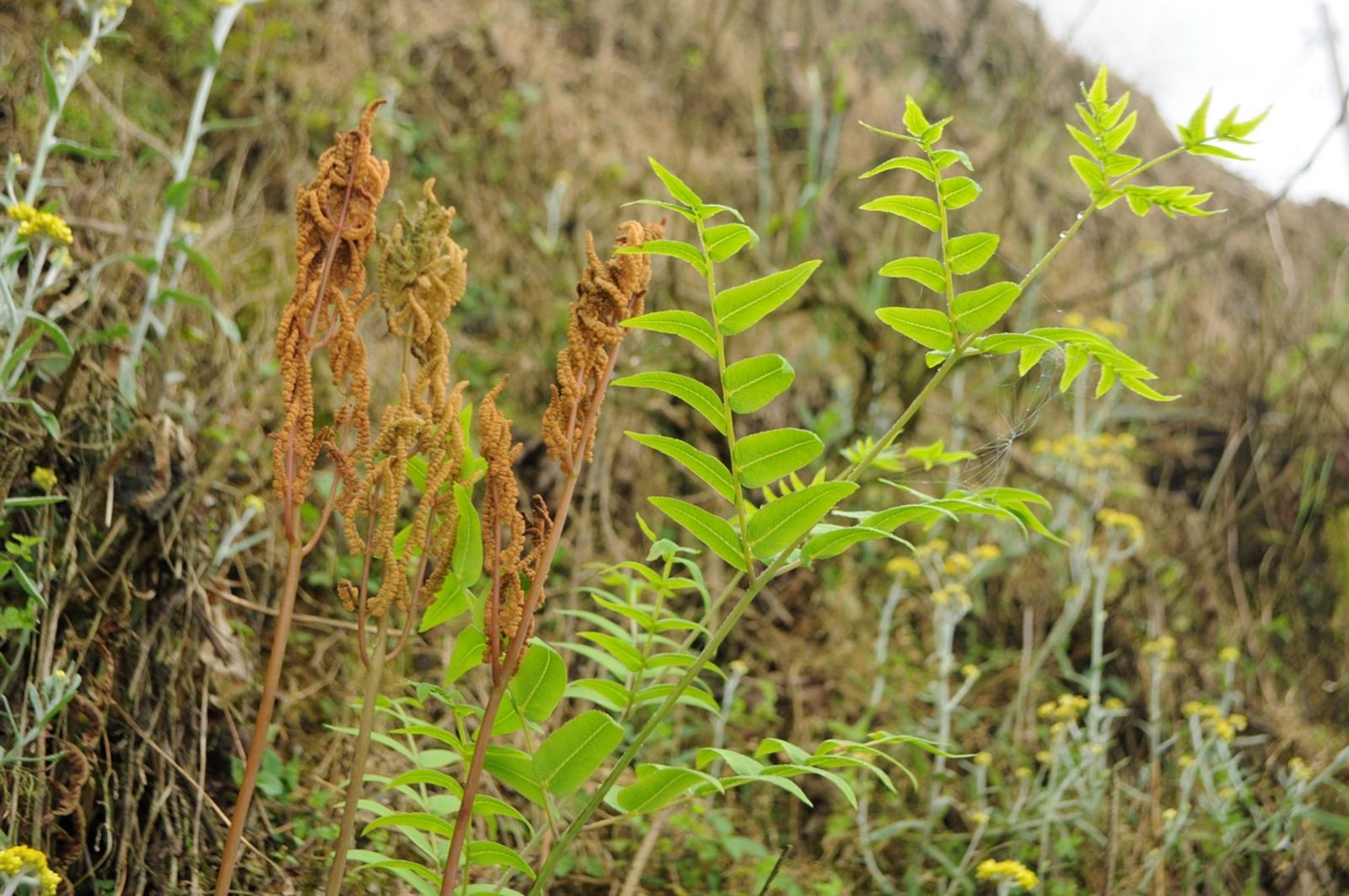
Sign in to saveOsmundaceae (royal fern family) is a family of ferns containing four to six extant genera and 18–25 known species. It is the only living family of the order Osmundales in the class Polypodiopsida (ferns) or in some classifications the only order in the class Osmundopsida. This is an ancient (known from the Upper Permian) and fairly isolated group that is often known as the "flowering ferns" because of the striking aspect of the ripe sporangia in Claytosmunda, Osmunda, Osmundastrum, and Plensium (subtribe Osmundinae). In these genera the sporangia are borne naked on non-laminar pinnules, while
Species
FAMILY
- KingdomPlantae
- PhylumTracheophyta
- ClassPolypodiopsida
- OrderOsmundales
- FamilyOsmundaceae
via GBIF · Kew POWO
Museum specimens
- Specimen records
- 64
- With media
- 31
- Family
- Osmundaceae
- Collections
- IBUNAM, MICH, TENN, TAES, GAS, UTC
- Recorded in
- Panama, United States, Canada, China
Wikidata facts
- Instance of
- taxon
- Parent taxon
- Osmundales
- Image
- OsmundaRegalis.jpg
Show 6 more facts
- Commons category
- Osmundaceae
- taxon rank
- family
- taxon name
- Osmundaceae
- topic's main category
- Category:Osmundaceae
- taxon common name
- 紫萁科
Sources (1)
via Wikidata · CC0
~12 min read
Encyclopedic overview
7 sectionsContents
- Description
- Taxonomy
- Subdivision
- Evolution
- References
- Bibliography
- External links
Osmundaceae (royal fern family) is a family of ferns containing four to six extant genera and 18–25 known species. It is the only living family of the order Osmundales in the class Polypodiopsida (ferns) or in some classifications the only order in the class Osmundopsida. This is an ancient (known from the Upper Permian) and fairly isolated group that is often known as the "flowering ferns" because of the striking aspect of the ripe sporangia in Claytosmunda, Osmunda, Osmundastrum, and Plensium (subtribe Osmundinae). In these genera the sporangia are borne naked on non-laminar pinnules, while Todea and Leptopteris (subtribe Todinae) bear sporangia naked on laminar pinnules. Ferns in this family are larger than most other ferns.
== Description == The stems of Osmundaceae contain vascular tissue arranged as an ectophloic siphonostele; that is, a ring of phloem occurs on the outside only of a ring of xylem, which surrounds pith (and no other vascular tissue). Stipules can be discerned at the leaf bases of these ferns. The hardened leaf bases are persistent and overlap to form a hardened layer surrounding the stem. The mantle of sclerenchymatous leaf bases and intermixed roots can form a woody trunk when the stem emerges above ground, up to in Todea barbara. Extinct members of the family, which flourished during the Mesozoic, could reach the stature of trees and be termed tree ferns. The leaves are either holodimorphic, with separate fertile and sterile fronds assuming an entirely different structure, or have fertile and sterile portions of the frond very distinct in structure.
Excerpted from Wikipedia’s “Osmundaceae” article, available under the CC BY-SA 4.0 licence.