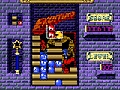
Pac-Attack · RAWG · Courtesy of RAWG
Pac-Attack
Sign in to savealso known as is a 1993 falling-tile puzzle video game developed and published by Namco for the Super Nintendo Entertainment System. Versions for the Sega Genesis, Game Boy, Game Gear, and Philips CD-i were also released. The player is tasked with clearing out blocks and ghosts without them stacking to the top of the playfield — blocks can be cleared by matching them in horizontal rows, while ghosts can be cleared by placing down a Pac-Man piece that can eat them. It is the first Pac-Man game to be released exclusively for home platforms.
Game details · IGDB
Based on Namco's Japanese-only arcade puzzler Cosmo Gang the Puzzle, Pac-Attack is similar to many block-dropping puzzle games from the time, such as Puyo Puyo. The objective of the game is to place ghosts and blocks that are arranged in a three part L-shaped piece, so that Pac-Man, after three or more pieces (who replaces one of the parts), can eat as many ghosts as possible to try and clear up the game area. Pac-Man's directions are chosen at random between left or right, but as he goes moving on in the game area (after you place him, of course), if he bumps against a block or the "walls…
- Released
- 1993
- Genres
- Puzzle
- Platforms
- Super Nintendo Entertainment System, Wii, Sega Mega Drive/Genesis, iOS, Wii U
- Game modes
- Single player, Multiplayer, Split screen
- Franchise
- Pac-Man
- Developer
- Namco
- Publisher
- Namco, Namco Bandai Games, Bandai Namco Entertainment
Wikidata facts
- Instance of
- video game
- Genre
- puzzle video game
- Country of origin
- United States
- Publisher
- Namco
- Developer
- Namco
- Platform
- Wii U
- Game mode
- single-player video game
- Official website
- www.pac-attack.com
Show 5 more facts
- publication date
- 1993-01-01
- distributed by
- App Store
- input device
- touchscreen
- language of work or name
- English language
- operating system
- iOS
via Wikidata · CC0
~9 min read
Encyclopedic overview
5 sectionsContents
- Gameplay
- Development and release
- Reception
- Notes
- References
also known as is a 1993 falling-tile puzzle video game developed and published by Namco for the Super Nintendo Entertainment System. Versions for the Sega Genesis, Game Boy, Game Gear, and Philips CD-i were also released. The player is tasked with clearing out blocks and ghosts without them stacking to the top of the playfield — blocks can be cleared by matching them in horizontal rows, while ghosts can be cleared by placing down a Pac-Man piece that can eat them. It is the first Pac-Man game to be released exclusively for home platforms.
Pac-Attack is an adaptation of the 1992 game Cosmo Gang the Puzzle, which was released for arcades worldwide and for the Super Famicom in Japan. Music was composed by Hiromi Shibano, and the cover art was designed by Greg Martin. To promote the game's release, a contest was held in GameFan magazine that awarded cash prizes to players who submitted their highest scores.
Excerpted from Wikipedia’s “Pac-Attack” article, available under the CC BY-SA 4.0 licence.
Available in 9 languages
via Wikidata sitelinks · CC0