File:Die_Gartenlaube_(1887)_b_016.jpg · Wikimedia Commons · See Wikimedia Commons
paganism
Sign in to saveAlso known as heathenism, heathenry
I don't have context provided to base an overview on. Could you please share the context material you'd like me to use as the foundation for the 2-sentence overview of paganism?
AI-generated from the Wikipedia summary — may contain errors.
Wikidata facts
- Instance of
- group of humans
- Subclass of
- religion
- Has part
- pagan
- Image
- Walpurgisnacht.jpg
Show 3 more facts
- Commons category
- Paganism
- topic's main category
- Category:Paganism
- on focus list of Wikimedia project
- Wikipedia:Vital articles/Level/4
via Wikidata · CC0
~45 min read
Encyclopedic overview
36 sectionsContents
- Etymology and nomenclature
- Pagan
- Hellene
- Heathen
- Definition
- Perception and Ethnocentrism
- History
- Prehistoric
- Bronze Age to Early Iron Age
- Ancient history
- Classical antiquity
- Late Antiquity
- In Albania
- Postclassical history
- The Byzantine lineage
- The End of the Athenian and Alexandrian Schools (5th–6th Century)
- The Macedonian Renaissance and Komnenian Era (9th–12th Century)
- The Palaiologan Renaissance (13th–15th Century)
- The Arabic transmission
- Harran
- The Sabian Core: Pagan Identity and Literary Transmission
- The Transmission to the Latin West (13th Century)
- Islam in Arabia
- Modern history
- Early Modern Renaissance
- Late Modern Romanticism
- In Italy
- Late 20th century
- Modern paganism
- 21st century
- Ethnic religions of pre-Christian Europe
- Reconstructionist groups
- See also
- Notes
- References
- External links
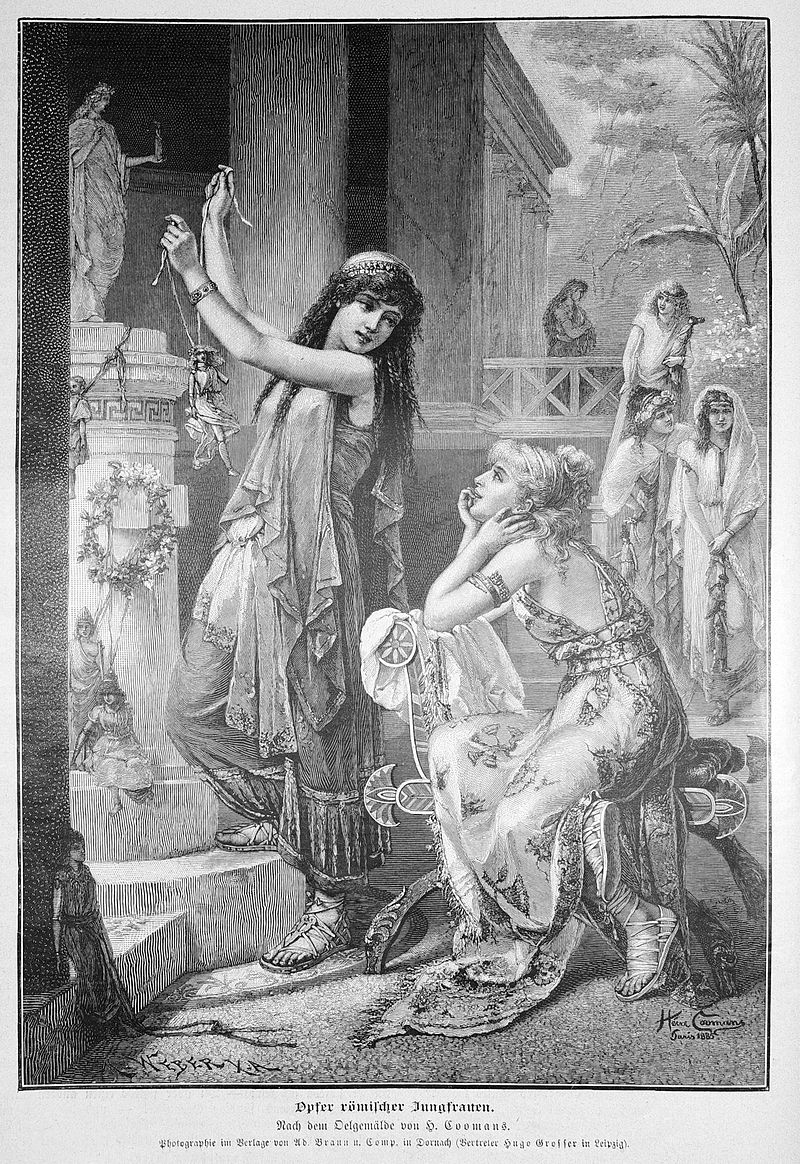
thumb|Engraving depicting two Roman women offering a ritual sacrifice to the pagan goddess Vesta, 1887 In early Christianity, paganism (from , ) collectively referred to the diverse religious practices of all people who were polytheists. More specifically, it denoted anyone who did not adhere to an Abrahamic religion in the Roman Empire. Individuals fell into the pagan class either because they were increasingly rural and provincial relative to the Christian population or because they were not a soldier of Christ (). Terms synonymously used in Christian texts of the period include heathen, Hellene, and gentile. A widely regarded indication of whether a person was a pagan or a Christian was their partaking in ritual sacrifice, which was an integral part of Greco-Roman religion. Paganism has broadly connoted the "religion of the peasantry" in Christian thought.
During and after the Middle Ages, Christians generally applied the term "pagan" to any non-Christian group with the implication of belief in false gods. The origin of the term's application to polytheism, however, is debated. In the 19th century, paganism was adopted as a self-descriptor by members of various artistic groups inspired by the ancient world. In the 20th century, it came to be applied as a self-descriptor by practitioners of modern paganism, modern pagan movements, and polytheistic reconstructionists. Modern pagan traditions often incorporate beliefs or practices (such as nature worship) that are different from those of the world's largest religions.
Excerpted from Wikipedia’s “paganism” article, available under the CC BY-SA 4.0 licence.
Gallery (24)
Available in 101 languages
- Español
- Français
- Deutsch
- 中文
- 日本語
- Русский
- Português
- Italiano
- العربية
- हिन्दी
- Afrikaans
- Albanian
- Albanian
- Armenian
- Asturian
- azb
- Azerbaijani
- Bahasa Indonesia
Show 82 more
- Bangla
- Bashkir
- Basque
- bat_smg
- Bavarian
- be_x_old
- Belarusian
- Betawi
- Bosnian
- Breton
- Bulgarian
- Catalan
- Chuvash
- Croatian
- Czech
- Danish
- Esperanto
- Estonian
- Filipino
- Finnish
- Galician
- Georgian
- Gothic
- Greek
- Hebrew
- Hungarian
- Iban
- Icelandic
- Ido
- Irish
- Kanuri
- Kazakh
- Kurdish
- Latin
- Latvian
- Limburgish
- Lingua Franca Nova
- Lithuanian
- Lombard
- Low German
- Macedonian
- Malagasy
- Malay
- Malayalam
- Nederlands
- Norwegian
- Norwegian Nynorsk
- nrm
- Occitan
- Pashto
- Polski
- Romanian
- Saterland Frisian
- Scots
- Serbian
- Serbian (Latin)
- Sicilian
- simple
- Slovak
- Slovenian
- Svenska
- Swahili
- Tamil
- Tatar
- Telugu
- Tiếng Việt
- Toki Pona
- Türkçe
- Ukrainian
- Urdu
- Uzbek
- Walloon
- Waray
- Welsh
- Western Frisian
- Wu Chinese
- Yiddish
- Zaza
- zh_yue
- فارسی
- ไทย
- 한국어
via Wikidata sitelinks · CC0