
File:Pollen_and_spore_grains_in_brightfield,_DIC_and_confocal_microscopy_-_Jaramillo_et_al_2025_-_PPP_Figure_1.jpg · Wikimedia Commons · See Wikimedia Commons
palynology
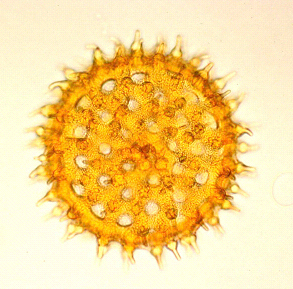
Sign in to savethumbnail|300px| Pine [[pollen under the microscope]] thumb|300px| A late Silurian [[sporangium bearing trilete spores. Such spores provide the earliest evidence of life on land. Green: A spore tetrad. Blue: A spore bearing a trilete mark – the Y-shaped scar. The spores are about 30–35 μm across.]]
Palynology is the scientific study of pollen and spores, which are examined under microscopes to understand their structure and characteristics. This field matters because pollen and spores provide important evidence about past life on Earth, including some of the earliest evidence of life moving onto land.
AI-generated from the Wikipedia summary — may contain errors.
Described at
Palynology – Paleobotany + Palynology
floridamuseum.ufl.edu →What Is Palynology? Palynology is the study of plant pollen, spores and certain microscopic plankton organisms (collectively termed palynomorphs) in both living and fossil form. Botanists use living pollen and spores (actuopalynology) in the study of plant relationships and evolution, while geologists (palynologists) may use fossil pollen and spores (paleopalynology) to study past environments, stratigraphy (the analysis of strata or layered rock) historical geology and paleontology. The oil industry is credited with demonstrating the usefulness of palynomorphs in the study of stratigraphic sequences of rocks and the potential for oil and gas exploration. Because palynomorphs are resistant to decomposition and are produced in great abundance, their recovery from rocks and sediments via special and careful chemical treatments is possible and provides scientists with information needed to describe plant life of past ages. By describing the sequence of selected palynomorphs through the rock layers of Earth, stratigraphers (scientists who study the rock layers of the earth) are able to correlate rocks of the same age and may therefore locate and correlate layers that contain oil or natural gas. Palynomorphs recovered from the gut or intestinal tract of early humans, and those associated with artifacts (pots, tools, or other cultural objects) found at their grave sites have been used to understand the diets and hunting practices of these early people. For instance, the pollen and spores found in the feces recovered from the mummies of humans living seven thousand years ago, allowed scientists to describe the changes in diets through several generations of native people in northern Chile. Melissopalynology is the study of pollen in honey, with the purpose of identifying the source plants used by bees in the production of honey. This is important to honey producers because honey produced by pollen and nectar from certain plants as mesquite, buckwheat, tupelo or citrus trees demand a higher price on the market than that produced by other plant sources. Some plants may produce nectar and pollen that is harmful to human health. A careful monitoring of the pollen types found in honey may identify these toxic sources and the honey produced may be kept out of the commercial market. Jarzen, D.M. and McAllister, D.E. 1994. Eco-services: l. Pollination – love in the plant world benefits the whole world. Wildflower, North America’s Magazine of Wild Flora, volume 10, number 3, pages 24-27. Fossil pollen grain from Eocene rocks (55 million years old) from west-central Florida. Photo by D.M.Jarzen The Palynology collections at the Florida Museum of Natural History are many and diverse. The collection was started in earnest in 1997 with the hiring of D.M. Jarzen on staff as Collection Manager for the Paleobotany and Palynology section. The various components of the collection are itemized below. The John F. Grayson Library : Received as a donation to D.M. Jarzen through the courtesy of the Canadian Museum of Nature, Ottawa, Canada, the library consists of about 10,000 reprints, books, maps, and other materials associated with the career of John Grayson (Pan American Petroleum Corporation, Tulsa, OK). Since the establishment of the Grayson Library, other palynologists have donated part or all of their collections to the Florida Museum. These include the Dan Beju Library of mostly dinoflagellate papers numbering about 800, The Evan Kidson Library , S.A.J. Pocock Photographic Collection and the Don Engelhardt Library of more than 6,000 entries of papers, reprints, books and reports. The Modern Pollen Reference Collection includes 7,500 prepared slides of pollen and spores of primarily tropical regions of the world, used as reference material in palynologic analysis of Paleogene, Neogene and younger fossil assemblages. Included, is a fine collection of 600, Orchidaceae pollinia received as a donation from Dr. Pamela Burns Balogh . The Florida
Excerpt from a page describing this subject · 7,349 chars · not written by Vinony
Wikidata facts
- Instance of
- branch of science
- Subclass of
- botany
- Part of
- biology
- Image
- Misc pollen.jpg
Show 4 more facts
- is the study of
- pollen
- topic's main category
- Category:Palynology
- Commons category
- Palynology
- described at URL
- www.floridamuseum.ufl.edu/paleobotany/palynology
Sources (7)
via Wikidata · CC0
~16 min read
Encyclopedic overview
15 sectionsContents
- Palynomorphs
- Palynofacies
- History
- Early history
- 1890s to 1940s
- 1940s to 1989
- 1990s to the 21st century
- Methods of studying palynomorphs
- Chemical preparation
- Analysis
- Applications
- See also
- References
- Sources
- External links
thumbnail|300px| Pine [[pollen under the microscope]] thumb|300px| A late Silurian [[sporangium bearing trilete spores. Such spores provide the earliest evidence of life on land. Green: A spore tetrad. Blue: A spore bearing a trilete mark – the Y-shaped scar. The spores are about 30–35 μm across.]]
Palynology is the study of microorganisms and microscopic fragments of macroorganisms that are composed of acid-resistant organic material and occur in sediments, sedimentary rocks, and even some metasedimentary rocks. Palynomorphs are the microscopic, acid-resistant organic remains and debris produced by a wide variety of plants, animals, and Protista that have existed since the late Proterozoic.
Excerpted from Wikipedia’s “palynology” article, available under the CC BY-SA 4.0 licence.