
OverviewAI-generated
Panama is a sovereign state and republic located in Central America, with territory extending into North and South America. Its capital is Panama City. The country shares borders with Costa Rica and Colombia, and maintains a border with the United States. The official name is the Republic of Panama. It operates under a presidential system of government.
The nation has a population of 4,064,780 and covers an area of 75,417 square kilometers. Its highest point is Volcan Baru. The currency used is the Panamanian balboa and the United States dollar. The top-level Internet domain is .pa, and the telephone country code is +507. Panama is a member of the United Nations, the World Trade Organization, the International Bank for Reconstruction and Development, and the International Development Association.
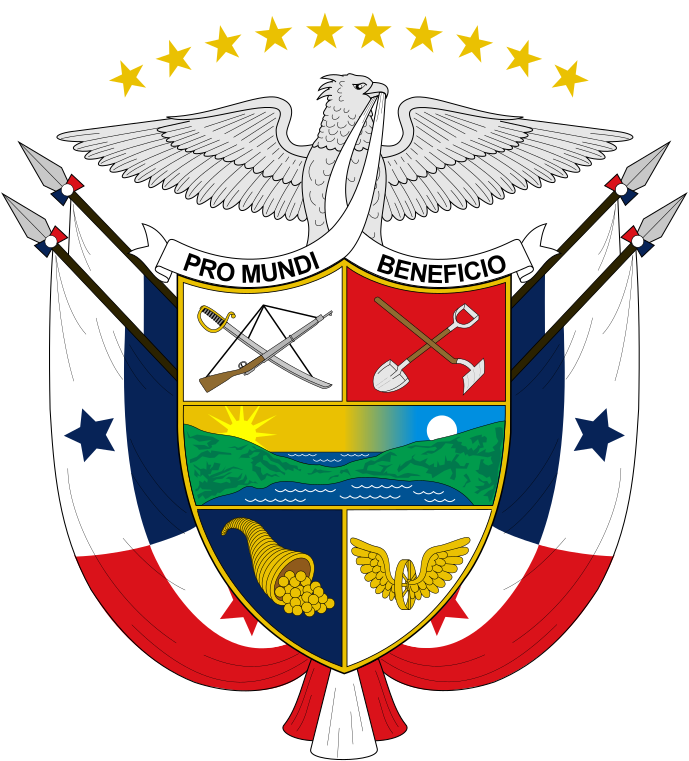
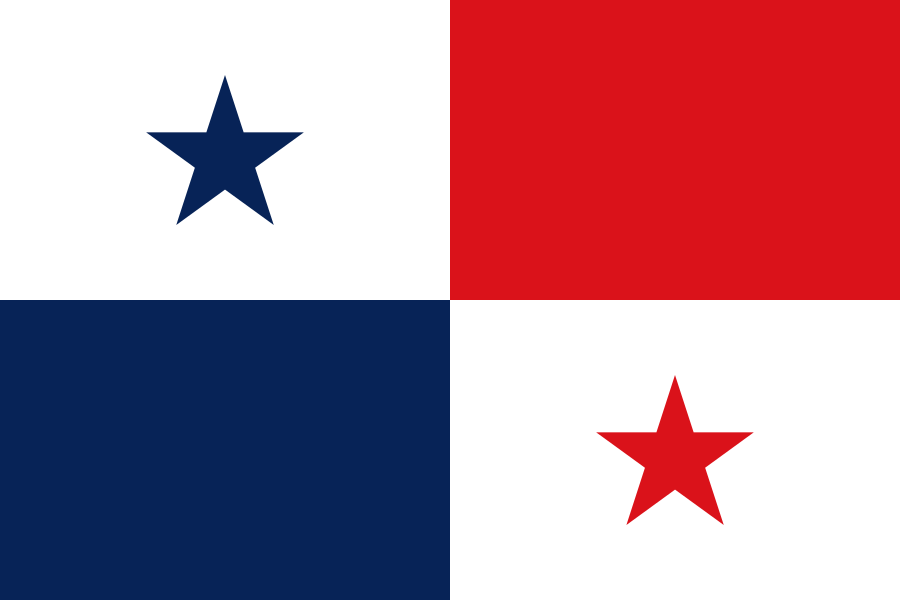
Administratively, Panama contains the Emberá-Wounaan Comarca, Guna Yala, Ngöbe-Buglé Comarca, and Madugandí. It is twinned with Incheon and Aisai. The national anthem is the National anthem of Panama, and the flag is the flag of Panama. The coat of arms is the coat of arms of Panama.
Synthesized by Vinony from 72 facts across 10 sources: Wikidata, REST Countries, Open Meteo, Openweathermap, World Bank, OpenStreetMap, Firecrawl, PubMed, Vinony graph, Geo. Generated from structured data (not the Wikipedia text) and checked against those facts — may still contain errors.
Weather now
7-day forecast
via Open-Meteo
Country
- Capital
- Panama City
- Population
- 4,064,780
- Region
- Americas · Central America
- Demonym
- Panamanian
- Currencies
- PAB (B/.), USD ($)
- Languages
- Spanish
- Calling code
- +507
- Drives on
- Right
- Gini
- 49.8 (2019)
- FIFA code
- PAN
- TLD
- .pa
- Timezones
- UTC-05:00
- Borders
- COL, CRI
via REST Countries
Indicators · World Bank
- GDP
- $86.5B(2024)
- Population
- 4,515,577(2024)
- Life expectancy
- 79.8 yrs(2024)
- Unemployment
- 8.4 %(2025)
- Urban population
- 66 %(2024)
- Internet users
- 72.8 %(2024)
- Forest area
- 56.3 %(2023)
- Renewable energy
- 28 %(2021)
via World Bank Open Data · CC BY 4.0
Wikipedia views (30d)
88,686 totalvia Wikimedia Pageviews API
Key facts
- Country.conventional_long_name
- Republic of Panama
- Country.common_name
- Panama
- Country.image_flag
- Flag of Panama.svg
- Country.image_coat
- Coat of arms of Panama.svg
- Country.national_motto
- Pro Mundi Beneficio (Latin)"For the Benefit of the World"
- Country.national_anthem
- "Hymn of the Isthmus"
- Country.capital
- Panama City
- Country.largest_city
- Panama City
- Country.official_languages
- Spanish
- Country.regional_languages
- GuaymíBuglereEmberáWounaanGunaTeribeBribri
- Country.ethnic_groups_year
- 2020
- Country.demonym
- Panamanian
- Country.government_type
- Unitary presidential republic
- Country.leader_title1
- President
- Country.leader_name1
- José Raúl Mulino
- Country.leader_title2
- Vice President
- Country.leader_name2
- Vacant
- Country.legislature
- National Assembly
via Wikipedia infobox
Research
12,462 papers- Characteristics of Madariaga and Venezuelan Equine Encephalitis Virus Infections, Panama.ReviewEmerging infectious diseases · 2024Rivera LF, Lezcano-Coba C, Galué J et al.DOI: 10.3201/eid3014.240182
- Panama.Department of State publication. Background notes series · 1985United States. Department of State. Bureau of Public Affairs
- Diabetes in Panama: Epidemiology, Risk Factors, and Clinical Management.ReviewAnnals of global health · 2015Mc Donald Posso AJ, Bradshaw Meza RA, Mendoza Morales EA et al.DOI: 10.1016/j.aogh.2015.12.014
- Mining threatens health of Panama's environment.Science (New York, N.Y.) · 2023Landires I, Castillero I, Ramos I et al.DOI: 10.1126/science.adm7959
- Panama.Department of State publication. Background notes series · 1992United States. Department of State. Bureau of Public Affairs. Office of Public Communication
- COVID-19: Panama stockpiles unproven drugs.Nature · 2020Torres-Atencio I, Goodridge A, Vega SDOI: 10.1038/d41586-020-03289-y
- Cardiovascular Surgery in Panama: Evolution and Training.Seminars in thoracic and cardiovascular surgery · 2023Rivas UE, Vinck EE, Jiménez OP et al.DOI: 10.1053/j.semtcvs.2021.10.001
- Drug utilization in Panama.ReviewJournal of clinical epidemiology · 1991Lee DDOI: 10.1016/0895-4356(91)90110-u
via PubMed
Official website

Welcome to Panamá | Beaches, Attractions & Things to Do
Visit Panamá, home to the Panama Canal, Bocas del Toro, Indigenous culture, stunning beaches, and nonstop flights to adventure and discovery.
visitpanama.com →Link to the official site · 10,978 chars · not written by Vinony
Wikidata facts
- Instance of
- country
- Official name
- la République du Panama
- Demonym
- 巴拿马人
- Country
- Panama
- Contains
- Bocas del Toro Province
- Continent
- North America
- Capital
- Panama City
- Official language
- Spanish
- Currency
- United States dollar
- Population
- 4570133
- Area
- 74177.3
- Head of government
- Mireya Moscoso
- Head of state
- José Raúl Mulino
- Form of government
- presidential system
- Legislature
- National Assembly of Panama
- Shares border with
- Colombia
- Highest point
- Volcan Baru
- Official website
- visitpanama.com/?lang=en
- Image
- Panama flag.png
- Life expectancy
- 79
- Nominal GDP
- 76522511781
- Unemployment rate
- 4
Show 60 more facts
- Calling code
- +507
- Licence plate code
- PA
- Mains voltage
- 110
- Motto
- Er Lles y Byd
- Flag
- flag of Panama
- Coat of arms
- coat of arms of Panama
- Significant event
- separation of Panama from Colombia
- twinned administrative body
- Aisai
- topic's main Wikimedia portal
- Portal:Panama
- top-level Internet domain
- .pa
- Commons category
- Panama
- topic's main category
- Category:Panama
- category for people who died here
- Category:Deaths in Panama
- category for people born here
- Category:Births in Panama
- category for films shot at this location
- Category:Films shot in Panama
- category of associated people
- Category:Panamanian people
- diplomatic relation
- Colombia
- history of topic
- history of Panama
- Commons gallery
- Panamá
- lowest point
- Caribbean Sea
- mobile country code
- 714
- driving side
- right
- geography of topic
- Geography of Panama
- age of majority
- 18
- marriageable age
- 18
- office held by head of government
- President of Panama
- number of out-of-school children
- 137470
- office held by head of state
- President of Panama
- has characteristic
- free country
- total fertility rate
- 2.444
- maritime identification digits
- 373
- inception
- 1903-01-01
- Unicode character
- 🇵🇦
- water as percent of area
- 2.9
- GS1 country code
- 745
- culture
- culture of Panama
- VAT rate
- 7
- BTI Status Index
- 6.58
- BTI Governance Index
- 5.35
- economy of topic
- economy of Panama
- demographics of topic
- demographics of Panama
- Democracy Index
- 6.84
- native label
- República de Panamá
- topic has template
- Template:Provinces and regions of Panama
- Human Development Index
- 0.805
- hashtag
- Panama
- on focus list of Wikimedia project
- Wikipedia:Vital articles/Level/4
- Happy Planet Index score
- 57.9
- Gini coefficient
- 49.8
- Inequality-adjusted Human Development Index
- 0.640
- replaces
- Department of Panama
- birth rate
- 17.4
- male population
- 2204410
- death rate
- 5.904
- rural population
- 1360444
- female population
- 2204170
- urban population
- 3048137
- located in/on physical feature
- Central America
Sources (15)
via Wikidata · CC0
Travel guide
Understand
The isthmus connects two major landmasses—South America with Central and North America—resulting in incredibly diverse flora and fauna. Panama is often cited as the country with the most bird species in the world, boasting close to 900. Several Indigenous tribes still thrive here, living much as their ancestors did, which contributes to the richness of the nation's cultural fabric.
The Panamanian government maintains strong ties with the United States and is highly supportive of business, development, and tourism. The International Monetary Fund has praised Panama’s diversified economy and predicts it will have one of the strongest GDP growth rates in the coming years. The country is well-known for its highly developed international banking sector, with nearly 80 banks from around the world—such as HSBC, BBVA, and Citi Bank—maintaining branches in Panama. The expanding Panama Canal continues to drive the country's service-based economy and remains one of the most important transportation hubs globally. Beyond its strong economic foundation, Panama's physical infrastructure—including modern hospitals, airports, and roads—is significantly more advanced than that of its Central American neighbors.
Panama is home to a large expatriate community; around 25,000 U.S. citizens live in the country. It's worthwhile to spend some time reading about Panama and connecting with locals, expats, and other travelers before arriving. Consider joining local forums, expat blogs, or the Central…
Get in
thumb|450px|Visa policy of Panama
See
thumb|Beach on Coiba Island The Panama Canal - one of the world's most important interoceanic connections and probably the first thing that comes to your mind when thinking about Panama. There are different ways to explore the canal: the most visited place at the canal is the Miraflores Visitor Center / Miraflores Locks in Panama City (see the city's article for details). It is located at the old canal with its smaller locks for smaller ships, but still very impressive. To see the new, expanded canal, you can visit the Agua Clara Visitor Center in the city of Colon (Panama), on the Caribbean side of the canal. In addition, it is also possible to book a luxury train ride along the canal, or a boat ride on the canal. Panama City - being not only the capital city of, but also by far the biggest and most populous city in Panama, it is the economic and cultural heart of the country.
Do
Panama's strongest attraction is its diversity. In less than five days you can visit a beach, a mountain, a modern city and historic ruins. While in Panama City don't miss the four must-dos: the Panama Canal, Panama Viejo, Casco Antiguo (also known as Casco Viejo) and the jungles surrounding the Canal area.
Panama Viejo was the first city of Panama, founded by the Spanish in 1519. It was the first city founded at the Pacific and it became rapidly a prosperous point where gold from the southern colonies would make it to the Caribbean and later to Europe. It was attacked by pirates several times, the last of them by Pirate Henry Morgan who destroyed it in 1671. In 1673, a new city was built, but this time using the knowledge painfully acquired by experience. The Spanish by then knew well the risks of settling cities in tropical swamps: mosquitoes, tropical diseases and difficulty to defend its territory. The second city was founded at the opposite side of the bay in very different conditions: a rocky peninsula easy to defend and with crossed winds that would ensure the health of its inhabitants. This city is known today as Casco Antiguo, and it is here where the Republic of Panama was born.
A UNESCO protected site, Casco Antiguo (or Casco Viejo) is Panama City's second touristic destination because its buildings reflect the diversity of Panamanian society. Although a Spanish colonial city, because of several fires and the influence of merchants from all around the world, it b…
Eat
In the larger cities you can find all types of food ranging from the French haute cuisine to the freshest sushi. There are Arabic restaurants, Italian, Chinese, Indian, Mexican... whatever you're in the mood for.
Outside of the cities, the selection is largely Panamanian with bountiful seafood and beef due to the abundance of cattle farms and the fantastic fishing in the area. Panamanian cuisine is a mix of several cultures. Reminiscent of the country's Afro-Caribbean, French and Spanish influences, the dishes take on a complete character of their own. If you get tired of eating beans or gallo pinto in the rest of Central America, you might want to head towards Panama. Since Panama has a little more Caribbean influence than other Central American countries, you'll see a lot more plaintain than beans here. Most dishes are served with coconut rice and a type of squash or other native vegetable. If Panamanian food has to be summed up in one word, that word would be culantro, which is a local plant that tastes like cilantro, except that it has a much stronger flavor. thumb|Lunch near [[Portobelo]] A typical plate in a humble, family restaurant can range from $1.25 to $5.00, including your choice of meat: mondongo (beef stomach), fried or baked chicken, pork, beef and sometimes fried fish; rice, beans, salad: cabbage, carrot & mayonnaise; beet salad; green salad; potato or macaroni salad; and patacones (fried green plantains). The Panamanians also enjoy their chichas (fruit, wate…
Drink
National beers are produced (Balboa, Atlas, Soberana, Panamá), but don't measure up to a good import. Balboa is probably the best of the domestic brands, however, Atlas is the most commonly purchased; many women favor Soberana. Beer can cost as little as $0.30 per 12-oz can in a supermarket or anywhere from $0.50 in a local town bar up to $2.50 in upscale bars.
Carta Vieja and Ron Abuelo are the main domestically produced rum. Seco, a very raw white rum, is the national liquor. Seco con leche (with milk) is a common drink in the countryside.
Sleep
thumb|Lobby in Hotel Colón, Casco Viejo, Panama City
Panama’s hotel accommodations are as diverse as its geography. Panama City has as much glamour and glitz as New York City, without the high price tag. You can find 5-star high rise hotels in the heart of downtown; or you can venture out to the smaller neighborhoods, where old Canal military barracks have been converted into B&Bs. In terms of an authentic Panama experience, the historic district of Casco Viejo provides the charm of yester-year with modern amenities of today. Because tourism is so new to the district, lodging accommodations are largely limited to the fleet of short term apartment rentals at Los Cuatro Tulipanes
Bocas del Toro has typical island cabanas and small hotels, some literally right on the water (similar to the cabanas in Bali). The Chiriqui Province, in the western lowlands, has small hotels on some of the outer islands, and an Eco-Preserve in Chorcha where you can spend the night in Jungle Hammocks with the monkeys. In the western highlands, around Boquete, there are hostels for $5 a night, and 5-star hotels for $300 a night or more. No high rises here, but small very artsy boutique hotels and casitas. David Panama, capital of the Chiriqui Province, has become a destination and a hub for backpackers crossing from Panama City to Bocas Del Toro and Costa Rica.
Stay safe
Most of Panama is very safe. People in rural areas are generally extremely friendly and very helpful. If you want to visit Latin America, but are paranoid about security, Panama might be a good place to cut your teeth.
One exception is the border region between Panama and Colombia, which is considered extraordinarily dangerous due to Colombian rebel groups and drug traffickers. Most of the city of Colon is considered dangerous, and some neighborhoods in Panama City are a bit sketchy, in particular El Chorrillo, Curundu and El Marañón, poor and crime-ridden areas. The old colonial quarter, Casco Viejo (also called San Felipe) has a lingering bad reputation among travelers and some Panamanians, but is gentrifying rapidly.
During the daytime, San Felipe is perfectly safe for foreigners. At night, the main streets and plazas, as well as the district of bars and restaurants toward the point, are also safe, but visitors should exercise caution as they move north along Avenida Central towards Chorillo.
Stay healthy
thumb|Located in the tropics, several major mosquito borne diseases are a risk in Panama Panama is well known for its excellent medical care, making it a hot spot for medical vacations.
Yellow fever vaccination is recommended for all visitors over 9 months of age travelling to the provinces of Darien, Kunayala (San Blas) and Panama, excluding the Canal Zone. Most countries require proof of yellow fever vaccination before permitting travelers to enter from Panama.
The U.S. Centers for Disease Control state that risk of malaria exists in rural areas of Bocas del Toro, Darién, and San Blas provinces; no risk in Panama City or in the former Canal Zone. NB: Chloroquine is no longer effective for San Blas Province.
Dengue fever is endemic, particularly in the province of Darien.
Tap water is safe in virtually all cities and towns, with the exception of Bocas del Toro, where bottled water is recommended.
The moisture and heat of the tropics can encourage yeast infections. 3-day and 5-day treatment courses are available in pharmacies, but must be purchased from the pharmacist. There are many hospitals that can give tourists first class attention. Many can take international insurance policies, though your insurance company may require you to pre-pay and submit a claim form. Verify with your company prior to travel what the requirements are for filing a foreign claim, as you will not typically be provided with a detailed receipt (one that includes diagnosis and treatment codes) u…
Respect
Panama is a diverse country, with a mix of cultures, ethnicities, and lifestyles that coexist in relative harmony. Although race is generally not a determining factor in daily life, it’s useful to understand certain customs and expressions to avoid misunderstandings.
In general, Panamanians are direct in their speech. In the capital, people may come across as abrupt or impatient due to the fast-paced environment, but this shouldn’t be interpreted as rudeness. In the interior of the country, interactions are usually more relaxed, friendly, and hospitable toward both locals and foreigners.
Respect for Indigenous cultures is highly valued. If you see someone wearing traditional clothing, do not point at them or take photos without their permission. Each Indigenous territory has its own style, reflecting its identity. When speaking about these communities, avoid using the term “Indian,” which can be offensive. It is more appropriate to refer to them as Indigenous peoples or by their specific names: Guna, Emberá, Ngäbe, among others.
In everyday language, it’s common to hear words like moreno or chombo to refer to people of African descent. While such terms may not be offensive in informal local contexts, their use by foreigners could be misunderstood, so it’s better to avoid them. Similarly, the word chino is popularly used to refer to shop or mini-market owners, regardless of their actual ethnic background.
Another sensitive topic is the 1989 U.S. military invasion, a painfu…
Travel guide from Wikivoyage (CC BY-SA 4.0)
Gallery (60)
On the map
6 mapped locations
Available in 244 languages
- Español
- Français
- Deutsch
- 中文
- 日本語
- Русский
- Português
- Italiano
- العربية
- हिन्दी
- Abkhazian
- Achinese
- Adyghe
- Afrikaans
- Albanian
- Albanian
- Amharic
- ami
Show 225 more
- Angika
- Aragonese
- Armenian
- Arpitan
- Asturian
- Awadhi
- Aymara
- azb
- Azerbaijani
- Bahasa Indonesia
- Balinese
- Bambara
- Bangla
- Bashkir
- Basque
- bat_smg
- Batak Toba
- Bavarian
- be_x_old
- Belarusian
- Betawi
- Bhojpuri
- Bikol
- Bishnupriya
- Bislama
- Bosnian
- Breton
- Bulgarian
- Buriat
- Burmese
- Catalan
- cbk_zam
- cdo
- Cebuano
- Central Kurdish
- Chechen
- Chuvash
- Cornish
- Crimean Tatar
- Croatian
- Czech
- dag
- Danish
- Divehi
- dty
- Dzongkha
- Egyptian Arabic
- Erzya
- Esperanto
- Estonian
- Ewe
- Extremaduran
- Faroese
- Fiji Hindi
- Filipino
- Finnish
- fiu_vro
- Gagauz
- Galician
- gcr
- Georgian
- Gilaki
- Goan Konkani
- Greek
- Guarani
- Gujarati
- Haitian Creole
- Hakka Chinese
- Hausa
- Hawaiian
- Hebrew
- Hungarian
- hyw
- Iban
- Icelandic
- Ido
- Iloko
- Inari Sami
- Interlingua
- Interlingue
- Irish
- Jamaican Creole English
- Javanese
- Kabyle
- Kannada
- Kara-Kalpak
- Karachay-Balkar
- Kashmiri
- Kashubian
- Kazakh
- kbp
- Khmer
- Kikuyu
- Kinyarwanda
- Komi
- Kotava
- Kurdish
- Kyrgyz
- Ladino
- Latin
- Latvian
- Ligurian
- Limburgish
- Lingala
- Lingua Franca Nova
- Lithuanian
- lld
- Lojban
- Lombard
- Low German
- Lower Sorbian
- Luxembourgish
- Macedonian
- Madurese
- Malagasy
- Malay
- Malayalam
- Maltese
- Manipuri
- Manx
- Māori
- map_bms
- Marathi
- Mari
- Mazanderani
- Minangkabau
- Mingrelian
- Mirandese
- Moksha
- Mongolian
- Moroccan Arabic
- nds_nl
- Nederlands
- Nepali
- Newari
- Northern Frisian
- Northern Sami
- Norwegian
- Norwegian Nynorsk
- Novial
- nrm
- Occitan
- Old English
- olo
- Oromo
- Ossetic
- Pampanga
- Papiamento
- Pashto
- Picard
- Piedmontese
- Polski
- Punjabi
- pwn
- Quechua
- Romanian
- Samoan
- Sanskrit
- Sardinian
- Saterland Frisian
- Scots
- Scottish Gaelic
- Serbian
- Serbian (Latin)
- Shan
- Shona
- Sicilian
- Silesian
- simple
- Sindhi
- Sinhala
- Slovak
- Slovenian
- Somali
- Standard Moroccan Tamazight
- Sundanese
- Svenska
- Swahili
- Swati
- syl
- szy
- Tajik
- Talysh
- Tamil
- Taroko
- Tatar
- tay
- Telugu
- Tetum
- Tibetan
- Tiếng Việt
- Tok Pisin
- Toki Pona
- Tongan
- Türkçe
- Turkmen
- Udmurt
- Ukrainian
- Upper Sorbian
- Urdu
- Uyghur
- Uzbek
- Venetian
- Veps
- Volapük
- Waray
- Welsh
- Western Frisian
- Western Mari
- Western Panjabi
- Wolof
- Wu Chinese
- Yakut
- Yiddish
- Yoruba
- Zaza
- Zeelandic
- zh_classical
- zh_min_nan
- zh_yue
- Zhuang
- Zulu
- فارسی
- ไทย
- 한국어
via Wikidata sitelinks · CC0