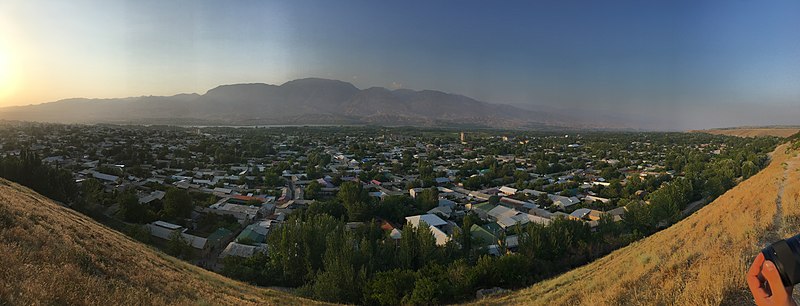
File:Panjakent_7-4-19.jpg · Wikimedia Commons · See Wikimedia Commons
Panjakent
Sign in to savePanjakent () or Penjikent () is a city in the Sughd province of Tajikistan on the river Zeravshan, with a population of 52,500 (2020 estimate). It was once an ancient town in Sogdiana. The ruins of the old town are on the outskirts of the modern city. The Sarazm Important Bird Area lies downstream of the city on the tugay-vegetated floodplain of the river.
OverviewAI-generated
Panjakent, known locally as Панҷакент, is a city in Sughd Province, Tajikistan. It serves as the capital of Panjakent District and is situated at an elevation of 996 meters above sea level. The city covers an area of 6.56 square kilometers and has a population of 43,800. Its earliest written record dates to 500 BCE.
The location falls within the UTC+05:00 time zone, also designated as Asia/Dushanbe. The postal code for the area is 735500. Panjakent is described in the Brockhaus and Efron Encyclopedic Dictionary.
Synthesized by Vinony from 46 facts across 7 sources: Wikidata, Open Meteo, Openweathermap, OpenStreetMap, GeoNames, Vinony graph, Geo. Generated from structured data (not the Wikipedia text) and checked against those facts — may still contain errors.
Weather now
7-day forecast
via Open-Meteo
Place details
- Locality
- Панҷакент
- Region
- Вилояти Суғд
- Country
- Тоҷикистон
- Population
- 35,085
- Timezone
- Asia/Dushanbe
via OpenStreetMap · GeoNames
Key facts
- Settlement.official_name
- Panjakent
- Settlement.pushpin_map
- Tajikistan#Central Asia
- Settlement.pushpin_label_position
- top
- Settlement.pushpin_map_caption
- Location of Panjakent
- Settlement.subdivision_type
- Country
- Settlement.subdivision_type1
- Region
- Settlement.subdivision_name1
- Sughd Region
- Settlement.population_as_of
- 2020
- Settlement.population_total
- 303,000
- Settlement.population_urban
- 52,500
- Settlement.timezone
- UTC+5
- Settlement.elevation_m
- 996
- Settlement.mapframe
- yes
- Settlement.mapframe zoom
- 10
- Settlement.mapframe wikidata
- yes
- UNESCO World Heritage Site.child
- yes
- UNESCO World Heritage Site.Part_of
- Silk Roads: Zarafshan-Karakum Corridor
- UNESCO World Heritage Site.ID
- 1675-006
via Wikipedia infobox
Wikidata facts
- Instance of
- city
- Official name
- Панҷакент
- Country
- Tajikistan
- Located in
- Sughd Province
- Population
- 43800
- Area
- 6.56
- Elevation
- 996
- Time zone
- UTC+05:00
- Capital of
- Panjakent District
- Image
- Pajakent Bazaar1.jpg
Show 5 more facts
- Commons category
- Panjakent
- native label
- Панҷакент
- postal code
- 735500
- P12749
- Rosearik Rikki Simons
- time of earliest written record
- 0500-00-00
Sources (6)
via Wikidata · CC0
Travel guide
Understand
The name Panjakent is derived from panj (five) and kant (settlements), meaning "five settlements". Rudaki, one of the most illustrious names of Persian/Tajik literature, was born in Panjakent.
Substantially closer to Samarkand, Uzbekistan, than to Dushanbe, Panjakent rivaled Samarkand in size and importance during the Sogdian Empire. Panjakant was the easternmost city of Sogdia.
There are excellent treks in the surrounding Fan Mountains and further up the Zeravshan Valley. Panjakent is usually visited from Samarkand as part of a tour along the Silk route, other entry points are Dushanbe in the South or Khujand in the North. For the latter routes, you will have to cross high passes. This means that Panjakent is often isolated from the rest of the country during winter.
The remains of the Sogdian city are just out of the modern city, on a hill overlooking the valley. You can wander around the site without being bothered by anyone. There are hardly any information signs, although the director of the museum next to the site is able to explain everything in detail. The site has been undergoing excavation since 1947. Excavations are primarily carried out by the Hermitage Museum in Saint Petersburg. You may also find some excavators present, and students from Saint Petersburg willing to tell you about their work and finds. Panjakent is famous for the outstanding frescoes. Today, a few of them are exhibited in the small Rudaki Museum at Panjakent, but most of them are exhibited in…
Get in
Most visitors enter Panjakent and the Zeravshan Valley from Samarkand, which is just across the border to Uzbekistan. You will need a valid Tajik visa to enter and a double/multi-entry Uzbek visa (if you need one) if you intend to return the same way you came. There is no public transport crossing the border and unless you have arranged your trip through one of the many Uzbek tour agents, you will have to switch taxis at the border. Leave from the Samarkand bus station called Kaftarxona, pronounced "kafthar-khona". The trip to the border takes about 45 minutes and costs 20,000 Som by marshrutka and more by shared taxi. From the border, the trip takes another 15 minutes and costs С20 (2025) by shared taxi, the only option. Travel agents at Samarkand organize the trip for about US$40 (including transportation, guide, admission fee and "border crossing fee").
As of June 2023, to cross the border seems to be quite straightforward. From Uzbekistan to Tajikistan: taxi/marshrutka drop off, walk through the two checkpoints. Some travelers have reported to have spent five minutes waiting for the office to read passport minutiae before stamping (don't show the Uzbekistan or Tajikistan visa unless asked), otherwise no questions, no search, no problems. From Tajikistan to Uzbekistan: shared taxis leave from the bazaar in Panjakent for С10 per person and travel to the border. The border crossing is a fairly quick process on both sides.
From Khujand or Dushanbe, it is a spectacular but e…
Get around
Panjakent is stretched along the south banks of the Zeravshan River. There is one bus line (not surprisingly bearing the number 1), which is running along the main road (Rudaki) connecting the far ends of this small city. For other explorations, you will have to rely on taxis or wave down any car going into the desired direction, which is a common practice in Tajikistan. Note though that drivers will expect as small as a contribution to their fuel costs.
Do
You can do excellent treks in the surrounding Fann Mountains and further up the Zeravshan Valley. The Fann Mountains are one of Central Asia's most popular trekking areas. You can do a day trip from Panjakent to the Seven Lakes (Haft-Kul, also called Marquzor Lakes), about 60 km south of Panjakent. It costs about US$40 to hire a car from Panjakent (2007). Another favourite place is Iskander Kul, a mountain lake about 25 km south of the road towards Dushanbe. There is no public transport to the lake. The former Soviet holiday camp offers accommodation for С20 (2007) and a great lakeside restaurant. The lake is at an altitude of nearly 2,200 m.
thumb|Sarazm UNESCO archaeological site The neolithic site of Sarazm, listed as a UNESCO World Heritage Site and dating back to 3500 BCE, is very close to the border crossing point. To go there, take a minivan from the town center (and a taxi from the road to come back). There is a museum and roofed archaeological places (with the grave of "princess of Sarazm"). Entry C30.
After having done the mandatory cultural tour, got stocked up on goodies on the bustling market in the city center. Since it got modernised and reorganised, it lost quite a lot of its original charm, but it will still allow an impressive vision of traditional Tajikistan on a busy day. Note that there is another market (for clothes mainly further east, not far from to the main bus terminal). Products there are fancy and cheap, but of dubious origin and quality.
Sleep
Travel agencies will also offer a variety of homestay accommodation (from US$5 with breakfast) or let you a complete apartment (US$10-15 /night). This may often be a better pick.
Connect
Tourist Information Centre, as of 2025, seems not to really exist. Rudaki Museum staff advises to visit Hotel Sugd (in the center) and ask there if they're forming a group of tourists i.e. for 7 lakes.
There is a number of tour operators in Penjikent which can organize about everything in Penjikent and the Zerafshan Valley.
Zeravshan Tourism Development Association (http://www.ztda-tourism.tj) is a network of small providers offering community based tourism products with special emphasis on cultural and ecological sustainability. Supported by international development organizations. Excellent for arranging custom made tours and accommodation for the individual and group traveler.
Go next
Most visitors leave Panjakent and the Zeravshan valley to Samarkand. There is no public transport crossing the border, so you will have to switch taxis at the border. The trip to the border takes about 15 minutes and costs С10 per person in a shared taxi (June 2023). From the border, the trip takes another 45 minutes and costs another 20,000 UZS in a marshrutka, more in a shared taxi (June 2023). Taxis arrive at Samarkand at Panjakent Kouchasi, the southeastern part of the Registan.
From Panjakent to Khujand or Dushanbe. It is a spectacular but exhausting trip to in shared taxi. In 2023, the price for a seat is about С120. In September 2019, the trip to Dushanbe is about 5 hr as the road has been greatly improved, the price is С100-150. Specific prices depend on which driver you get and your haggling skills.
Flight to Dushanbe operate infrequently in winter. Ticket price is US$ 45 (2007). The airport is about 4 km west of the city.
Travel guide from Wikivoyage (CC BY-SA 4.0)
~7 min read
Encyclopedic overview
10 sectionsContents
- History
- Ancient murals and artifacts
- Geography
- Climate
- Subdivisions
- Notable people
- See also
- Notes
- References
- External links
Panjakent () or Penjikent () is a city in the Sughd province of Tajikistan on the river Zeravshan, with a population of 52,500 (2020 estimate). It was once an ancient town in Sogdiana. The ruins of the old town are on the outskirts of the modern city. The Sarazm Important Bird Area lies downstream of the city on the tugay-vegetated floodplain of the river.
==History== Ancient Panjakent was a small but flourishing town of the Sogdians in pre-Islamic Central Asia. It was known as Panchekanth. The ethnic and territorial name "Soghd/Soghdian" or Sughd/Sughdian was mentioned in history as early as the Iranian Achaemenid dynasty (6th century BC). The Achaemenids founded several city-states, as well as cities along the ancient Silk Road and in the Zarafshan valley.
Excerpted from Wikipedia’s “Panjakent” article, available under the CC BY-SA 4.0 licence.
Gallery (20)
On the map
9 mapped locations